Apex of the turn is, in standard ski terminology, the point where the skis during the turn point down the fall line, that is, directly downhill. In practice, people often also speak of the apex zone, because a real turn is not a perfect geometric shape and the direction of the skis changes smoothly, not in a jump at a single moment. This is also how the U.S. Ski & Snowboard methodology defines the apex.
What the apex shows
Before the apex, the skier guides the skis increasingly toward the fall line. After passing it, they steer them away from the fall line and, depending on the intent, continue across the slope or move into the next turn. The apex therefore divides the turn into two easily observable parts and helps assess its shape, smoothness, and timing of movements.
However, the apex is not automatically the point of greatest pressure, edging, body inclination, or highest speed. These maxima may be located before it, at it, or after it. They depend on the slope gradient and terrain features, speed, turn radius, snow conditions, the way the skier is skidding or carving, and the chosen line. Research in racing skiing therefore evaluates the entire turn, not just one skier position.
Practical significance
When the skis cross the fall line, the direction of travel is most strongly aimed downhill. The skier therefore needs to create the shape of the turn and regulate speed already before the apex, not start turning sharply only after it. In a smooth turn, edging, ski pressure, and the change of direction develop gradually according to the situation.
In most dynamic parallel turns, support is created mainly on the outside ski. However, this does not mean that a child should force the outside leg straight in the apex, lift the inside ski, or copy a racer’s extreme inclination. Body position is the result of speed, turn shape, and the forces involved. The higher the speed and the smaller the radius, the more demanding it is to maintain balance and safely handle the load on the skis.
Apex in a racing line
In a gate course, the apex is not a synonym for the gate. It is a point on the skier’s trajectory, while the gate is a spatial reference and rule element of the course. The position of the apex in relation to the gate affects the entry into the next turn. If the skier creates a substantial part of the change of direction too late, they may add abrupt edging under the gate, skidding, or a so-called hooked finish to the turn. An overly early change of direction can, on the other hand, lead to an unsuitable line or a loss of space at the gate.
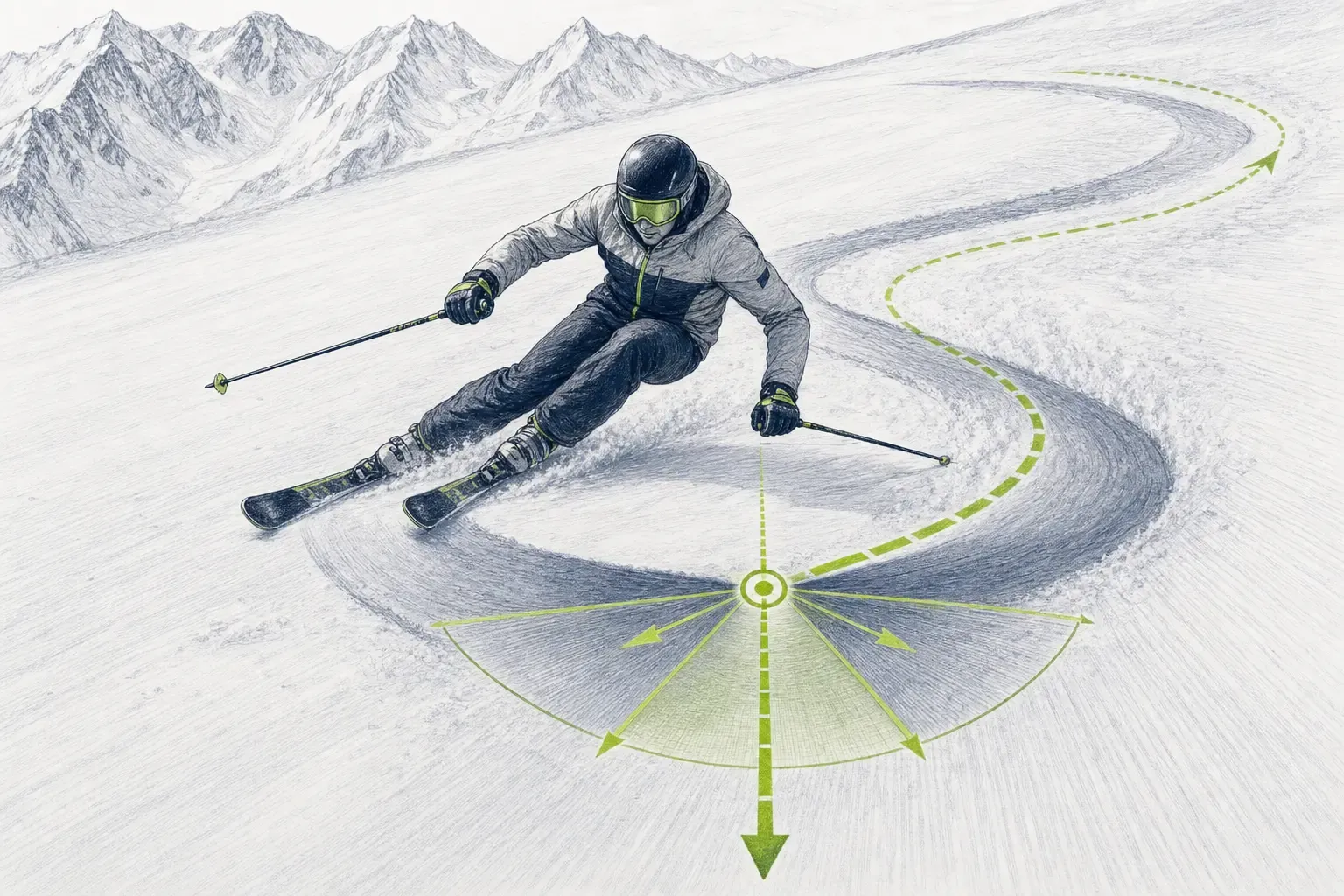
Terms early apex and late apex make sense only in relation to a specific gate, terrain feature, or training corridor. There is no single ideal position valid for every course. Even the shortest and most direct line does not have to be the most efficient in terms of energy or time.
U.S. Ski & Snowboard uses pairs of brushes or gates in turn-shape training, between which the skier is supposed to create a smooth apex. The goal is not to hit one point, but to create a continuous turn without double turning and without additional abrupt edging on the exit. It is a training aid, not a universal course template.
How to explain the term to children
For a younger child, a simple explanation is usually enough: the apex is the point where the tips of the skis briefly point downhill. On gentle, easy-to-read terrain, a colored marker, brush, or wide corridor can be used. The task should lead to a smooth turn and speed control, not to chasing a big edge angle or pressure.
As the skill level grows, the coach can watch whether the child:
- starts changing direction in time and without a sudden turn of the skis,
- passes the apex in balance,
- has usable support on the outside ski,
- continues smoothly through the fall line to complete the turn,
- can adapt the apex position to the terrain and the next gate.
Common misconceptions
The most common mistake is the idea that a skier must take one exact, fixed position at the apex. Skiing is continuous movement, and the apex is above all a reference point on the trajectory. It is equally inaccurate to equate it with maximum pressure or with the point where a gate is crossed.
The coach should therefore not evaluate only a snapshot from the apex. It is more important to watch the whole turn: the approach, the gradual build-up of edges and support, the ski direction in the fall line, the completion of the turn, and the start of the next change of direction.
Sources and further reading
- U.S. Ski & Snowboard – Level 100 Alpine Manual
- U.S. Ski & Snowboard – Turn Shape (Apex Drill)
- U.S. Ski & Snowboard – Alpine Coaching Dictionary
- U.S. Ski & Snowboard – The Turn Model
- Gilgien et al. – Recent Kinematic and Kinetic Advances in Olympic Alpine Skiing
- Fasel et al. – A Comprehensive Comparison and Validation of Published Methods to Detect Turn Switch during Alpine Skiing
- Kröll et al. – Sidecut Radius and the Mechanics of Turning
- Supej – Differential Specific Mechanical Energy as a Quality Parameter in Racing Alpine Skiing
- Spörri et al. – Turn Characteristics of a Top World Class Athlete in Giant Slalom
- Dynamics of Carving Runs in Alpine Skiing: The Basic Centrifugal Pendulum