Definition
Late Line is a training and racing term for a trajectory in which the skier reaches the turning gate without enough change of direction toward the next gate. The main part of the turn, edging, or pressure into the skis therefore happens only at the gate or below it, that is, farther down the slope.
It is not an independent term defined by FIS competition rules, nor is it the name of an offense. It is above all a tactical and coaching assessment of the skier's position in the gate sequence. Official FIS race reports use expressions such as “late in the line” or “low in the line” when describing a run in which the racer got too low and had trouble with the next gate. At the same time, they show that a lower line does not have to be automatically wrong in every situation – its effectiveness depends on the terrain, gate set, snow surface, and speed.
How to recognize a late line
A typical sign is that the skier is still changing direction significantly while passing the turning pole. The biggest edging, ski bend, or pressure often comes only below the gate. The exit then heads too far across the slope or out of the optimal space for preparing the next turn.
In practice, you may see:
- an approach to the gate that is too direct,
- a sharp turn or skid just before the pole,
- long pressure into the skis below the gate,
- late release of the edges,
- a low exit and a difficult approach to the next gate,
- a gradual increase in the mistake in the following turns.
A late line cannot be judged only by the skier's distance from the pole. A tight pass by the gate can be smooth and fast, while a skier farther from the pole may still be too low. What matters is the continuity of the turns and the direction of movement toward the next gate.
Why it happens
The cause is often one or more gates earlier. The skier may finish the previous turn for too long, release the skis too late, lose balance, or choose an approach that is too direct to the current gate. A late line is also encouraged by focusing only on the nearest pole instead of the space for the next turn, by an unsuitable reaction to a change in rhythm, terrain undulation, or a rutted track.
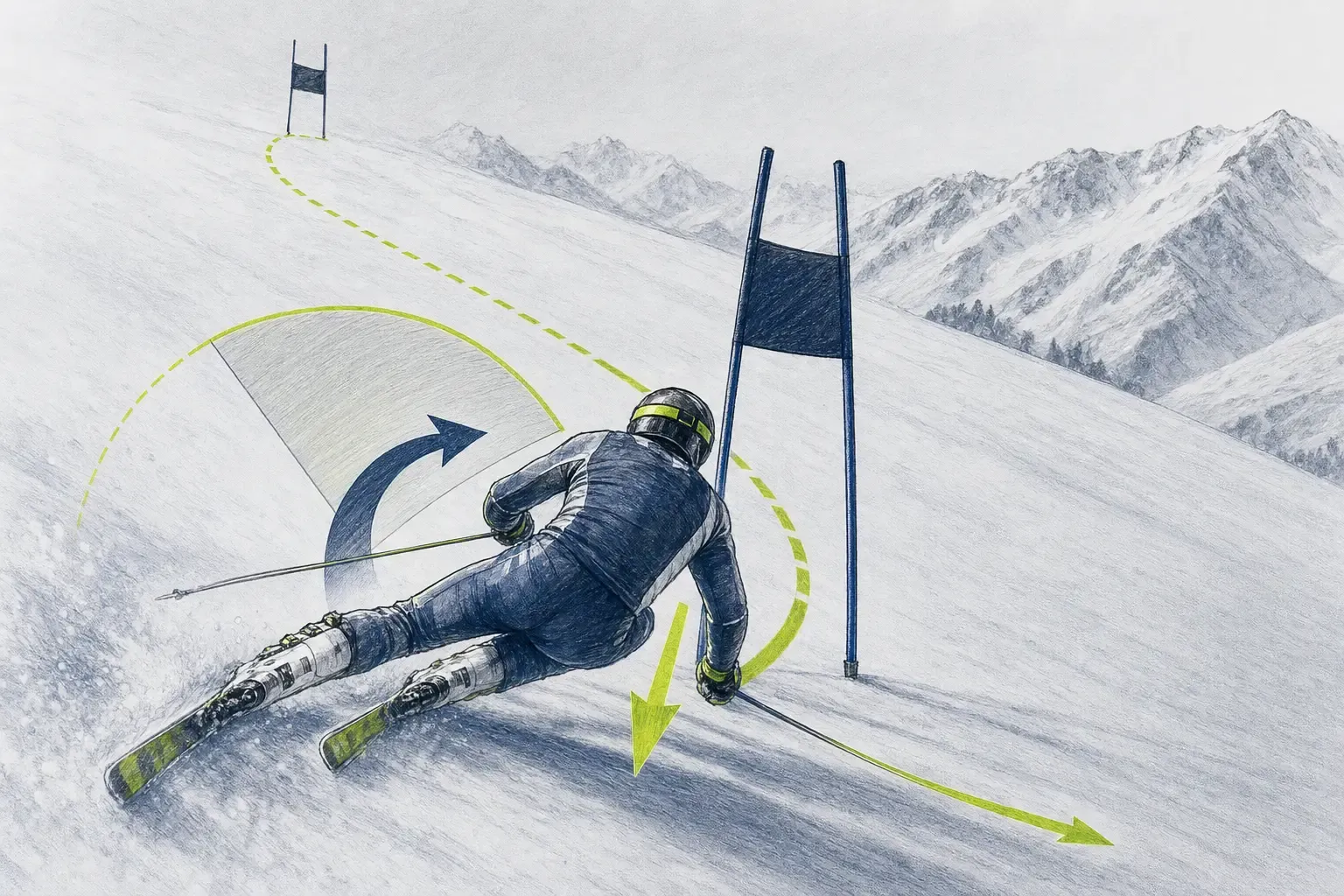
In slalom, there is little time to correct, and the mistake can quickly carry through several gates. In giant slalom, a late exit often leads to greater distance, a sharp correction, and loss of speed. In speed events, the line is evaluated in the broader context of the terrain and safety; the shortest or most direct track is not necessarily the fastest or safest.
Children's training and the coach's view
With children, it is not appropriate to deal with a late line by simply telling them to "start earlier." The child must first be able to make a balanced turn, release the skis, and adapt the turn shape to the speed and terrain. Tactics development should build on mastered basic skiing skills and the level of motor development. The U.S. Ski & Snowboard methodology recommends that younger skiers progress from free skiing and simple practice courses to brushes, short poles, and age-appropriate gates; the difficulty of the setup should increase gradually.
The coach mainly watches:
1. where the direction change begins, 2. what direction the skis are facing at the gate, 3. where the main pressure and ski flex occur, 4. whether the skier can release smoothly after the gate, 5. how much space is left for the next turn.
Short courses with a clear rhythm, guide brushes above the turning gate, corridors, and video from a suitable angle help. The goal is not to teach the child to turn mechanically at one fixed point, but to develop the ability to read the course in time and change the turn shape according to the situation. The setup must match the age, technical level, slope, and snow conditions.
Late line and the rules
A late line does not, by itself, mean disqualification. What matters is whether the competitor correctly passes all gates according to the valid rules. However, if they get too low, the risk increases of going around the turning pole on the wrong side, hitting the gate between the skis, or missing the gate completely. The rules and referee manuals therefore need to be distinguished from the coach’s evaluation of line quality.
Sources and further reading
- FIS – Alpine Skiing: education for technical delegates and official documents
- FIS – Robinson battles terrain and weather to win in Tremblant
- FIS – Macuga grabs superb debut win in St. Anton
- FIS – Making Alpine Skiing safer over the years
- U.S. Ski & Snowboard – Alpine Competition Officials Education Resources
- U.S. Ski & Snowboard – Athlete Performance Profile
- U.S. Ski & Snowboard – Alpine Course Setting Recommendations
- U.S. Ski & Snowboard – Alpine Officials’ Manual: Gate Judges