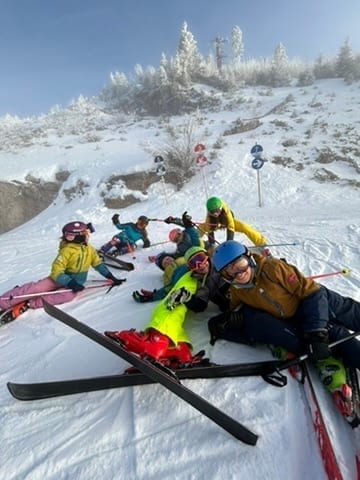
A five- or six-year-old can be completely absorbed in an interesting game one moment and, shortly after, seem not to hear even its own name. On skis, this contrast is even more pronounced. The child is processing speed, balance, slope angle, snow, other skiers, cold, equipment, emotions, and the coach’s instruction all at once. When we add five technical tips in a row, the problem is often not “poor discipline,” but that the task has exceeded the child’s current capacity.
For a parent, the more useful question is “What is taking the child’s attention right now?” rather than “Why isn’t it focused?”. At five or six, we do not want to turn a child into a little adult who analyzes technique for an hour. We want the child to be able to repeatedly catch one important task, try it in movement, get appropriate feedback, and then mentally take a short break.
Alpine Canada has an interesting framework for this age. Five-year-old children are still in the Gliding Start (1–6 years), where the goal is to discover winter sports in a playful environment and build basic movement skills. From age six, the Skier Essentials phase begins(boys 6–9, girls 6–8), which develops technique further, but still in a fun, varied, and developmentally appropriate environment. The age boundary here is not a biological law; it is a development model that reminds us that six-year-olds are often right at the transition between “I’m exploring” and “I’m starting to train more systematically.” (, Alpine Canada – Gliding Start)
Alpine Canada – Skier Essentials How to read the recommendations in this article:
Alpine Canada is a development and coaching methodology, not a medical standard. Research on motor learning provides scientific evidence, but with children it still has many limitations. The practical examples below are training methods that should be adapted to the individual child, terrain, and situation — not universal rules.
Attention is not an on/off switch: “it has it” or “it doesn’t”
The attention of a five- to six-year-old is highly situation-dependent. The same child may ski a simple run well for ten minutes and then ignore instructions two runs later. The reason is not necessarily disobedience.
| On the slope, attention is often drained by: | What the parent or coach sees | What may be behind it |
|---|---|---|
| What to try first | the child keeps looking around,too many stimuli, friends, traffic | move the task to a calmer place |
| after two runs, the instruction is “forgotten” | the instruction is too long or abstract | shorten it to one specific task |
| starts doing silly things | tiredness, boredom, or a need for free skiing | a short game or an easy run without corrections |
| brakes hard and stops listening | the terrain or speed is beyond the comfort zone | lower the difficulty of the slope or task |
| suddenly falls a lot | tiredness, cold, hunger, poorer coordination | a break, warmth, food, checking the gear |
| refuses to repeat the exercise | the task is monotonous or the child does not see the point of it | change the form, terrain, or “story” of the task |
First, let’s adjust the environment and the task; only then deal with discipline. With small children, that is often a more effective approach than repeating the same instruction louder.
One run, one main task
The most common adult mistake is seeing everything at once. The hands are low, the child is leaning back, the knees are not working enough, the turn starts too late, and the gaze is directed a meter in front of the skis. The adult names it in one sentence — and the child gets five tasks.
Try comparing:
Overloaded instruction:
“Go more forward, bend your knees, hands in front of you, look down the slope, and don’t start the turn so late.”
One clear task:
“In every turn, look at the next blue brush.”
Or:
“Go through the corridor without your skis knocking over even one brush.”
In the second case, the child has a clear external goal. It does not have to consciously control five parts of the body, but instead deals with what it needs to do in space.
A systematic review of research on motor learning in children from 2022 examined instruction and feedback with a so-called external focus of attention. The authors found some promising results with visual analogies or feedback that the child requests on its own, but they also emphasized that the included 13 studies had low methodological quality and the results were inconsistent across several comparisons. So research cannot be turned into a simple rule, “always use external instruction.” For a coach, it is wiser to have more tools and watch what helps a particular child. (van der Veer et al., PLOS One, 2022)
Let the terrain teach sometimes instead of words
Good children’s ski exercises often do not need a long explanation. A properly set corridor, small waves, brushes, a coach’s track, or a simple slalom can naturally trigger the right movement.
For a five- to six-year-old child, for example, this can work:
- follow the track — the child copies the coach without a technical lecture,
- colored markers — in each section, the child looks for the next visual target,
- narrow and wide corridor — the child changes turn size according to the space,
- “quiet through the waves” — the child tries to go over small terrain changes calmly and balanced,
- catch the coach — a short controlled game that encourages looking ahead and reacting,
- choice of route — two safe options and the child chooses which way to go.
Alpine Canada explicitly recommends varied terrain and snow, small rollers, brush runs, and lead/follow tasks in Skier Essentials, as well as changing the environment. In technical training, it also recommends changing only one variable between runs so there is contrast without mindless repetition. That is a coaching methodology, not proof that a specific drill will work for every child. (Alpine Canada – Technical and Tactical Focus)
Let’s alternate concentration with freer skiing
Focus does not need to stay at its peak for the whole lesson. A more useful rhythm is a short focus block → freer skiing or play → the next block.
Example of one training segment — not a universal time rule:
- the coach explains one task in one or two sentences,
- the child tries it in a few runs,
- then comes easier skiing, a game, or a change of terrain,
- the coach picks one thing that worked,
- only then adds another request or increases the difficulty.
This rhythm allows enough repetitions without every run feeling like a test. In Skier Essentials, Alpine Canada even recommends activities with plenty of room for repetition and minimal corrections so children can safely try, discover, and build confidence. (Alpine Canada – Skier Essentials)
If you are dealing with how much time a child really skis, also see the article How long should a child ski. The minutes alone are not the goal — what matters is movement quality, emotions, cold, hunger, fatigue, and the demands of the day.
Feedback: not everything after every run
A child needs to know what went well and what to try differently. But that does not mean they need an immediate technical breakdown after every run.
In practice, useful feedback tends to be:
- short,
- focused on one priority,
- specific,
- and leaves the child room to try the solution again.
Sometimes a question helps:
“Which turn felt easiest?”
Or:
“Where did you feel the skis went exactly where you wanted?”
Such a question teaches the child to perceive their own skiing. The Australian Sports Commission recommends asking similar reflective questions when developing self-regulation after sport and also emphasizes that the quality and type of training are more important than the amount itself. (Australian Sports Commission – Nurturing a child’s sporting development)
Research on feedback frequency also does not give a simple rule that “the less, the better.” In a study of school-age children, Goh et al. found that reduced feedback worsened learning of the movement’s timing parameter, while Sidaway et al. showed that the effect of feedback frequency also depends on task difficulty. The practical conclusion for a parent is modest: we should not overwhelm the child with comments, but with a new or difficult task, they may need help more often than an experienced adult. (Goh et al., 2012, Sidaway et al., 2012)
Play is not a break from learning
A parent may sometimes see play on the slope as wasted time: “Well, today they hardly trained at all, they just ran around.” With younger children, however, play can be a way for the coach to teach balance, reaction, spatial awareness, speed changes, or decision-making.
When children follow a track, go through waves, compete in a simple skill, or move between tasks in a safe space, they are still training. They are just not doing it through a long verbal explanation.
The Australian Sports Commission lists “deliberate play” among the basic tools for development and points to the importance of variability, creativity, and solving movement problems. FIS uses similar logic with children in its World Snow Day program at the level of engaging in sport — the goal is to let children discover snow, enjoy it and experience it. That is not a technical alpine skiing methodology, but it is a good reminder that a positive relationship with snow is not a side product of training. (Australian Sports Commission, FIS – World Snow Day)
What a parent can do even before training
Attention often “breaks” before the child even puts on skis. A five-year-old who is hungry, has wet gloves, is being squeezed by ski boots, and has spent ten minutes stressing about missing the group does not have the same capacity to learn as a child who arrived calm and prepared.
Before training, check the basics rather than the technique:
- Has the child eaten and had something to drink?
- Is the child already cold when getting started?
- Do the gloves, goggles, and helmet fit?
- Do the ski boots not pinch and are they not unnecessarily loose?
- Does the child know who their coach is and where the group meets?
- Does the child have a rough idea of what will happen?
On the first club days, it helps to reduce the number of unknowns. You can find more in the article The Child’s First Day on Skis.
What a Parent Should Do During Club Training
If the coach is leading the group, the parent should not be a second coach at the edge of the slope. Two different technical instructions can interfere with each other — even if both are sensible on their own.
A parent’s biggest help is often more practical:
- make sure the equipment works,
- arrive on time,
- do not focus on the result of every run,
- do not overwhelm the child with feedback after training,
- tell the coach relevant information if the child slept badly, is afraid after a fall, or is being squeezed by the equipment,
- respect the agreed coaching priority.
When choosing a club and a coach, the Australian Sports Commission emphasizes quality coaching, a supportive environment, appropriate development, and good communication with parents. A parent should support the coach, not compete with them over who gives the final technical instruction. (Australian Sports Commission – Right coach and club fit)
If you want to praise your child, try naming something they had under control: “I liked that after the fall you tried the task again.” We discuss more similar situations in the article 10 mistakes parents make when skiing with children.
If you are interested in what club training looks like even off the snow, take a look at training sessions SKI Lokomotíva. In fact, general movement preparation, games, coordination, and working in a group build many skills that a child then uses on skis too.
Four situations parents know from the slopes
“After 20 minutes, he doesn’t listen at all anymore.”
Do not automatically conclude that 20 minutes is his “attention limit.” Look at what has changed: terrain, cold, hunger, task difficulty, group pace, number of repetitions. If technique and behavior worsen at the same time, it often helps to lower the difficulty or include an easier run.
“He keeps watching the other children.”
That may not be a problem. Children also learn by watching. The coach can use this tendency: “Look where Mišo is going and try the same line.” The Australian Sports Commission directly recommends supporting observational learning, and Alpine Canada uses “lead/follow” tasks as part of ski development. (Australian Sports Commission, Alpine Canada – Technical and Tactical Focus)
“He says he is bored.”
Boredom can mean the task is too easy, too repetitive, or the child does not see its purpose. We do not have to increase the slope right away. Sometimes it is enough to change the challenge: a more precise line, a different rhythm, a game, a pair with a friend, or new terrain.
“When he is scared, he stops paying attention completely.”
In that case, technical instructions usually are not the first problem. If the child sees the situation as too demanding, first he needs to regain a sense of control — easier terrain, lower speed, a familiar task. Only then does it make sense to add the technical requirement again. We have a separate article on this topic The child is afraid on skis.
When it is no longer just training attention
This article deals with ordinary attention when learning a sports skill. If a parent notices long-term significant difficulties with concentration in several settings — at home, at school, and during different activities — ski training is not the place for a diagnosis. In that case, it makes sense to look at the broader picture with people who know the child in other situations, and if needed with a pediatrician or the appropriate specialist.
On the slope, however, we usually start more simply: is the child warm, does he feel safe, does he understand the task, and is the task not unnecessarily complicated?
Five questions before the phrase “Concentrate!”
- Can the child say in one sentence what to do?
- Is the terrain easy enough for them to focus on the task, not survival?
- Did they get enough time to try the task several times?
- Are they tired, hungry, frozen, or frustrated?
- Is the parent adding another technical tip on top of the coach’s?
If these things are in order, only then does it make sense to consider whether the child needs clearer boundaries or more discipline.
What counts as a good result at age five or six
Good training at this age does not have to look like 60 minutes of perfect concentration. A much better sign is when the child:
- can repeatedly catch a simple task,
- tries a solution without fear of making a mistake,
- can switch back to the exercise after free skiing,
- gradually becomes better at reading the terrain and the other skiers,
- can say what they managed well,
- and at the end still wants to come back to the snow.
That is the foundation on which technique can later be built, slalom and giant slalom, racing discipline and the ability to handle more demanding training tasks. A five-year-old does not need to hear more instructions. They need a better-chosen task, a good environment, and an adult who knows how to tell learning apart from constant correcting.
Sources and further reading
- Alpine Canada, Gliding Start: https://ltad.alpinecanada.org/stages/gliding-start
- Alpine Canada, Skier Essentials: https://ltad.alpinecanada.org/stages/skier-essentials
- Alpine Canada, Skier Essentials – Technical and Tactical Focus: https://ltad.alpinecanada.org/stages/skier-essentials/technical-and-tactical-focus
- van der Veer I. P. A. et al. (2022), How can instructions and feedback with external focus be shaped to enhance motor learning in children? A systematic review, PLOS One: https://doi.org/10.1371/journal.pone.0264873
- Australian Sports Commission, Nurturing a child’s sporting development: https://www.ausport.gov.au/athlete_development/top_10_tips_for_parents
- Goh H.-T. et al. (2012), Movement pattern and parameter learning in children: effects of feedback frequency: https://pubmed.ncbi.nlm.nih.gov/22808721/
- Sidaway B. et al. (2012), Interaction of feedback frequency and task difficulty in children’s motor skill learning: https://pubmed.ncbi.nlm.nih.gov/22421736/
- FIS, World Snow Day: https://www.fis-ski.com/inside-fis/development/world-snow-day