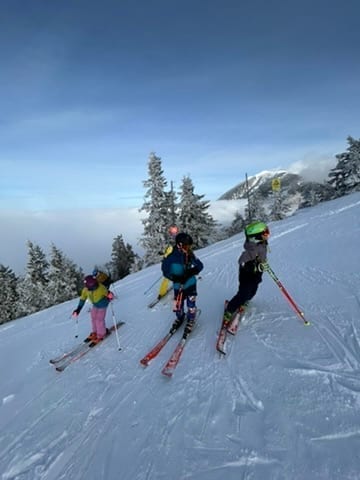
The first run went completely fine. On the second one, the slope opened up a little, the child picked up more speed than they wanted, and since then they have been standing at the edge of the hill and refusing to move. The parent sees the same gentle slope as a moment ago. The child does not.
Fear on skis is not stubbornness or proof that the child “isn’t cut out for it.” It is information: at this moment, the child feels less control than they need.
Loko rule: first we restore a sense of safety and control. Only then do we teach technique again.
First find out what they are actually afraid of
“I’m scared” can mean ten different things. Until we know the cause, we can easily solve the wrong problem.
Most often, it is worth checking:
- speed — the child feels they cannot stop,
- steepness — the slope looks much worse from the top than from the bottom,
- fall — one unpleasant moment can change the next runs,
- lift or cable car — getting on, getting off, or the height can be more stressful than the skiing itself,
- traffic on the slope — fast skiers around the child reduce the feeling of control,
- weather — fog, wind, darkness, or poor visibility change how the terrain feels,
- winter, wet gloves, or a painful ski boot — sometimes “fear” is simply the body saying it does not want to keep going.
Instead of asking “Well, what are you afraid of?” it often works better to be more specific: “Is it the speed, the hill, the people around you, or does something hurt?”
When a child is scared, the difficulty should go down
If a child has lost confidence on a blue slope, the next run does not have to be an attempt to convince them the slope is easy. It makes more sense to go back to where the child can again stop, turn, and control their speed.
That is not a step backward. It is regaining control.
The American Academy of Pediatrics recommends that when children are afraid, the fear should not be dismissed and the child should not be pushed into “bravery.” A more helpful approach is to move forward in small, manageable steps. The same principle works very well on the slope, too.
A practical five-step reset
- Stop the pressure. Pause dealing with technique and performance for a moment.
- Name the problem. Find out what is specifically uncomfortable.
- Simplify the situation. Easier terrain, lower speed, fewer people, or a short break.
- Set one small goal. For example, calmly stopping by the coach or making three controlled turns.
- Let success sink in for a moment. There is no need to add another challenge right away.
What usually does not help when a child is afraid
Phrases like “it’s nothing,” “look, everyone else is going,” or “you just have to get over it” come from a good intention to encourage the child. The problem is that they do not give the child back control.
Even worse is mocking or comparing them in front of friends. The AAP explicitly recommends not to dismiss children’s fears and not to laugh at them. Pressure may bring one forced run, but it can also worsen confidence for the next attempt.
A calmer sentence works better:
“I can see this is a lot right now. Let’s make it one step easier and try only what you can control.”
Fear and courage are not opposites
A brave child is not one who is never afraid. Courage grows when a child repeatedly experiences this sequence:
new situation → appropriate uncertainty → manageable step → success → greater confidence.
If we make the jump between uncertainty and success too big, it is more likely to lead to defensive behavior: freezing, sudden braking, leaning back, crying, or a complete refusal to move.
That is why, when teaching skiing, we do not look only at whether the child can technically do the task, but also whether they can still do it with relaxation and a sense of control.
After a fall, we do not need to immediately “prove everything is fine”
After an unpleasant fall, it is tempting to send a child right back to the same place so they do not “develop a block.” But that may not be the best first step.
If the child is physically fine, it often helps to make the next run much easier. The goal is to create as soon as possible a new calm experience, not to repeat the situation that triggered the fear.
If the fall included a hit to the head or a hard impact, we first deal with health, not psychology. The CDC lists possible signs of a concussion such as headache, dizziness or balance problems, nausea or vomiting, vision problems, unusual tiredness, slowed thinking, or changes in behavior. Symptoms may not appear right away.
If a concussion is suspected, the child should not continue skiing and you should follow medical advice. For severe or worsening symptoms, seek urgent medical care.
Sometimes the problem is not fear, but overload
A child may ski completely calmly in the morning and start fearing the same slope in the afternoon. That does not mean something has “gone wrong.” Fatigue lowers coordination, reaction time, and the ability to regulate emotions.
If more falls appear together with fear, stiff braking, crying, disinterest, or reduced attention, it is worth checking fatigue, hunger, cold, and the length of the day.
We write more about this in the article How long should a child ski?.
When does a coach help more than a parent
A parent has one huge advantage: they know the child. A coach has another: they are not the parent.
For some children, a simple technical task from the coach works much better than ten well-meant sentences from mom or dad. The coach can also change the terrain, the spacing in the group, the speed, or the form of the game without the child feeling that a big issue is being made out of their fear.
That is why it is important to tell the coach if:
- the child started being afraid after a specific fall,
- they have a problem with the lift or with a certain type of slope,
- the fear keeps coming back for several training sessions,
- they talk about skiing very differently at home than on the slope.
When it is no longer ordinary uncertainty
Ordinary situational fear often decreases with an appropriate approach. But if the fear is very strong, long-lasting, appears even outside skiing, or significantly affects the child’s everyday functioning, there is no need to turn it into a “skiing problem.” In that case, it is wise to consult a pediatrician or a child mental health specialist.
What to remember
The goal is not to eliminate every fear. The goal is to teach the child that uncertainty can be managed safely and step by step.
When we lower the difficulty, name the specific problem, and let the child experience a few runs under their own control, courage often returns on its own. And that kind of courage is useful on skis — not blind, but built on experience.
Sources and methodology
- American Academy of Pediatrics / HealthyChildren — Help Your Child Manage Anxiety
- American Academy of Pediatrics / HealthyChildren — Fears & Phobias in Children
- CDC HEADS UP — Signs and Symptoms of Concussion
- Alpine Canada — Gliding Start
Recommendations about working with fear are general parenting and sports principles, not an individual psychological or medical diagnosis.