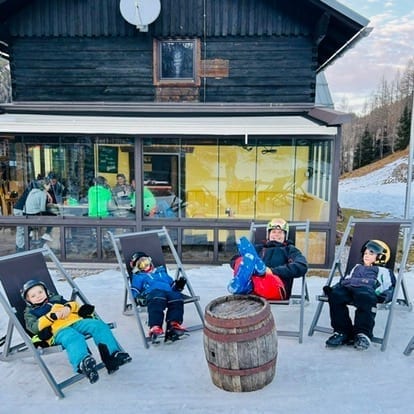
The parent can ski well. The child is on skis for the first time. On paper, the solution is simple: I’ll teach them myself.
Sometimes it works wonderfully. Other times, after twenty minutes, a voice comes from the slope: “Don’t lean back!”, the child is crying, and both feel that the other one is doing everything wrong.
The problem is often not that the parent cannot ski. Being able to ski and being able to teach a small child are two different skills.
The best model is not parent or coach. The best model is parent and coach — each in their own role.
What a parent can do in an irreplaceable way
A parent has something no coach has: they know the child away from the slope.
They know whether the child is tired, hungry, more sensitive to the cold, whether they need a moment to watch a new environment or, on the contrary, would most love to throw themselves into movement. They know what motivates them and what reliably shuts them down.
At the very beginning, the parent can be an excellent guide:
- help the child get used to ski boots and gear,
- play in the snow with them,
- move together on flat ground,
- show that a fall is not a disaster,
- choose an easy environment,
- create a sense of safety,
- and above all connect skiing with pleasant time together.
Alpine Canada explicitly recommends that for the youngest skiers, alongside a structured program, children ski with their parents as often as possible. Shared family skiing increases time on snow and helps build a love for the sport.
So the parent definitely does not have to disappear from the learning process.
Where the coach's advantage begins
A coach or ski instructor has a different role.
A good coach does not see only that a child "does not turn." They watch, why they do not turn and what the next appropriate step should be.
They can work with:
- methodical progression,
- choice of terrain,
- the size and form of the task,
- the speed of progression,
- differences between children,
- group fatigue,
- safety and organization,
- and age-appropriate feedback.
Alpine Canada recommends that parents look for trained or certified coaches and instructors, who work according to developmentally appropriate methodology.
That is a key difference. A good skier knows how they ski. A good coach needs to know, how to help someone else move better.
Why a child sometimes listens to a coach differently
The parent-child relationship has a long history. The training situation does not.
When a parent says "hands forward," the child may not hear only a technical instruction. They may also hear the whole package of earlier morning reminders: get dressed, eat breakfast, don't run around the parking lot, be careful with your gloves.
A coach can say the same task more neutrally and in a situation where their role is clear.
That does not mean children always obey the coach and never the parent. It only means that the emotional dynamic is different.
If shared learning between a parent and child regularly turns into conflict, there is no need to prove that “we have to manage it ourselves.” Sometimes it is wiser to hand the technical side over to the coach and keep skiing together for the joy of it.
A parent does not have to correct technique on every run
This is often one of the most common traps.
In the morning, the child hears one specific task from the coach. In the afternoon, they go with a parent and get five more tips:
- bend your knees more,
- don’t go so wide,
- push into the outside ski,
- hands forward,
- and lean back less.
Each tip can make sense on its own. Together, though, they can overwhelm a child completely — and sometimes even contradict what the coach is currently developing in a different way.
After club training, a parent does not have to continue with a second shift as a technical coach. They can simply be a skiing buddy.
If you want to build on the training, just ask the coach about one thing, which the child should be working on right now.
What to say after training
The American Academy of Pediatrics recommends support in children’s sports that is not tied to results. A parent should notice the developmental process, the realistic pace of learning, and praise progress without constantly judging performance.
Instead of an interrogation:
- “How many times did you fall?”
- “Why didn’t you go faster?”
- “Did you win?”
- “Didn’t the coach tell you to push more into the ski?”
these questions can work:
- What did you enjoy most today?
- What new things did you try?
- What was hard today?
- What are you proud of?
- Do you want to show me something from training?
Questions like these leave the child thinking about their own experience, not just the adult’s evaluation.
The group adds something that individual learning does not have
Club training is not just "more children with one coach".
The group creates a different learning environment.
Child:
- sees peers moving,
- naturally imitates,
- waits for their turn,
- learns to follow simple rules,
- experiences other children’s successes and mistakes as a normal part of training,
- takes part in shared games and tasks,
- and gradually gains independence without a parent right beside them.
For some children, the group is a big source of motivation. For others, it can be too much stimulation at first. That is why a good club does not approach everyone the same way — the group, the task, and the expectations must match the children’s age and level.
We write more about readiness for a club in the article When is a child ready for a ski club?.
When a parent can teach safely on their own
Not every child needs a coach from the very first day.
A parent can be an excellent first teacher if they:
- can control their skis very well even at low speed,
- can choose truly easy terrain,
- can explain briefly and simply,
- does not push for faster progress,
- knows when to stop before conflict starts,
- can tell fear apart from disobedience,
- and accepts that the first day may not bring a visible technical result.
Another big advantage is the ability to let the child explore. Not every second needs to be commented on.
In the first contacts, it is often more important for the child to gain balance, a sense of glide, and confidence than to hear the exact terminology of a turn.
When a coach makes a lot of sense
Expert guidance is especially useful when:
- the parent and child regularly argue during learning,
- the child has gotten stuck in one movement pattern,
- they start skiing faster or on more difficult terrain,
- the parent cannot safely explain the next step,
- fear appears that the parent cannot reduce,
- the child needs more systematic progress,
- or the group of peers motivates them strongly.
A coach is not a sign that the parent has failed. It is the same as in swimming, gymnastics, or music: from a certain point, specialized guidance has value in itself.
What to do when the coach and the parent say different things
The worst solution is to settle a methodological dispute through the child.
“The coach told you this, but I think it should be different” creates two authorities, and the child has to choose during the run which one to follow.
It is better to talk briefly with the coach directly.
Ask:
- What are you working on now?
- What can we support during skiing together?
- What should we rather avoid for now?
- Is there anything you notice about your child that we should know?
A good coach should be able to explain the goal simply, and a parent does not need to understand every technical detail in order to cooperate.
Parents are still important in the club
Handing technical guidance over to the coach does not mean handing over the child and stopping taking an interest.
Alpine Canada recommends that parents stay a positive role model, respect coaches and the sporting environment, support skiing together, and take an interest in the quality of the club.
At the same time, parents have every right to ask about:
- the coaches' qualifications,
- safety rules,
- the way they communicate with children,
- the long-term goals of the program,
- whether the training load is appropriate,
- group organization,
- and how the club handles unpleasant situations or conflicts.
Alpine Canada recommends asking these questions directly when choosing a club.
Trust in the coach should not be blind. It should be informed.
What a good coach looks like for a young child
Not by how well they ski slalom themselves.
With the youngest children, what matters is whether the coach:
- can make contact,
- uses age-appropriate language,
- finds small successes,
- adjusts difficulty to the situation,
- does not laugh at mistakes or fear,
- keeps a safe framework,
- can use play,
- supports effort and learning, not just results,
- and can explain to the parent what they are doing and why.
In the Gliding Start phase, Alpine Canada recommends that coaches focus on a positive experience, small successes, fun, and effort, not on labels like talented/untalented or on results.
That is a good filter for parents choosing a program too.
And what about races?
As children get older, it can be tempting for a parent to turn into a second coach between practices and races as well.
However, the AAP points out that a young athlete needs support that does not depend on results. A child should know that a poor run is not a personal failure and that the parent-child relationship does not change based on where they finish.
That is why after a bad race, the car ride home does not have to be the place for an immediate technical analysis.
Sometimes this is completely enough:
“It didn’t go as planned. That’s part of sport too. If you want, we can talk about it later.”
The coach can do the technical analysis. The parent can remain a safe place even on a day when sport does not go well.
What if the child does not want to go to the coach
That does not automatically mean the club is not right for them.
For young children, being separated from a parent, a new environment, and a new group can be a bigger challenge than skiing itself.
It helps to find out, what exactly they are refusing:
- the coach,
- group,
- separation from a parent,
- a specific slope,
- speed,
- winter,
- or just a new routine.
If the problem is adjustment-related, a gradual start can help. But if a child has long-term fear of the coach, describes inappropriate behavior, or repeatedly comes back from training in strong stress, it needs to be addressed directly with the club and not brushed aside.
The ideal collaboration in practice
A simple model can look like this:
Coach
Leads systematic learning, chooses tasks, terrain and progression, watches the group and technical progress.
Parent
Supports attendance, equipment, sleep, food, logistics, and the child’s overall relationship with sport. When skiing together, they create extra safe kilometers and joy from snow.
Child
Is not a project between two adults. Needs space to try, make mistakes, ask questions, improve at their own pace, and gradually take responsibility for their skiing.
The coach should lead the training. The parent should stay a parent. And both should be on the child’s side.
What to remember
A parent can teach a child the first steps and can share hundreds of great kilometers on snow with them. A coach, in turn, brings method, distance, a group, and systematic progress.
These roles do not compete.
When a parent respects the training process and the coach communicates clearly with the parent, the child does not have to deal with two conflicting authorities. They have a team around them.
And for long-term sport, that is much more valuable than the question of who taught them the snowplow first.
Sources and methodology
- Alpine Canada — Gliding Start for Parents
- Alpine Canada — Gliding Start
- Alpine Canada — Athletic Character: Gliding Start
- American Academy of Pediatrics / HealthyChildren — Parenting an Athlete
- American Academy of Pediatrics / HealthyChildren — Organized Sports: For the Fun of It
The article distinguishes general recommendations for parents and youth sports from specific club practice. There is no one universal model suitable for every child; age, personality, experience, the coach’s quality, and the environment all matter.