What ski boots are
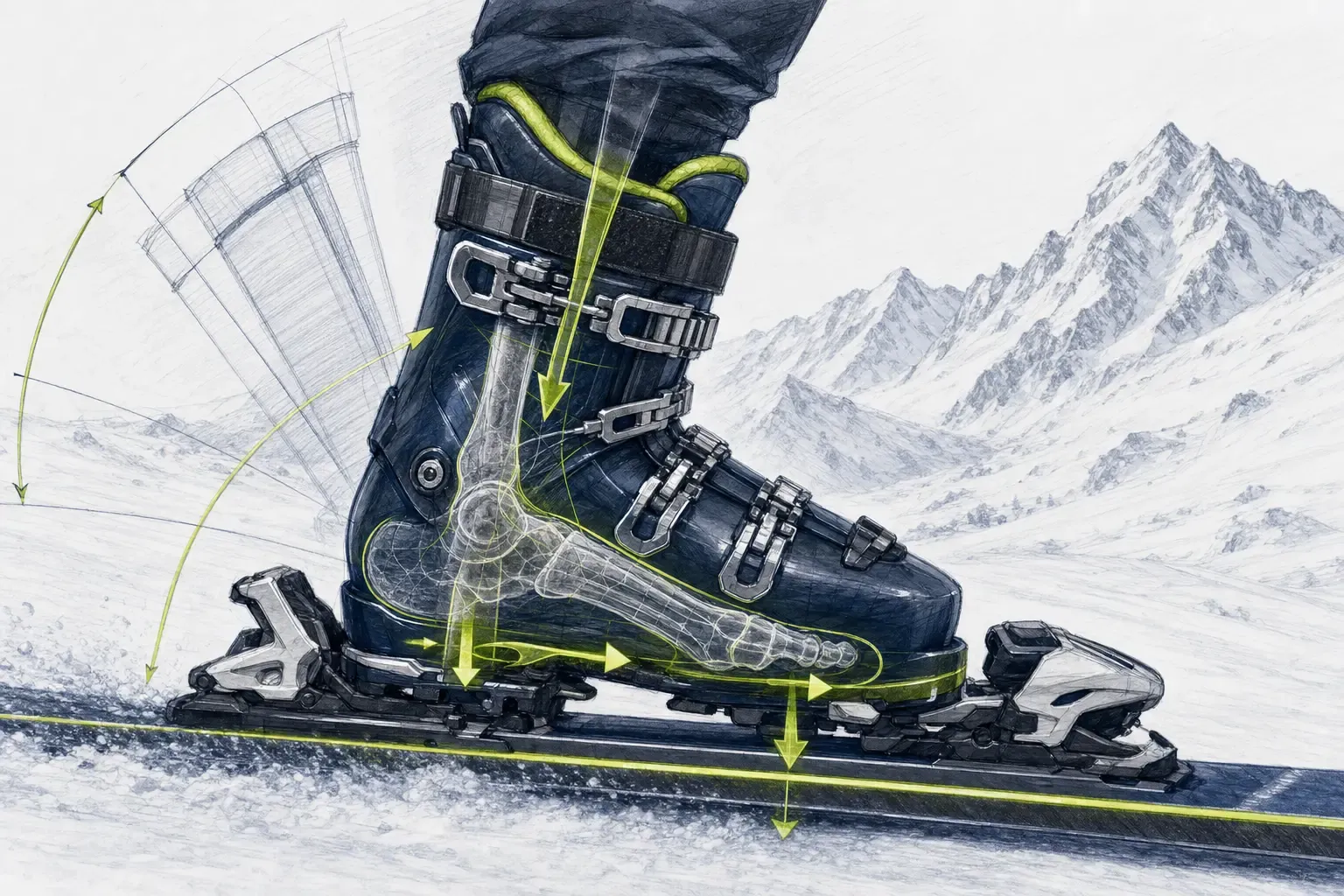
Ski boots are rigid sports footwear designed to connect a skier’s foot and lower leg to the ski through the binding. They consist mainly of the outer shell, movable cuff, inner boot, buckles, and sole with a binding interface. In alpine skiing, they must transfer forces and movements, while also working with the binding so that the whole ski-binding-ski boot system functions as intended.
A ski boot is not just warm winter footwear. It is part of ski control: it stabilizes the foot, limits unwanted heel movement, and transfers pressure to the tongue, the sides of the shell, and then to the ski edges. A ski boot that is too loose slows this transfer down. A boot that is unsuitable because it is too narrow, too short, or too stiff can cause pain, cold feet, and a defensive stance.
Size and shape
Ski boot sizes are commonly marked using the Mondopoint. But the number alone is not enough: two feet of the same length can differ in width, instep height, heel shape, and ankle position. ISO standards distinguish between children’s and adult sole interfaces and set requirements for dimensions, testing, and marking of ski boots used with the relevant binding types.
When trying them on, the heel should be stable and the foot should not float inside the shell. The toes may lightly touch the front in a basic stance, but after taking a skiing stance the heel shifts back. Strong toe pressure, sharp localized pain, or numbness are not signs of a “race” choice.
For a more precise assessment, the space between the foot and the empty shell without the inner boot is also checked. Such a test and any shell shaping should be done by an experienced salesperson or bootfitter. The inner boot will partly adapt and compress with use, but it cannot fix a fundamentally wrong shell size or shape.
Flex and controllability
Flex describes the resistance of the ski boot when the cuff bends forward. The flex number is not a safety class defined by standards for the ski boot and binding interface. When comparing different brands, model lines, and constructions, it serves mainly as a guide.
Proper stiffness depends on body build, strength, technique, speed, discipline, and temperature conditions. A softer ski boot bends more easily, but for a strong or technically advanced skier it may not provide enough support. A boot that is too stiff can prevent a child from getting into a balanced stance over the middle of the foot.
For a child, flex is not chosen only by age or by the idea that a stiffer ski boot automatically means better performance. The coach watches whether the young skier can load the cuff properly without falling back, lifting the heel, or bending excessively at the waist.
Children’s ski boots
The most common mistake is buying ski boots that are significantly too big “for more seasons.” The child then stabilizes the foot by curling the toes, overtightening the buckles, or moving the whole foot inside the shell. The result is poorer ski control and less precise feedback.
A proper room to grow is a matter for individual assessment. Current foot length and width, the child’s experience, how often they ski, and planned use are all taken into account. The size should be checked again during the season, especially during growth, toe pain, or a change of socks or insoles.
The child should wear one thinner functional ski sock. Several thick socks reduce space, create folds, and can make the foot less sensitive. Buckles are fastened so the foot is held in place, not with maximum force. If stability can only be achieved by extreme tightening, the size or shape of the ski boot should be checked.
Sole and binding compatibility
Classic alpine ski boots use the interface according to ISO 5355. Ski boots with a sole that makes walking easier have a separate interface according to ISO 23223 and require bindings specifically designed for it. The shape of the sole cannot be judged by sight alone; what matters are the markings on the ski boot and the bindings, as well as the manufacturers’ instructions.
A worn, damaged, or incompatible sole can change the contact with the binding. After replacing ski boots, the binding settings must therefore be checked for the specific shell. The ski boot itself has no DIN setting; release values and system function checks are handled by the binding and qualified service. Standards for assembly, adjustment, and inspection work with the full ski–binding–boot system, including special procedures for rental equipment.
Racing skiing
A racing ski boot is usually tighter and stiffer, but it must remain manageable for the specific racer. Shell modifications, cuff alignment, sole grinding, or changes to the stand height are not ordinary at-home adjustments. They can affect stance, the interface with the binding, and compliance with the rules.
FIS publishes competition equipment specifications for each season and also updates the measurement of the ski boot and binding setup. As of 2 September 2026, the FIS website lists the version for the 2026/27 season, valid from July 2026. For a racer, the current rules of FIS, the national federation, and the specific age category must always be checked; an older seasonal table is not automatically valid.
Coach’s view
A coach does not judge a ski boot only by the number on the shell. They watch whether the child stands in balance, can press the tongue without losing posture, has a stable heel, and does not have pressure marks, numbness, or unusual pain after training. A sudden technical change may also be related to a growing foot, a loose buckle, a shifted liner, or ski boots that are no longer the right size.
The coach’s job is to recognize and describe the problem. The final size choice, expert shell modifications, and compatibility checks with the binding belong to a specialized workshop and service.
Sources and further reading
- ISO 5355:2019 – Alpine ski-boots: Requirements and test methods
- ISO 23223:2025 – Alpine ski boots with improved walking soles
- ISO 9838:2023 – Alpine and touring ski-bindings: Test soles for ski-binding tests
- ISO/TC 83/SC 4 – Catalog of standards for snow sports equipment
- ISO 13993 – Inspection of rental ski–boot–binding systems
- FIS – page with current competition equipment specifications 2026/27
- FIS – Specifications for Alpine Competition Equipment 2025/2026