What Race Skis Are
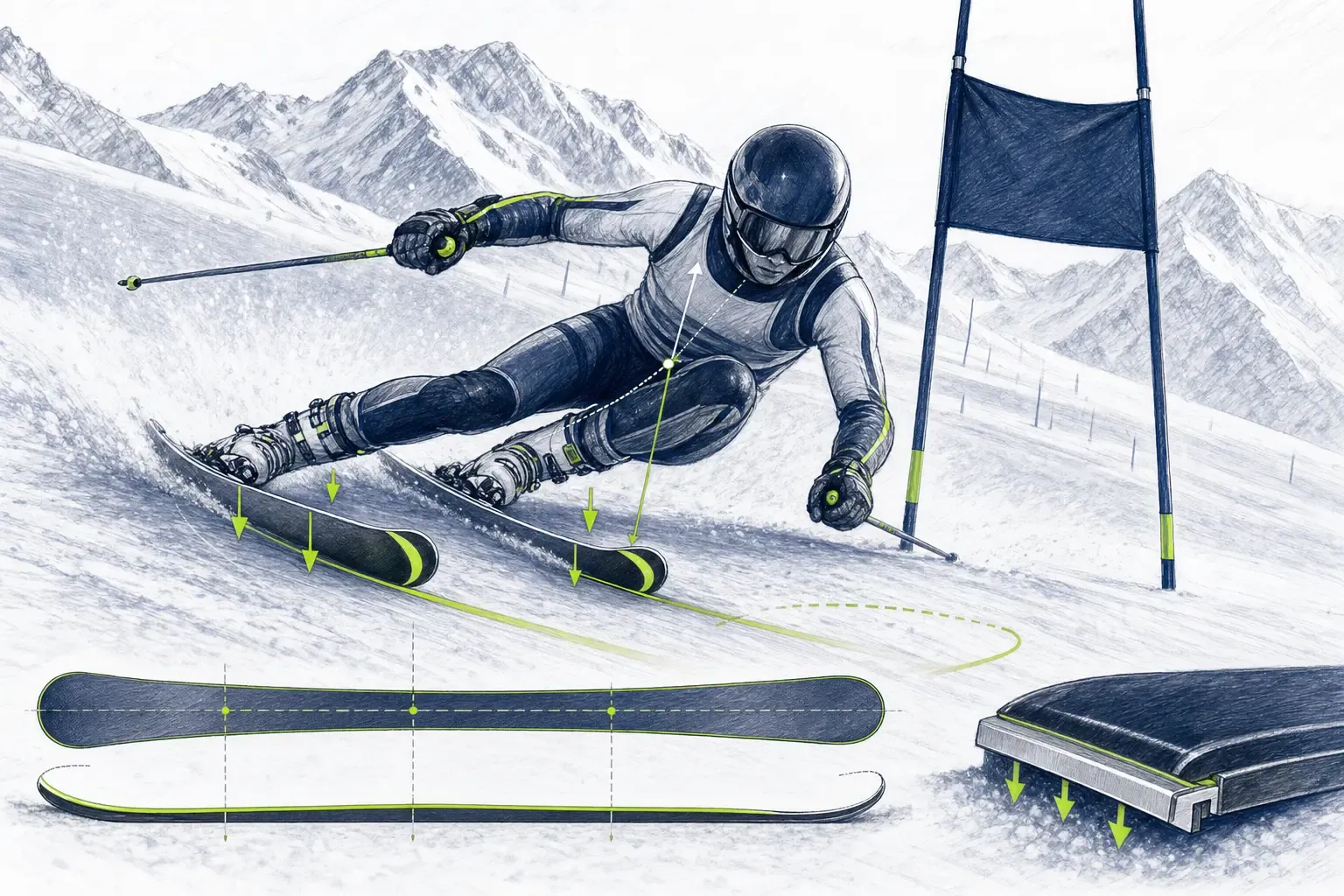
Race skis are downhill skis designed primarily for skiing a race course. In its technical specifications, FIS associates them with the disciplines slalom, giant slalom, super-G, and downhill. They have wear-resistant steel edges and a geometry that allows large lateral forces to be transferred between the skier, the ski, and the snow.
Label race on a commercial model, however, does not by itself mean that the ski meets the current FIS dimensions. Manufacturers also offer sport or so-called race-carver skis, which resemble race models in appearance but tend to be more forgiving, more versatile, and have a smaller sidecut radius. Conversely, a ski made according to FIS rules can be unnecessarily demanding for a child or a recreational skier.
Geometry by Discipline
The basic geometry data are the length, tip width, waist width, and tail width, and sidecut radius. FIS defines it as an approximate average radius describing the ski's side shape. It is not a fixed radius for every turn. The actual turn shape is also affected by edging, the ski's flex, speed, snow, slope angle, and the skier's actions.
Individual disciplines require different properties:
- Slalom skis are relatively short, more strongly sidecut, and intended for quick edge changes and short turns.
- Giant slalom skis are longer, have a larger sidecut radius, and need more space, speed, and precise control.
- Super-G and downhill skis are even longer and less sidecut. They are intended for large turns and stability at high speed, not for ordinary children's training on a short slope.
As speed and turn radius increase, ski length and sidecut radius usually increase as well. The decisive limits for a specific competition should always be checked in the current rules. For the 2026/2027 season, the FIS specifications effective from July 2026 apply. National and children's competitions may use their own age adjustments, so knowing only the general FIS table is not enough.
Construction and Performance
Modern race skis usually have a sandwich construction with a wooden core and reinforcement layers. The specific materials and composition vary between manufacturers and models. Longitudinal and torsional stiffness are important: the ski must bend into an arc under load, but at the same time keep its edge on hard snow.
Higher stiffness is not automatically an advantage. If a child cannot load and flex the ski properly, they may ski stiffly on it, slide across the surface, or compensate for a lack of control by rotating and moving the upper body excessively. The ski's geometry and stiffness also affect how strongly the ski guides itself on edge. Research in giant slalom has shown that changes in a ski's radius and width change its aggressiveness when in contact with snow; however, results from elite-level skiing cannot simply be transferred to every child.
Race skis for children
A child’s race ski should not be just a shortened adult ski. When choosing one, consider the child’s height and weight, biological maturity, strength, technical level, discipline, course type, and training content. Two children of the same height may therefore not need the same model or the same length.
In younger categories, it is important that the ski allows:
- to start and finish a turn independently,
- to change edges without excessive effort,
- to control speed even outside the gates,
- to handle different turn radii,
- to learn balance and pressure control, not just rely on strong sidecut.
General rules like chin height or above the head are only rough guidelines. They do not account for the stiffness of a specific model, the discipline, or the child’s motor skills. The final choice should be made by the coach, who knows the athlete’s skiing, in cooperation with a qualified ski technician.
A young racer also does not need to use the most demanding discipline-specific ski at every training session. Training practice may deliberately include easier or more versatile skis, free skiing, and exercises outside the gates. This is not an FIS rule, but a coaching decision based on the goal of the session.
Rules and technical inspection
In competition, the deciding factors are the valid rules and the actual equipment parameters, not just the commercial model name. FIS sets the method for measuring length, sidecut radius, and other features, and requires the relevant markings on the ski. Exact requirements may vary by discipline, category, and competition system.
The binding, plate, and ski form one functional unit. Installation, compatibility checks, and release-value settings should be entrusted to a qualified service technician. Neither the race ski itself nor compliance with FIS dimensions confirms that the entire setup is correctly adjusted for a specific child.
Typical mistakes and misunderstandings
The most common mistake is moving too early to a long or stiff ski just because it matches an older age category or is used by successful racers. It is also wrong to assume that a smaller stated radius always means easier turning. A strongly sidecut ski may gladly start a turn, but with strong edging it may require precise balance and timely edge release.
Another mistake is confusing a sharp edge with a properly prepared edge. The edge angle, base structure, and condition of the material are chosen according to the discipline, conditions, and the instructions of the manufacturer or service technician. Repeated aggressive grinding also removes material and shortens the ski’s lifespan.
Coach’s view
A good race ski is one on which an athlete can complete the training task while maintaining balance, speed control, and proper movement habits. If the equipment forces a child to struggle with every turn initiation, the problem may not be a lack of courage or strength. It may be an unsuitable length, stiffness, geometry, service, or a combination of ski, plate, binding, and boot.
The choice should therefore not begin with the question of the longest ski a child can handle, but with the question of which ski allows them to develop technically and train safely in the conditions the club actually has available.
Sources and further reading
- FIS – Specifications for Alpine Competition Equipment 2026/27, documents valid from July 2026
- FIS – Specifications for Alpine Competition Equipment 2025/2026, technical definitions and measurement methods
- U.S. Ski & Snowboard – 2026 Alpine Competition Guide
- Spörri et al. – Effect of ski geometry on aggressive ski behaviour and visual aesthetics
- Reid et al. – Alpine Ski Motion Characteristics in Slalom
- Müller et al. – Long-Term Athletic Development in Youth Alpine Ski Racing
- Gilgien et al. – Recent Kinematic and Kinetic Advances in Olympic Alpine Skiing
- Zorko et al. – The Waist Width of Skis Influences the Kinematics of the Knee Joint in Alpine Skiing