What Is the Ski Tip
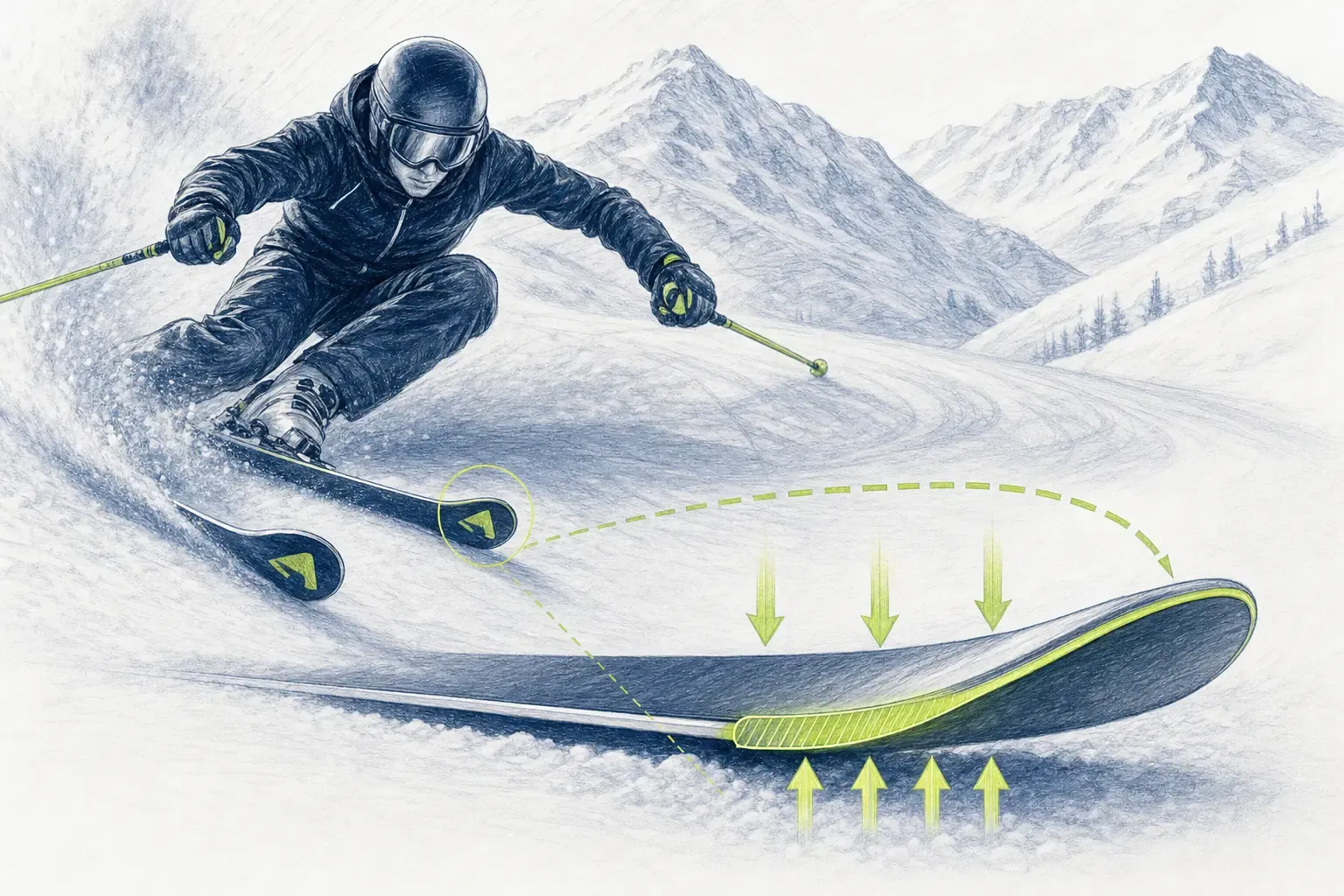
The ski tip is the front, upward-curved end of the ski. In everyday coaching terminology, the term can also refer to the wider front section of the ski from the binding to the tip itself. It is therefore useful to distinguish between the tip itself, the widest front section, and the front part of the edges that touches the snow in a turn.
The shape, rise, flex, and sidecut of the front section affect how the ski travels over bumps and how it engages into a turn. But the tip does not turn on its own: the ski’s behavior comes from the combined action of edging, pressure, leg rotation, speed, snow conditions, and the ski’s construction.
Engaging the Tip in the Turn
When a coach talks about “engaging” or “loading” the tip, they usually mean creating effective contact between the front part of the ski and the snow. With proper edging and balance, pressure in the front section can help bend the ski and guide it into a new turn.
The U.S. Ski & Snowboard methodology describes using pressure in the tip area when initiating a carved turn as a developing technical skill. At a higher level, however, the skier distributes pressure smoothly along the whole ski and according to the phase of the turn. So it is not about staying forward all the time.
For children, a stable, mobile stance appropriate for their age comes first. The cue should be chosen according to the child’s level: a beginner is more likely to need to feel support through the whole foot and keep the skis in contact with the snow than to deliberately create strong pressure into the tips.
Common Misunderstandings
- Pressure into the tip does not mean standing on your toes. The foot should remain supported in the ski boot, and movement should happen in a coordinated way through the ankles, knees, and hips.
- Knees pushed forward do not guarantee proper balance. If the pelvis and torso stay back, the skier can still be in the back seat despite bent ankles.
- The tips do not need to be loaded equally throughout the whole turn. The pressure distribution changes with terrain, speed, and the skier’s intention.
- Lifting the inside tip is not a general goal. It can be used as an exercise, but it does not replace guiding the outside ski or maintaining a balanced stance.
Race Context and the Coach’s View
FIS uses the tip as a technical reference point when measuring skis and, in competition specifications, distinguishes for example the nominal length, the width of the front section, and the height of the tip. Specific requirements depend on the discipline, age category, and competition level; before a race, the current FIS document for the given season is therefore checked.
A coach does not assess the tip in isolation. They watch whether the skier creates pressure smoothly, keeps the ski in contact with the snow, and can change the shape of the turn without suddenly falling forward or backward. The verbal cue is only a aid — what matters is how the individual child responds on the snow.
Sources and further reading
- FIS – Alpine Skiing Documents, current rules and documents
- FIS – Specifications for Alpine Competition Equipment 2026/27, documentation overview
- FIS – Specifications for Alpine Competition Equipment 2025/2026, geometric definitions and ski measurement
- U.S. Ski & Snowboard – Athlete Performance Profile
- U.S. Ski & Snowboard – Alpine Guide to Ski Fundamentals: The Turn Model
- U.S. Ski & Snowboard – Level 100 Updates, basic ski exercises