What upper body work means
Upper body work is the coordinated use of the torso, shoulders, head, and arms while skiing. Its goal is not to create one fixed position, but to help the skier maintain balance, regulate the center of gravity, and allow the legs to turn, edge, and load the skis effectively.
In alpine skiing methodology, the term often used is stable or quiet upper body. But stable does not mean motionless. The torso adapts to the slope, speed, turn radius, bumps, and the forces acting on the skier. What matters most is its appropriate control relative to the movements of the pelvis and legs. An advanced skier can move the legs under a relatively stable torso while keeping the whole movement smooth.
Stability is not rigidity
The upper and lower body do not work separately. They form one movement system in which the individual parts move through different ranges and at different times. When guiding a turn, the skis, legs, and pelvis may rotate more than the chest and shoulders. This relationship is called separation of upper- and lower-body work or movement separation.
A relatively quiet torso creates the conditions for:
- independent rotation of the legs in the hip joints,
- gradual edging of the skis,
- pressure control, especially on the outside ski,
- smoother transitions between turns,
- maintaining balance when the terrain and rhythm change,
- purposeful pole planting.
Exercises with different arm positions are used in coaching practice precisely because they test torso stability and the ability of the legs to move more independently. However, this is not a target technique or proof that the hands should stay in one exact position throughout the whole run.
The role of the torso, head, and arms
Torso It helps regulate fore-aft, lateral, and rotational balance. In a turn, it may lean inward together with the whole body, but at the same time it bends at the hips and through the torso as needed so the skier keeps the right relationship to the outside ski. The rotational position of the torso changes depending on the type of turn; it should not be the result of forcing the shoulders to twist.
Head and gaze support orientation in space. In training practice, the skier is guided to look in the direction of travel, at the terrain, and at the next point they are heading toward, not just at the tips of the skis. A raised gaze by itself, however, will not fix a poor stance or insufficient balance.
Arms help balance movement and prepare for pole use. Their position should be functional and relaxed. The exact height or width of the hands is not universal: it changes according to body proportions, speed, discipline, and situation. Sudden waving of the arms can be a sign of lost balance, while rigidly fixed hands limit the body’s natural response.
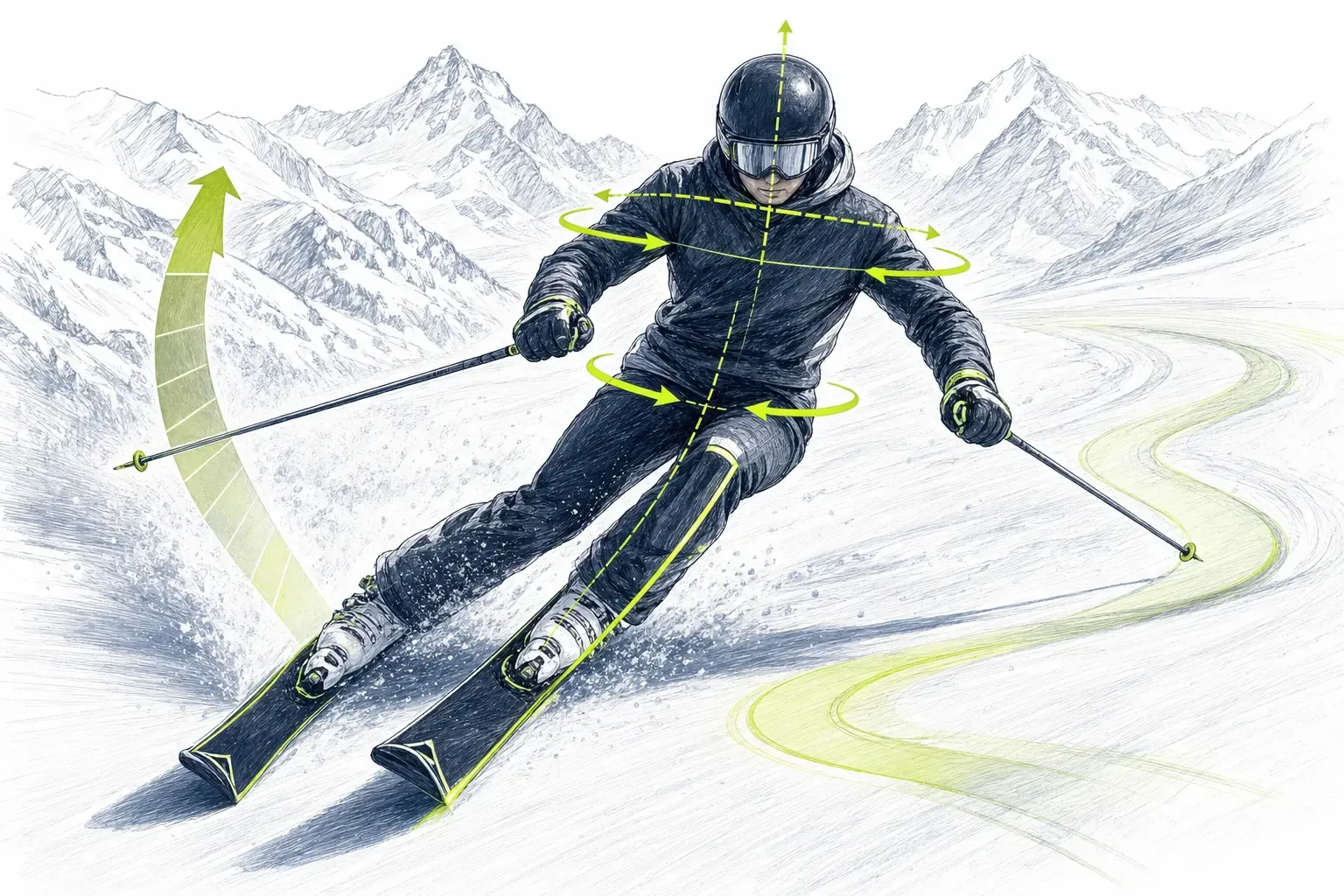
Arm and torso movement affects the position of the overall center of gravity. Biomechanical models therefore include the upper limbs when analyzing a skier; the torso cannot be viewed only as a passive part above the legs.
Children and learning technique
For children, it is not suitable to start with the abstract instruction “keep your shoulders down the slope.” A small or beginner skier is still developing balance, orientation, coordination, and the ability to control individual parts of the body independently. Too much correction of the shoulders can lead to stiffness or mechanical counter-rotation of the torso.
More appropriate are simple movement tasks: skiing while holding an object in front of the body, changing arm positions, touching the outside knee with the hand, or turning without poles. The task must match the age, level, and safety of the group. The coach watches whether the exercise really improves balance and leg work, or whether the child is only imitating the required shape.
In young skiers, upper-body stability develops gradually together with agility, mobility, and experience in varied terrain. It should not be separated from overall movement development.
Race context
In racing, a controlled torso helps keep the body pointed along the intended line while the legs guide the skis around the gates. Stabilization of the upper body is one of the basic technical areas of slalom, together with balance, outside-ski work, early activation of the lower limbs, ski-to-snow contact, and the use of poles.
Even in races, however, it is not true that the shoulders must always be level or constantly turned straight down the slope. The position changes in short and long turns, in bent combinations, over terrain rolls, and when balance is lost. What matters is the function of the movement: whether it helps maintain ski-to-snow contact, pressure on the skis, direction of travel, and readiness for the next turn.
Typical mistakes and misunderstandings
- Turning the turn with the shoulders: the torso starts the rotation and pulls the legs along behind it instead of the skis being guided by the movement of the lower limbs.
- Rigid posture: the shoulders are raised, the arms are locked, and the skier reacts worse to uneven terrain.
- Falling inward with the torso: the upper body shifts too far toward the inside ski and makes support on the outside ski harder.
- Hands behind the body: these often go along with the center of gravity lagging behind or delayed pole use, but they are not the only cause of these problems.
- Forced counter-rotation: The effort to keep the shoulders down at all costs while skiing downhill disrupts the natural coordination of the turn.
- Confusing stability with strength: trunk strength is important, but on its own it does not replace timing, mobility, or technical coordination. Research points out that knowledge of the ideal trunk strength ratios specific to alpine skiing remains limited.
Coach’s view
A coach does not assess the upper body only by how it looks in a single photo. They watch how it moves through the whole turn and how it relates to the legs, skis, terrain, and chosen line. Corrections should be based on the cause: pronounced shoulder movement may be the result of poor balance on the outside ski, a delayed edge change, or an unsuitable line, not a separate arm error.
Good upper-body work is therefore dynamic, relaxed, and purposeful. It allows the skier to respond without unnecessary movements, while not locking them into an artificially fixed position.
Sources and further reading
- U.S. Ski & Snowboard – Alpine Training Systems
- U.S. Ski & Snowboard – Arms in Various Positions
- U.S. Ski & Snowboard – Alpine SL Technique and Tactics
- Journal of Sports Sciences – A framework for measuring alpine skiing technique
- Frontiers in Physiology – Inertial sensor-based estimation of joint positions and centre-of-mass kinematics in alpine ski racing
- Journal of Human Kinetics – Trunk Strength Characteristics of Elite Alpine Skiers
- Sensors – Motion Analysis in Alpine Skiing: Sensor Placement and Orientation-Invariant Sensing
- Sensors – Wearable Biomechanics and Video-Based Trajectory Analysis for Improving Performance in Alpine Skiing