What Knee Work Means
Knee work is a common technical term for coordinated bending, extending, and side guiding of the lower limbs while skiing. It is not isolated knee twisting or a racing rule. The movement of the knee joints must follow the work of the ankles and hips, the position of the torso, the movement of the center of gravity, and the skis’ reaction to the snow. From a biomechanical point of view, technique or muscle activity therefore cannot be reliably assessed only by the angle at the knee.
Knees help the skier:
- maintain a mobile and balanced stance,
- release the old edges and move into a new turn,
- change the ski edge angle together with the ankles and hips,
- regulate pressure between the skis and along the length of the ski,
- absorb bumps and keep the skis in contact with the snow,
- create different lengths of the outside and inside leg in the turn.
How the knees work in a turn
Knee work does not have just one fixed form. It depends on speed, turn radius, slope steepness, snow surface, terrain, skis, and the intent of the run.
During the transition between turns the skier reduces pressure and releases the edges of the old turn. Often the old outside leg bends and allows the body to move across the skis or the skis to move under the body. The new outside leg prepares to gradually take over support. However, not every transition requires a pronounced lowering of the stance; the movement should match the situation.
During the turn the new outside leg usually becomes relatively longer and the inside leg shorter. This difference creates space for the body to incline and angulate and helps keep the pelvis in a usable position. The knees move together with the feet and thighs, not forcibly against the direction of the skis.
At the end of the turn appropriate bending can help manage increasing pressure, adapt to the terrain, and prepare the release of the edges. It should not be a sudden collapse of the legs or sitting back.
Although training often emphasizes the outside ski, the distribution of forces between the legs is not the same throughout the entire turn. Measurements show that the load on the outside knee is not automatically greater than the load on the inside knee for every force component and at every phase. Likewise, it cannot simply be said that a carved turn always loads the knees more than a skidded turn.
Edging is not just pushing the knees inward
Side movement of the knees contributes to changing the edge angle, but the instruction “move the knees inward” on its own is incomplete. If a skier moves the knees without proper work from the ankles, hips, and torso, an unstable stance, uneven ski edging, or the typical A-shaped leg position may result.
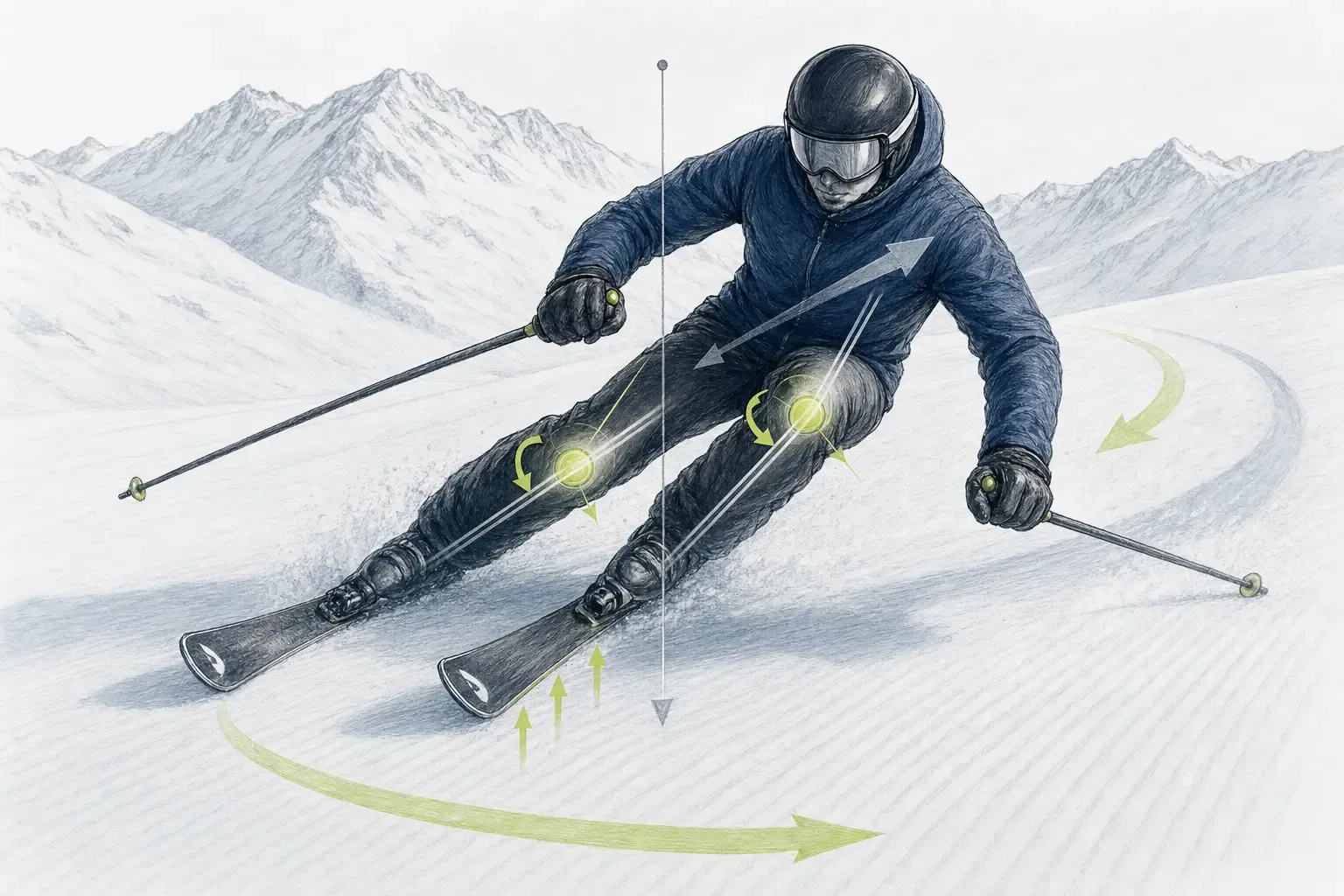
Effective edging is created by combining whole-body inclination and angulation in the individual parts of the movement chain. The knee remains mobile, but it should not be forcibly pushed into an extreme position. Ski width also affects knee kinematics; on very wide skis on a hard surface, different movement strategies and approaches to larger ranges of motion in some planes were measured.
Knee action in children
For children, overall balance and natural mobility take priority over imitating the deep angulation of an adult racer. Motor skills, experience, strength, and the ability to understand instructions develop gradually. The technical task must therefore match the child's age and skiing level.
In training practice, clear movement tasks are often more effective than isolated instructions about one joint. On a suitably gentle slope, a child can for example:
- switch between a higher and lower stance without sitting back,
- go over gentle terrain waves so that the legs follow the terrain,
- alternate longer and shorter turns,
- feel the gradual extension of the outside leg and shortening of the inside leg,
- try smooth edge release without jumping.
The goal is not to achieve the greatest possible bend. An overly low stance can limit further movement, increase fatigue, and lead to skiing on the tails of the skis. On the other hand, fully straight and stiff legs make it harder to regulate pressure and react to bumps.
Race context
In race skiing, dynamic leg action helps maintain the right line, build pressure earlier and more smoothly, and react to gates, changes in slope, and bumps. Research in elite skiing describes different movement and muscular demands across disciplines; slalom in particular brings faster and more extensive changes than speed events. Successful technique, however, is not determined by maximum knee movement, but by its timing and coordination with the whole body.
A young racer needs to know how to both extend and actively shorten the legs depending on the situation. A one-sided instruction like “push into the outside” can lead to stiffness, late pressure loading, or loss of contact between the inside ski and the snow. The coach mainly watches the smoothness of the transition, the alignment of the lower limb, pelvis position, ski contact with the snow, and whether the movement helps the chosen line.
Typical mistakes
- Static knees: the skier stays in the same bent stance and creates the turn mainly by rotating the torso.
- Sitting back: the knees do bend, but the pelvis drops behind the feet and pressure shifts toward the tails of the skis.
- Pushing one knee inward: the skis end up at different edge angles and an ineffective A-position forms between the knees.
- Jumping in every transition: a pronounced upward movement unloads the skis more than the situation requires and can disrupt contact with the snow.
- Sudden collapse of the outside leg: support disappears before it releases and forms a new arc.
- Extreme flexion or extension: the joint loses movement reserve for the next response.
From a safety point of view, it is not appropriate to teach a child to forcefully twist the knee against the position of the foot and ski. A laboratory biomechanical study showed adverse loading of the anterior cruciate ligament when lower-leg twisting was combined with a fully extended or extremely bent knee. This finding must not be mistaken for a diagnosis or an individual treatment guide. Pain, swelling, or a feeling of instability belong in the hands of a healthcare professional.
Coach’s view
A coach does not assess knee work by how deeply the knees are bent in a photo. What matters more is, when the legs shorten and lengthen, whether they stay elastic, and whether the movement improves balance, ski guidance, and contact with the snow. Good knee work is smooth, appropriate to the situation, and connected with the ankles, hips, and torso. The knee is not the engine of the turn by itself; it is one link in the whole movement system.
Sources and further reading
- U.S. Ski & Snowboard – Alpine Training Systems
- U.S. Ski & Snowboard – Level 100 Alpine Ski Fundamentals Instructor Manual
- Klous, Müller, Schwameder – Three-dimensional knee joint loading in alpine skiing
- Zorko et al. – The Waist Width of Skis Influences the Kinematics of the Knee Joint in Alpine Skiing
- Gilgien et al. – Recent Kinematic and Kinetic Advances in Olympic Alpine Skiing
- Muscle-tendon unit length changes in knee extensors and flexors during alpine skiing
- Spörri et al. – Biomechanical factors influencing the performance of elite Alpine ski racers
- Hame, Oakes, Markolf – ACL injury, tibial torque and knee flexion angle during alpine skiing
- Interski – Influence of Motor Abilities on Learning of Alpine Ski Technique