What is the center of gravity
Center of gravity is a theoretical point used to simplify the effect of gravity on a skier. In biomechanics, the more precise term center of mass (center of mass, CoM) is used. The center of mass expresses how the weight of individual body parts is distributed; the center of gravity expresses the action of gravitational force. In an approximately uniform gravitational field, their position is practically the same, so in ski terminology both terms are often used as synonyms.
The center of gravity is not an anatomical point attached to the pelvis or abdomen. Its position changes when you lean forward, stand up straight, bend your legs, move your arms, or change the position of individual body parts. In biomechanical measurement, it is therefore calculated from the position and mass share of body segments. For more detailed evaluation, ski equipment can also be included in the model.
Importance in skiing
Skiing balance does not come from keeping one unchanging point
above the middle of the skis. The skier continuously adjusts the relationship between the position of their center of mass, the ski-snow contact points, the ski path, and external forces. These include mainly gravity, ground reaction, and air resistance.
In straight and slow gliding, the vertical projection of the center of gravity can be roughly between the skis. But in a dynamic turn, the body and the skis do not move along the same path. The skis may guide the turn farther from its center, while the center of mass moves along a more inside trajectory. Such a position does not by itself mean a loss of balance; it is a natural part of turning. Research in racing skiing therefore tracks separately the ski path, the path of the center of mass, its speed, forward and backward position, and the distance from the feet.
- The skier does not move the center of gravity directly as a separate object. They change the position of body parts through movement in the ankles, knees, hips, and torso. The result is a shift of the center of mass:sideways
- , for example when moving into a new turn, forward or backward
- relative to the feet and skis, higher or lower
when straightening and bending the legs.
The range and timing of these movements depend on the phase of the turn, slope gradient, speed, turning radius, snow conditions, and chosen technique. That is why there is no single correct position of the center of gravity for the entire turn.
Center of gravity is not pressure on the ski
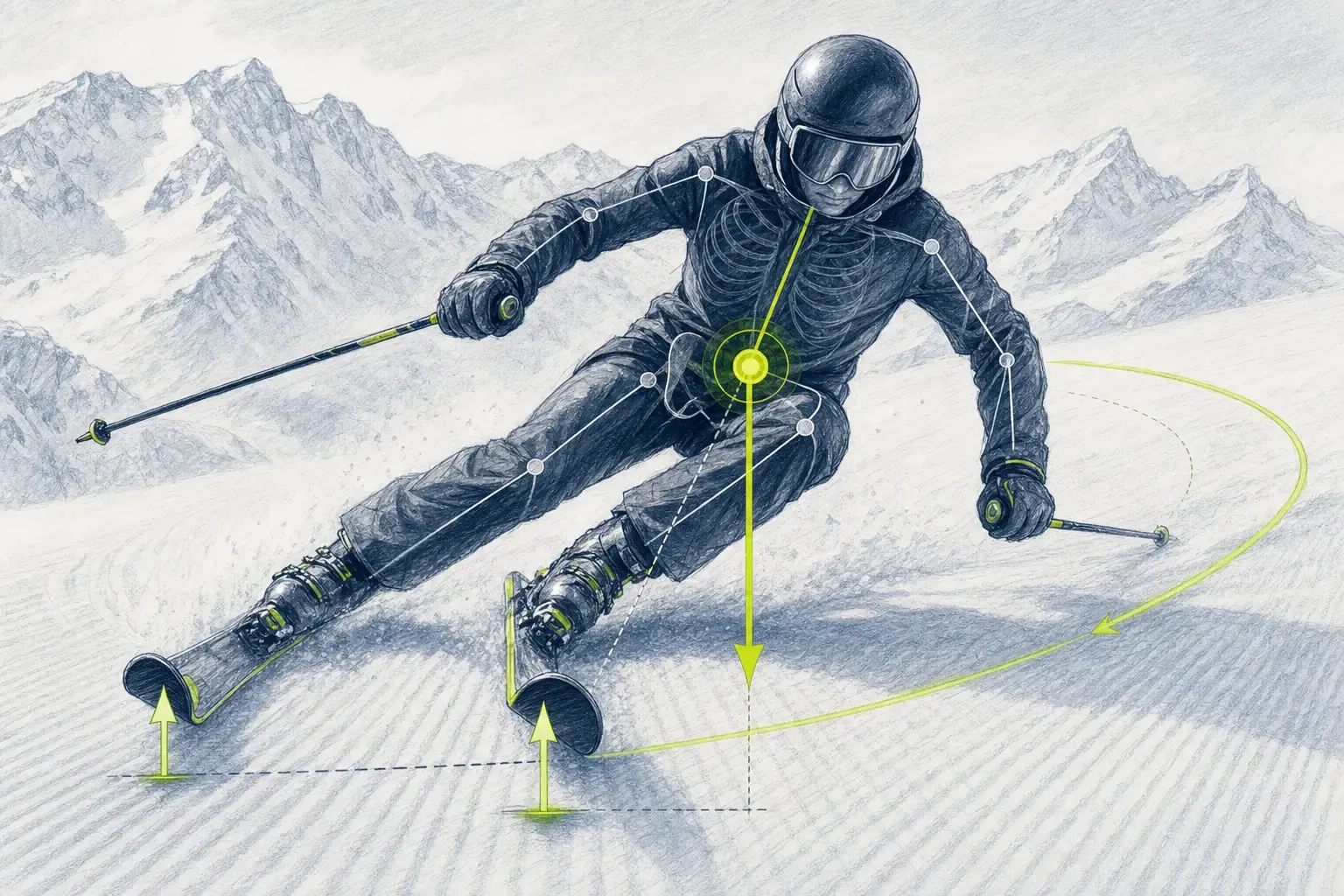
Center of gravity – technical illustration of Ski Loko, Ski Loko Bratislava? no maybe preserve Ski Loko only? Wait source has
Children's context
To children, the center of gravity can be roughly explained as “the point that moves together with the whole body.” Pointing to the abdomen or belt area is a useful visual aid, not an exact anatomical definition. When posture changes, this point shifts.
In training practice, it is better for a child to experience the effect of body position through a simple movement task than to try to consciously set an imaginary point. The tasks must match the child's skiing level, coordination, strength, proportions, and the conditions on the slope. Fixed instructions such as “stay low all the time” or “keep your shoulders always above the tips” can limit natural movement and the ability to react to the terrain.
Race skiing
In racing, the trajectory of the center of mass is an important part of performance analysis. It affects the skier's line between gates, the ability to create and absorb forces, and the transition from one turn to the next. Modern studies estimate it using a combination of multi-camera systems, satellite measurement, and inertial sensors. A sensor placed on the helmet, neck, or lower back area is not the center of gravity itself; its data must be processed using a body model.
The position of the center of gravity is not covered by a separate FIS rule, and there is no prescribed angle or distance that a racer must maintain. It is a biomechanical parameter used to evaluate technique, load, and performance.
Typical misconceptions
“The center of gravity is always at the navel.”
- That is only an approximate idea; the position changes with posture. “A good skier always has the center of gravity above the skis.”
- In a turn, the center of mass is commonly located toward the inside of the ski track. “The lower the center of gravity, the better the technique.”
- The stance height must allow movement, shock absorption over bumps, and further changes in load. “The position of the center of gravity shows where the pressure is.”
- These are related, but different, quantities. “One still image proves leaning back.”
- Without the turn phase, slope angle, movement direction, and force data, such a conclusion may be wrong. Coach's view
A coach does not only watch roughly where the center of gravity is. They mainly assess the result of the movement: whether the skier can guide the skis along the intended line, change edges smoothly, regulate loading, and keep enough range of motion for the next situation. With children, a clear task and a safe environment come before mechanically copying the stance of an adult racer. Video is useful when the whole sequence of movements and a specific phase of the turn are evaluated, not an isolated body position.
Related terms
Sources and further reading
- US Ski & Snowboard: Level 100 Alpine Manual – glossary and fundamentals of skiing biomechanics
- Fasel et al. (2017): An Inertial Sensor-Based Method for Estimating the Athlete's Relative Joint Center Positions and Center of Mass Kinematics in Alpine Ski Racing
- Spörri et al. (2012): Course setting and selected biomechanical variables related to injury risk in alpine ski racing
- Gilgien et al. (2013): Determination of External Forces in Alpine Skiing Using a Differential Global Navigation Satellite System
- Fasel et al. (2018): A New Training Assessment Method for Alpine Ski Racing – Estimating Center of Mass Trajectory
- Gilgien et al. (2019): Methodological and Practical Considerations Associated With Assessment of Alpine Skiing Performance Using Global Navigation Satellite Systems
- Oštrek et al. (2019): Are Existing Monocular Computer Vision-Based 3D Motion Capture Approaches Ready for Deployment?