Definition
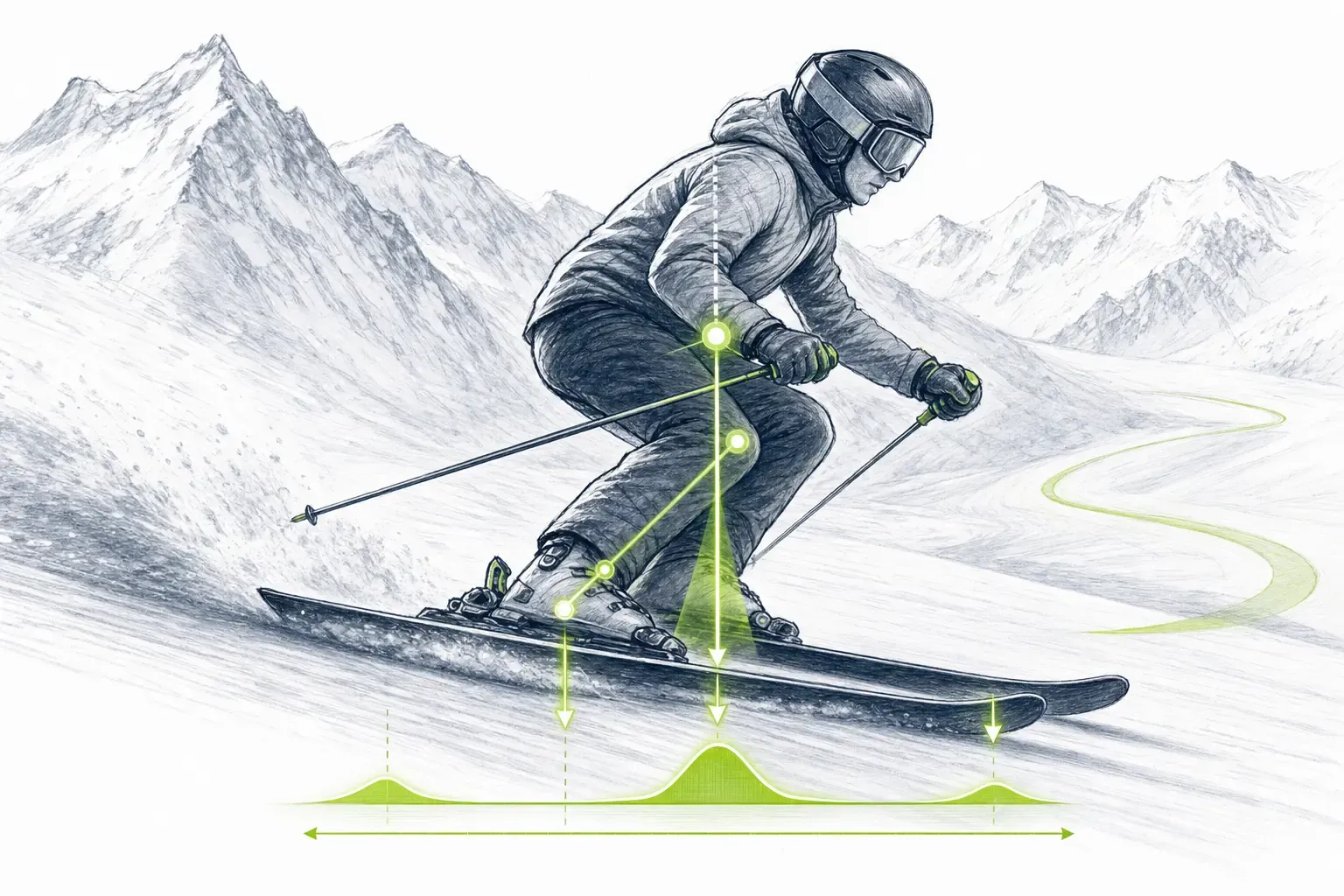
Fore-Aft Balance is the skier’s ability to regulate the relationship between the body’s center of mass, support in the ski boots, and pressure distributed along the skis—from the front through the middle to the heels. It is about movement and stabilization along the skis’ longitudinal axis, not a single prescribed body position.
Professional methods describe balance as managing the relationship of the center of mass to the support surface. In fore-aft regulation, the skier mainly uses coordinated flexion and extension of the ankles, knees, and hip joints. The position of the pelvis, torso, and arms also contributes to the result, but simply moving the arms or pelvis forward will not solve balance.
Not always in front, but always ready to react
The common simplification “you have to be more forward” can help a skier who stays far behind the skis, but it is not an exact definition of proper technique. Fore-aft balance is dynamic: the body’s position relative to the feet and the point of pressure change during the turn together with the direction of travel, the slope angle, edging, acceleration, and uneven terrain.
In basic skiing, the goal is a stable, adaptable stance from which the skier can move forward and back without losing control. For a more technically advanced skier, the range of fore-aft movements increases and pressure can be intentionally directed along the length of the ski. However, there is no universal timing rule that says every skier must be exactly on the tips or tails at a certain part of the turn. U.S. Ski & Snowboard distinguishes between a mostly centered stance for younger and less experienced skiers and a greater functional range of movement for more advanced racers.
Fore-aft position in biomechanical research is tracked, for example, as the position of the center of mass relative to the foot or ankle projected onto the slope plane. On snow, pressure insoles are also used to record loading on the front and back of the foot. Such data, however, must be evaluated together with the phase of the turn, speed, and movement of the whole body; a single number is not a universal sign of correct technique.
Practical meaning
Proper fore-aft regulation helps the skier:
- keep the skis in contact with the snow,
- start and guide the turn without a delayed recovery move,
- change edging and ski direction more smoothly,
- adapt to terrain undulations, soft snow, or changes in slope,
- retain the ability to flex and extend the lower limbs,
- regulate pressure without overloading one end of the ski.
A noticeably back seat position often shows up as the skis running away ahead, weaker guidance of the front part of the skis, straight or stiff legs, and a delayed start to the next turn. Pushing too far forward can, on the other hand, overload the front of the skis, lighten the tails, and limit further movement in the ankles. These are possible signs, not a diagnosis from a single photo. The coach must watch the whole turn and the skis’ response.
Children and young skiers
For a child, a stable, mobile stance and the ability to regain balance take precedence over mimicking a racing position. A younger or less experienced skier first needs plenty of safe movement on suitable terrain: gliding, turning, skating, moving over gentle terrain changes, and simple tasks that require continuous position adjustments.
In training practice, for example, small steps while skiing, alternating ski shifting, skating, turns with a light unweighting, or controlled searching for the forward, middle, and rear positions are used. Exercise is not an end in itself. It should trigger a specific response, and the coach must adapt it to age, technical level, fatigue, space, and conditions. Skiing backward, jump tasks, or exercises on one ski belong only on suitable terrain and under the direct supervision of a coach. Official methods list similar tasks as means of developing balance, not as a mandatory training recipe.
Proper equipment is also important. A boot that is too large, poorly secured, or inappropriately stiff can make it harder to feel support and move the ankle effectively. Assessment of the size, shape, and stiffness of the boot belongs to a qualified specialist; a child should not be forced to compensate for unsuitable equipment with an extreme body position. The importance of correct foot placement and suitable boot stiffness is also emphasized by the U.S. Ski & Snowboard development system.
Race context
In racing skiing, fore-aft balance is part of pressure regulation, guiding the outside ski, and choosing the line. The racer needs to move the body from one turn to the next, maintain ski-snow contact, and respond to gates, the rhythm of the course, and the terrain. Higher speed does not mean a more static stance; on the contrary, it requires more precise timing and a greater ability to regain balance after a deviation. U.S. Ski & Snowboard therefore includes balance and stance among the basic technical elements of slalom and increases the development of fore-aft regulation according to the athlete’s performance level.
Typical misunderstandings
- “The correct thing is to always be on the balls of your feet.” The correct stance changes depending on the situation; the goal is the ability to regulate pressure.
- “It is enough to push the knees forward.” Knee flexion alone can move the pelvis backward and make the problem even more pronounced.
- “Hands forward will pull the body forward.” The hands support a ready stance, but without movement in the lower limbs they may not change the center of mass position.
- “Pressure into the boot tongues must always be strong.” Contact with the boot should be functional and variable, not tense and rigid.
- “The rear position is always a mistake.” A short movement backward can be part of regulation or a reaction to the terrain; the problem is a state from which the skier cannot continue in time.
Coach’s view
The coach does not evaluate fore-aft balance only by the angle of the lower leg or a single video frame. The coach watches whether the skier can smoothly start the next turn, keep ski-snow contact, adapt the legs to the terrain, and regain a functional stance after disruption. Good fore-aft balance is not a position that a child can hold, but a range within which they can move safely and effectively.
Sources and further reading
- U.S. Ski & Snowboard – Level 100 Alpine Manual
- U.S. Ski & Snowboard – Athlete Performance Profile
- PSIA-AASI – Fundamental Mechanics of Alpine Skiing Across Adaptive Disciplines
- Fasel et al. – An Inertial Sensor-Based Method for Estimating Joint Positions and Center of Mass Kinematics in Alpine Ski Racing
- Spörri et al. – Course Setting and Selected Biomechanical Variables Related to Injury Risk in Alpine Ski Racing
- Asymmetries in Ground Reaction Forces During Turns by Elite Slalom Alpine Skiers
- U.S. Ski & Snowboard – Alpine Guide to Ski Fundamentals: Arms in Various Positions
- U.S. Ski & Snowboard – Men’s Tech Reboots at Mt. Hood