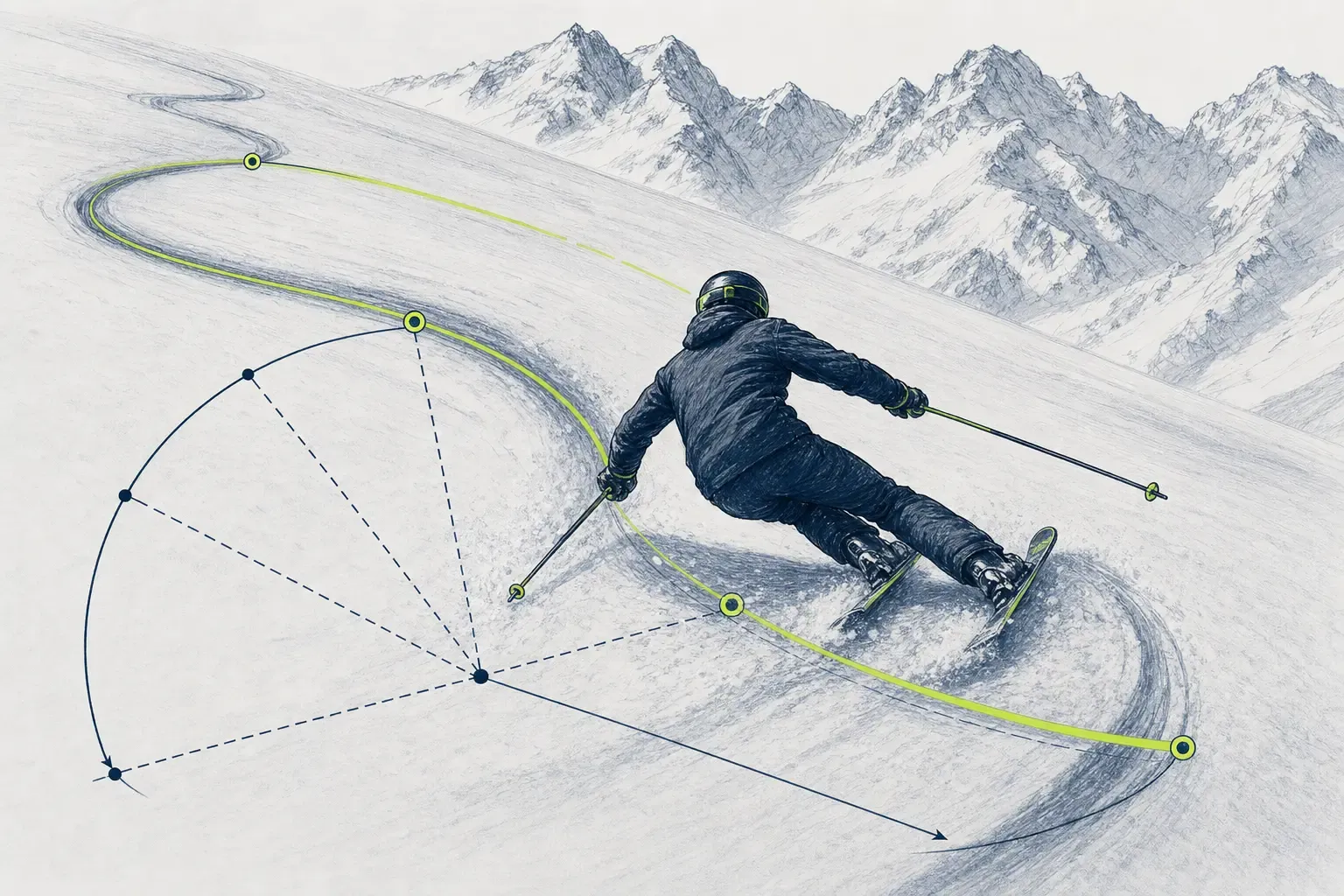
Turn radius, more precisely turn radius, expresses the degree of curvature of the skier's or ski's path. A smaller radius indicates a tighter turn, a larger radius a more open turn. It is given in meters.
A ski turn is usually not an exact part of a circle. Its curvature changes from the start through the fall line to the finish. It is therefore possible to speak of an instantaneous or local radius in a particular part of the turn, or of the average radius of the entire path.
Three different radii
When explaining the term, at least three quantities must be distinguished:
- ski sidecut radius is a geometric figure describing the ski's side shape,
- ski track radius describes the track along which the ski moves over the snow,
- skier center of mass path radius describes the movement of the body and does not have to be the same as the ski path.
FIS defines the sidecut radius as an approximation of the average radius that makes it possible to describe the ski's side profile as a whole. For racing skis, it is calculated from the specified length and widths of the ski measured at precisely defined points. It is therefore a property of the equipment, not a measurement of the turn the skier has just made.
A marking such as R 13 m on a ski therefore does not mean that every turn on that ski will have a radius of 13 meters. A skier can make bigger or smaller turns depending on the way the skis are guided and the conditions.
What affects the actual radius
In a carved turn, the edged and loaded ski bends and its edge creates a curved track. Simplified mechanical models show that a greater edging angle can allow a smaller radius of a carved turn. But the actual path also depends on the ski's longitudinal and torsional stiffness, pressure distribution, speed, slope angle, snow conditions, and possible sideways skidding. Measurements from slalom confirm the importance of ski geometry, but also show the limits of simple models, especially with strong edging and complex ski-snow contact.
In a skidded or mixed turn, the ski does not move only in the direction of its longitudinal axis. Turning the skis and their sideways movement make it possible to change direction even without clean edge guidance. The radius of the turn ridden therefore cannot be reliably derived from the sidecut radius alone. This also applies to the basic braking turn, where the change of direction combines with the skis' braking and turning effect.
At the same speed, a tighter turn usually places higher demands on balance, edging, and handling the forces acting between the skis and the snow. A larger turn can lead to a more open line and higher speed if the skier does not finish it sufficiently across the slope. Speed control is therefore determined not only by the radius, but also by the shape of the turn and the direction in which the skier is moving at the finish.
Children's skiing
Training practice: For a child, there is no single correct radius determined by age alone. The appropriate turn size depends on skiing level, speed, terrain, motor maturity, and the ability to keep balance. The goal is to gradually master small, medium, and large turns and to be able to adapt them to space and situation.
Practice should be carried out on a slope where the child does not need to use defensive movements out of fear or excessive speed. Wide and narrow corridors can be used, skiing in the coach’s track, or alternating larger and smaller turns on a clear slope. Recognized development methods emphasize the ability to change the size and shape of the turn and to carry out most technical learning on appropriately easy terrain.
The radius stated on a ski should not be the only criterion when choosing children’s skis. Length, stiffness, the child’s body parameters, technical level, and intended use are also important. A race ski that is too demanding may not allow the child to bend and control it properly, even if it has a suitable radius on paper.
Racing context
In a gate course, the required radius changes continuously depending on the distance and lateral offset of the gates, the slope gradient, speed, and the chosen line. Slalom usually requires shorter and quicker linked direction changes, giant slalom more open turns. Even a race turn is not usually a regular circle, and the smallest radius value may be reached only in a certain phase.
Rule context: FIS sets geometric requirements for competition skis, including sidecut radius. The specific limits depend on the discipline, category, gender, and the applicable seasonal update. Before using race skis, therefore, check the current FIS documents for the 2026/27 season and the relevant national rules; tables from older seasons cannot automatically be considered valid.
Research on six European Cup-level racers compared giant slalom skis with sidecut radii of 30, 35, and 40 meters. A larger sidecut radius was associated, in the observed part of the turn, with a larger radius of the ski and center of mass path and with a lower reaction force from the snow. The result describes a specific group of elite skiers and cannot be turned into a universal rule for children, but it does confirm that ski geometry affects its self-turning effect and the mechanics of the turn.
Typical misunderstandings
- The ski radius and the turn radius are not the same. The first describes the geometry of the equipment, the second the actual path.
- A smaller radius does not automatically mean better technique. Turn quality is assessed by balance, ski guidance, speed control, smoothness, and whether the intended goal is achieved.
- A carved turn does not have to keep the same radius all the time. Curvature can change with edging, pressure, and the skier’s position.
- The distance between gates is not the turn radius. The resulting path is also affected by lateral offset, the entry line, and the linking of neighboring turns.
- The tightest possible turn is not always the safest or the fastest. Conditions, speed, and the skier’s abilities are what matter.
Coach’s view
The coach does not only watch the size of the turn, but especially where and how the child changes direction. They evaluate the ski tracks, smoothness of the curve, balance, speed control, and the ability to change radius according to the assignment. With young skiers, versatility is more important than trying to force the smallest possible carved turn. Radius is a useful description of movement and equipment, not a goal of technique on its own.
Sources and further reading
- FIS – Alpine Skiing Documents: current rules and seasonal documents
- FIS – Specifications for Alpine Competition Equipment 2025/2026: sidecut radius definition and measurement
- Spörri, Kröll, Gilgien, Müller – Sidecut radius and the mechanics of turning
- Reid et al. – Alpine Ski Motion Characteristics in Slalom
- U.S. Ski & Snowboard – Athlete Performance Profile
- U.S. Ski & Snowboard – Alpine Guide to Ski Fundamentals: The Turn Model
- Sports Engineering – Mechanics of wedge turns in alpine skiing
- International Journal of Mechanical Sciences – Mechanics of a turning snow ski