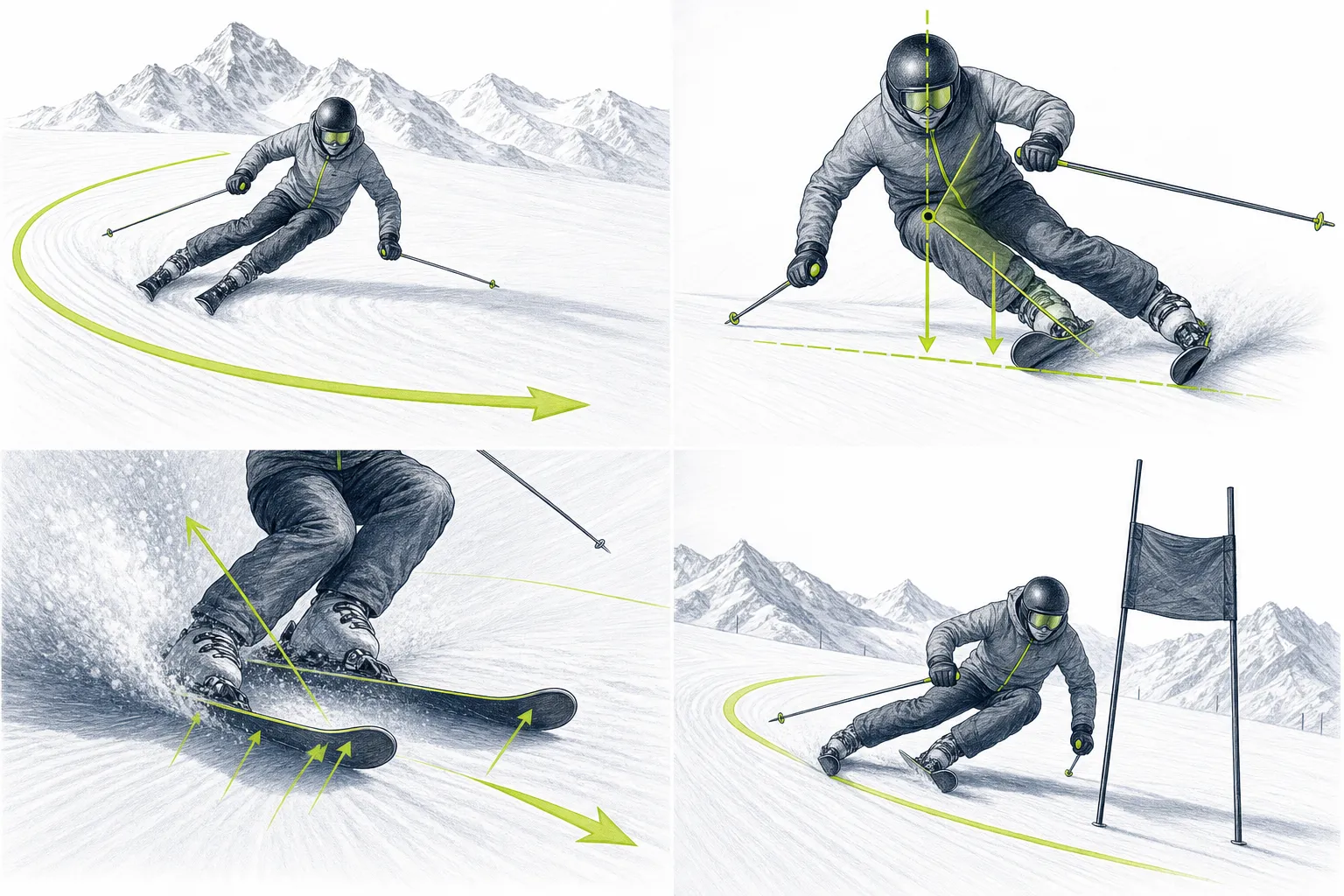
What is carving
Carving or cut turn is a turning method in which the skis move mainly along their edges and only minimally skid sideways. An edged and weighted ski bends into an arc; as it moves forward, it then follows a curved path carved into the snow by the edge. In ideal pure carving, the individual parts of the edge trace roughly the same track. In practice, however, there is a smooth transition between pure carving and controlled skidding.
A typical sign of a well-carved turn is two narrow, continuous tracks without noticeably disturbed snow. In soft, uneven, or broken snow, however, the appearance of the track alone may not accurately show what the skis were doing throughout the turn.
How a cut turn is formed
Verified technical fact: the path of an edged ski is influenced mainly by the following factors:
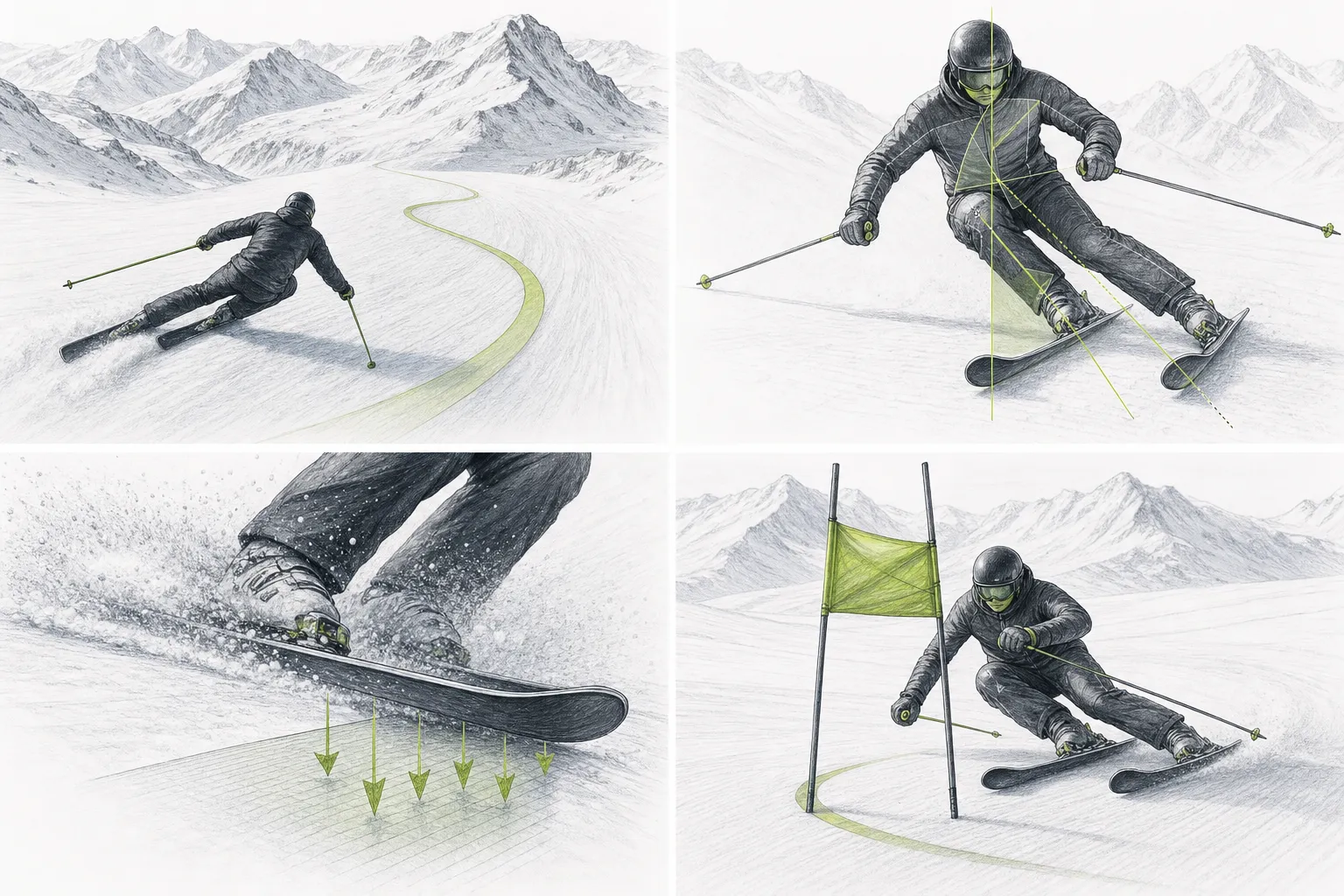
- Ski sidecut – the difference between the width of the tip, waist, and tail creates the geometric sidecut radius. A smaller radius usually means a stronger tendency for the ski to turn, but it is not an automatic guarantee of a short turn.
- Edge angle – the more the ski is tipped onto its edge and the more appropriately it is weighted, the more it can bend. The resulting relationship between angle, flex, and the actual radius is not a simple geometric equation in real snow.
- Pressure distribution – pressure changes during the turn both along the ski and between the outside and inside ski. The ski’s flex and its contact with the snow are therefore not the same throughout the whole turn.
- Speed, slope, and snow – the hardness and cohesion of the surface determine whether the edge holds its line or starts to slide sideways. At higher speed, the forces the skier must balance increase.
The radius stated on the ski is therefore not the radius of every turn. It is a geometric characteristic of the ski’s side shape. In its specifications, FIS describes it as an approximate average radius used to characterize the ski’s side profile and also sets out the method for measuring it.
Carving does not arise only from “tipping the knees,” either. The skier coordinates the release of the old edges, the movement of the center of mass, tipping the skis, pressure control, and appropriate steering of the skis. The movements come from the ankles, knees, and hip joints, while the torso helps maintain balance. Modern teaching methods therefore do not break good skiing down into isolated skills, but work with the interaction of edging, pressure control, and rotational movements.
Practical significance
A carved turn lets you guide your skis precisely and usually keeps more speed than a turn with noticeable sideways skidding. That is useful on groomed runs and in races, but carving is not a universal solution. Skidding is needed to control speed, change turn size, correct your line, move in a narrow space, or on a surface where the edges do not have enough grip.
A skilled skier therefore does not have to carve every turn without any skidding. The important thing is to know how to choose and change the amount of carving and skidding according to the terrain, space and intended speed. Race skiing research distinguishes carving and parallel skiing with skidding, while real race turns can contain both elements.
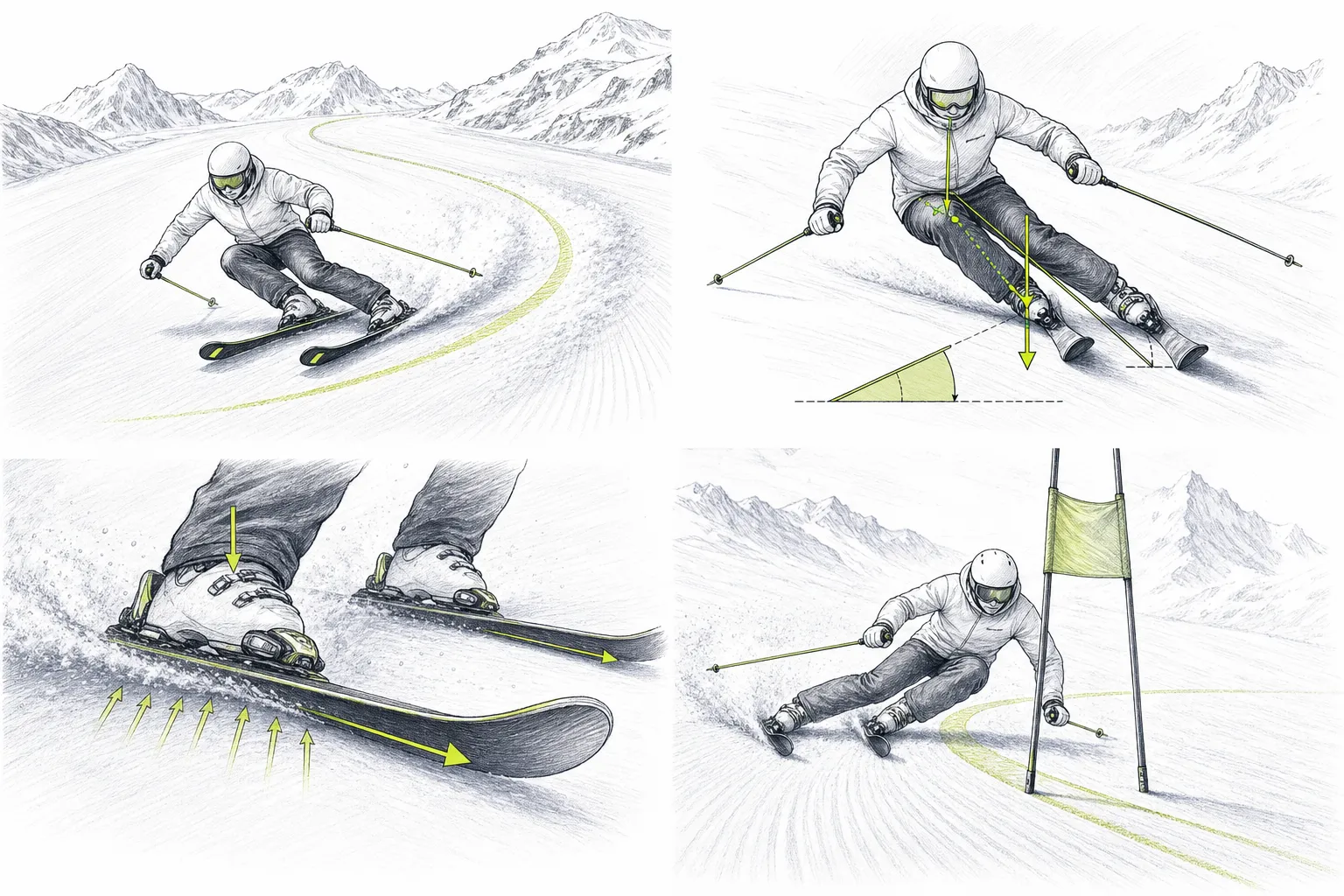
Carving in children
Training practice: for children, the first goal is not a big edge angle, touching the snow with the hand, or imitating the positions of adult racers. The prerequisites are balance, independent leg action, a reasonably parallel ski position, speed control and the ability to finish a turn safely.
The basic feeling of carving often develops on a gentle, wide and clear slope by simply tipping the skis from edge to edge. A coach may use traversing on a slight diagonal, turns with a small edge angle, or so-called rails, where the child follows clean ski tracks. The specific drill must match the child’s age, movement level, speed and conditions; not every child is ready for the same task.
Carving usually slows you less than a skidded turn, and the skis may travel strongly across the slope. Practice therefore belongs on an easy section with enough open space. Children’s skis should have the right length and stiffness and functional edges; unsuitable or neglected equipment makes learning harder. It is a good idea to consult a coach and a professional ski service when choosing skis and servicing the edges.
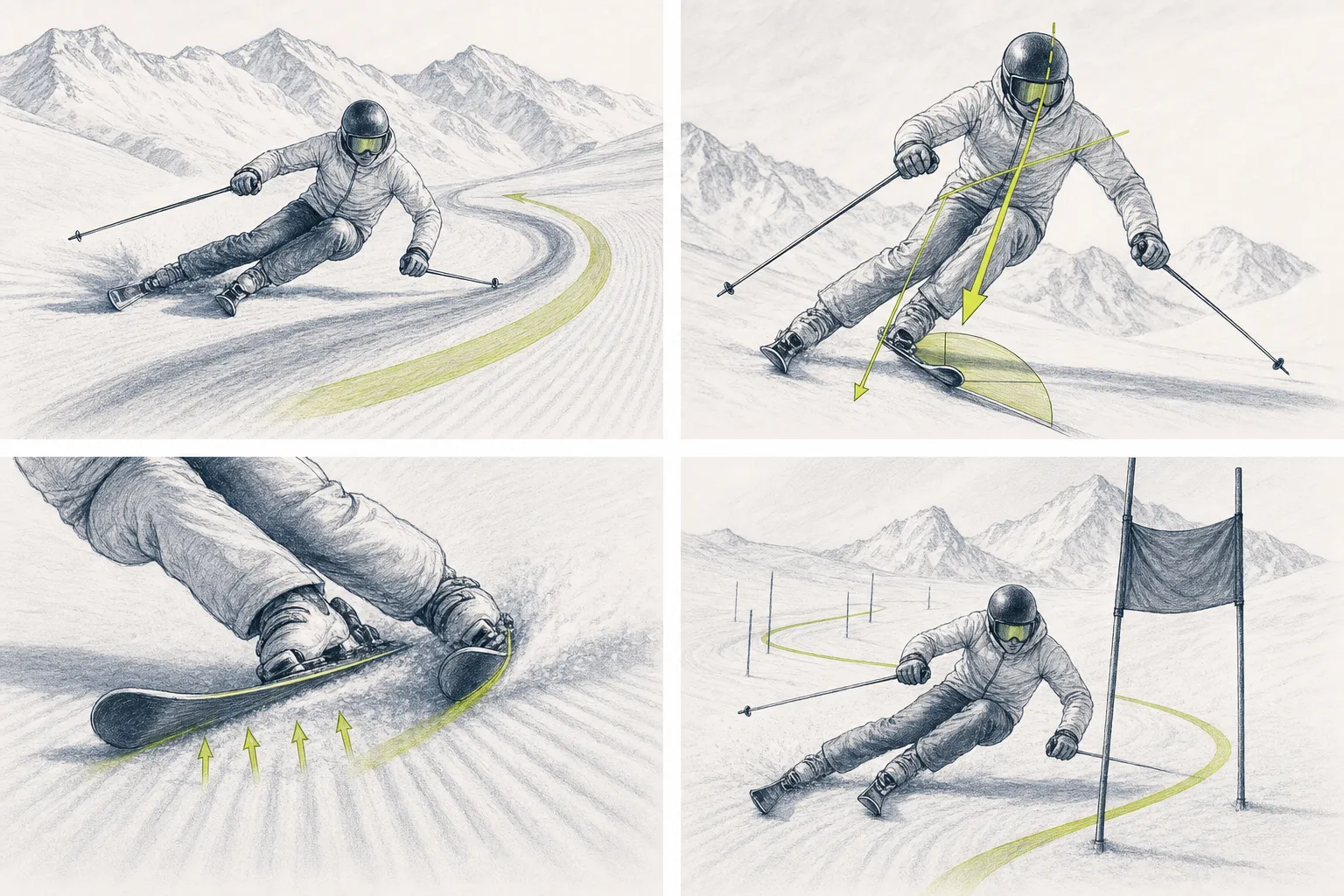
Carving in races
In race skiing, carving is a means of getting through the course quickly and precisely, not a body position for its own sake. A larger share of carving can limit speed loss, but the fastest run also depends on the line, timing, turn shape and the ability to prepare for the next gate. Especially in slalom, more active steering of the skis may be needed before the edge is set; even in giant slalom, not every part of the turn is equally clean.
Rule context: FIS sets the dimensions and radius of race skis by discipline, category and season. Current limits therefore must not be derived from the common label “carving ski” or from older tables. For the 2026/27 season, the valid FIS specifications and the relevant national rules must be used.
Most common misunderstandings
- “Just lean inside.” Excessive leaning without support on the outside ski often leads to loss of balance or loading the inside ski.
- “Carving means pushing your knees into the slope.” Isolated knee angulation does not replace the work of the ankles, legs and pelvis, or pressure control.
- “The bigger the angle, the better the technique.” The edge angle matters only together with speed, turn shape and the ability to hold the edge.
- “A good skier never skids.” Controlled skidding is a full-fledged tool for controlling direction and speed.
- "The ski’s radius determines the exact radius of the turn." The actual path also depends on camber, snow, pressure, speed, and the skier’s movements.
Coach’s view
The coach does not just watch for narrow tracks in the snow. They judge whether the skier starts the turn in time, changes edges smoothly, stays over the support ski, controls pressure, and can repeat the same quality without uncontrolled acceleration. For a child, quality carving is the result of foundations built step by step. If it appears only at high speed, with strong body angulation or without the option to shorten or skid the turn at any time, the technique is not yet mastered in a versatile way.
Sources and further reading
- FIS – Specifications for Alpine Competition Equipment 2026/27, page with current documents
- FIS – Specifications for Alpine Competition Equipment 2025/2026
- Alpine Ski Motion Characteristics in Slalom
- Technique-Dependent Relationship between Local Ski Bending Curvature, Roll Angle and Radial Force in Alpine Skiing
- Sidecut radius and the mechanics of turning in alpine giant slalom ski racing
- Effect of ski geometry on aggressive ski behaviour and visual aesthetics
- Recent Kinematic and Kinetic Advances in Olympic Alpine Skiing
- U.S. Ski & Snowboard – Alpine Training Systems
- Joint motion and reacting forces in the carving ski turn compared with the conventional ski turn