What is edge skiing
Edge skiing or edging is a way of guiding skis in which the skier tips the skis from their bases onto the side edges and uses their grip on the snow. With the edges, the skier controls the direction of travel, the amount of side slip, the shape of the turn, and braking.
Edge skiing is not a synonym for carving. In a pure carved turn the tail of the ski roughly follows the track of the tip and side slip is minimal. However, the edges also work in a drifted or skidded parallel turn: the skier uses them to control how quickly the skis move sideways. When the grip increases sharply at the end of the drift, we speak of setting or engaging the edges (edge set).
What affects edge grip
The result is not created by tipping the ski alone. It depends on the interplay of three components:
- edge angle – how much the ski is tipped relative to the snow surface,
- ski loading – where, when, and how smoothly the skier transfers pressure to it,
- ski guidance – the direction of movement, the rotation of the legs, and the chosen turn line.
Edge grip is also influenced by speed, snow hardness and unevenness, ski construction, its camber, and the condition of the edges. A greater edge angle therefore does not automatically mean a better turn. If the skier loses balance or loads the ski too suddenly, the edge may release, the ski may unexpectedly “bite” or change direction abruptly.
Tipping the skis results from coordinated movement in the ankles, knees, and hips together with an appropriate lean of the whole body. It is not correct to understand edging as forcefully pushing the knees inward. With greater edge angle, angulation between the lower and upper body helps maintain balance above the supporting ski.
An important part of the turn is transition between edges: releasing the old edges, briefly guiding the skis closer to the bases, and smoothly setting the new edges. The timing depends on speed, slope, discipline, and the desired turn shape.Edge skiing – technical illustration of Ski Loko
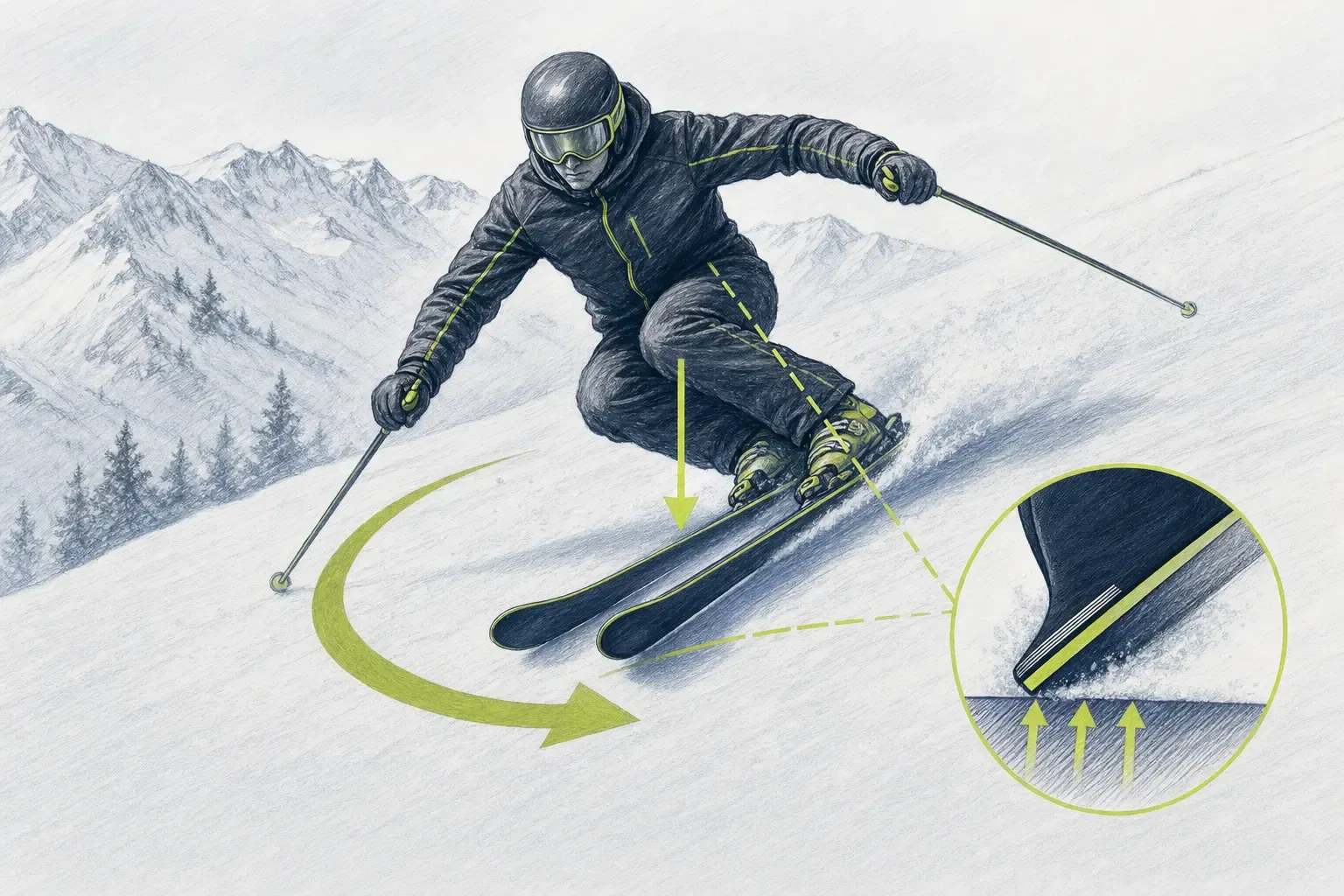
In children, edging develops gradually. First, they need to feel the difference between skiing on the bases, slightly edged skis, and controlled sideslipping. In training practice, for example traverses, garlands, alternating sideslipping and edge engagement, or turns within a marked wide corridor are used.
The terrain should match the age and skill level of the skier. On a gentle, open slope, a child can try movements without increasing speed forcing them into a defensive stance. A clean carved turn generally preserves more speed than a turn with pronounced skidding, so carving cannot be considered automatically safer or the only correct goal.
The coach mainly watches the fluidity of movement, balance, symmetry of right and left turns, and the ability to change the amount of edge engagement. Useful information comes from the ski tracks, the amount of snow thrown off, the sound of the edges, and whether the child can deliberately lengthen or shorten a turn or move into controlled skidding.
Race significance
In alpine disciplines, edging is a technical means, not a separately scored element. The result is determined by time and correct passage of the course according to the current FIS rules. A racer therefore does not seek the greatest possible edge angle in every situation, but the amount of grip that matches the line, gate spacing, surface, and speed.
Clean edge-based skiing can limit unwanted braking, but race skiing also includes deliberate edge release, directional correction, or a short skid. In slalom, giant slalom, and speed disciplines, the ratio of these elements differs. In FIS freestyle moguls, carving is directly described as efficient, clean use of the edges with minimal skidding.
Typical mistakes and misconceptions
confusing every edge-based run with carving,
- forcing the knees outward instead of coordinating ski angulation,
- letting the whole body fall inward without enough support,
- sudden and delayed edge catch,
- trying to keep the skis at a high angle all the time regardless of the line and speed,
- training on a slope that is too steep, too hard, or too crowded.
- The condition of the edges significantly affects ski behavior. Damage, improper tuning, or servicing, however, belongs in the hands of qualified technicians; training advice does not replace the manufacturer's instructions or expert assessment of equipment.
Related terms
- FIS – International Freestyle Skiing Judging Handbook, Carving section
- FIS – Alpine Skiing Documents and current International Competition Rules
- FIS – Moguls 101: Understanding Moguls and Dual Moguls
- U.S. Ski & Snowboard – Straight Run to Sideslip to Edge Set with Pole Plant
- U.S. Ski & Snowboard – Level 100 Updates: Carving & Transitions
- U.S. Ski & Snowboard – Alpine Resources: Pocket Guide and Coaching Dictionary