What a parallel turn is
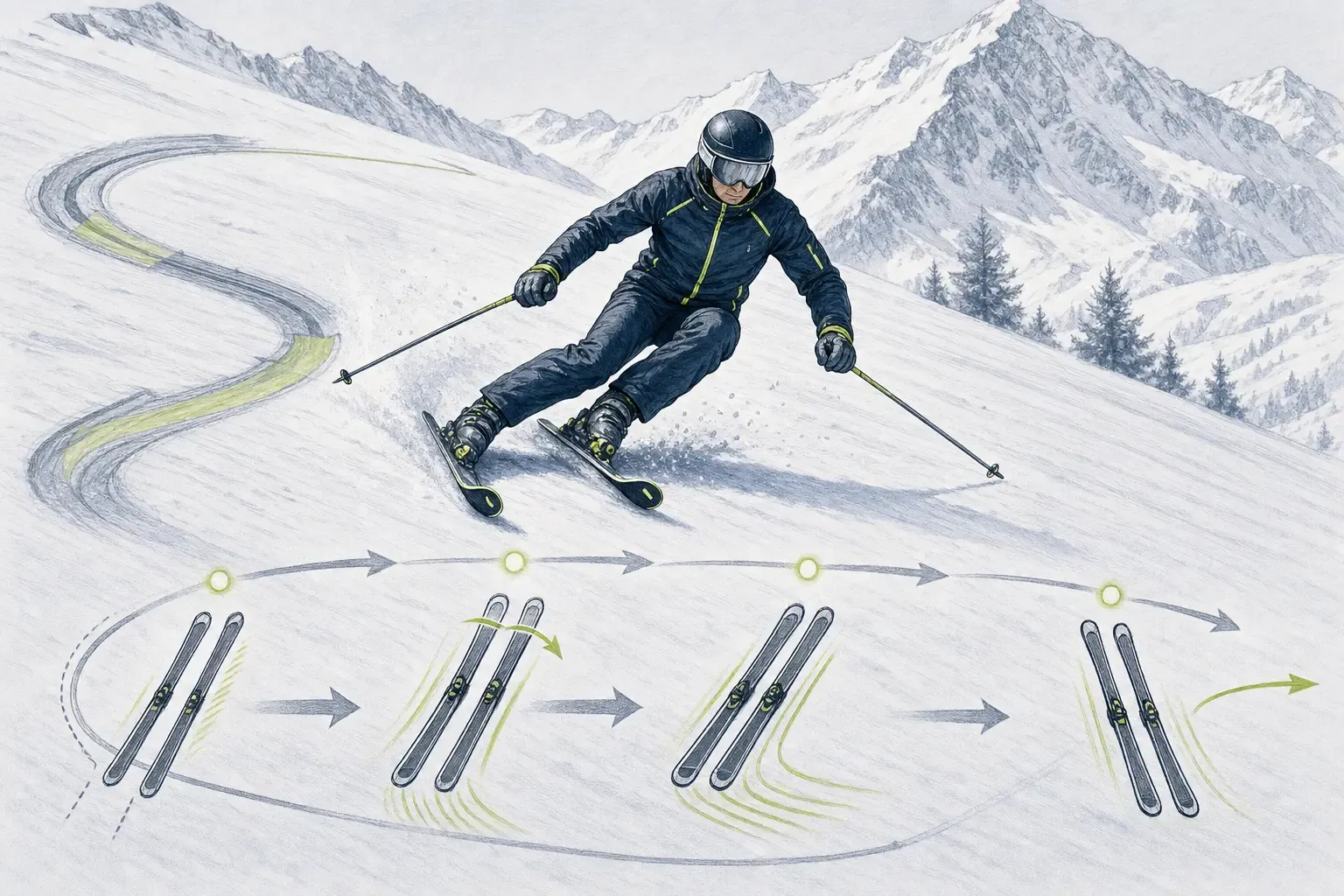
Parallel turn is a change of direction in which both skis enter the new turn together and remain approximately parallel. Unlike a wedge turn, the ski tips are not deliberately brought together into a V shape. In the basic demonstration, the skis tilt and turn at roughly the same time and in the same rhythm, while keeping an appropriate distance apart.
The word parallel mainly describes the position of the skis relative to each other, not the way their edges leave a track in the snow. A parallel turn can therefore be done with a skidded turn, a partially carved turn, or, at suitable speed, slope, and technique, mostly as a carving turn. The claim that every parallel turn is a carving turn is incorrect.
How a turn is created
For a practical explanation, the parallel turn can be divided into the transition between turns, the start of the new turn, its guidance, and the finish:
1. Transition and release of the old edges. The skier gradually reduces edging and pressure from the previous turn. The body’s center of mass moves over the skis’ support area toward the new turn. 2. Starting the turn. The feet and lower limbs tip and guide both skis into the new direction. The movement does not come only from the shoulders or from a sudden twisting of the upper body. 3. Guiding and shaping. As edging and pressure increase, the skis turn. A greater part of the effective pressure usually goes to the outside ski, while the inside ski stays guided and active. 4. Finishing. The skier uses the shape of the turn to control direction and speed and prepares for the next edge release.
Modern teaching methods describe skiing as a changing combination of balance, turning the skis with the legs, edging control, and pressure management. The ratio of these actions changes according to the slope, snow, speed, turn radius, and the intention of the run; it is not a single fixed movement pattern.
It is important that the skier does not stand rigidly. The ankles, knees, and hips adapt to the forces and the terrain, while the legs may flex and extend differently. A relatively calm and stable torso creates the conditions for more precise work by the lower limbs. In a basic parallel turn, the movement should be smooth and the speed should be controlled mainly by the line and rounded shape of the turns, not by repeated sudden braking at the end of them.
Parallel turn in children
The transition to parallel turns cannot be tied to one exact age. What matters is the level of balance, coordination, speed control, confidence on the given slope, and the ability to release and guide both skis. A child who is afraid on steeper terrain or speeds up without control often uses a wedge turn for help even when they can already ski parallel on an easy slope.
In training practice, the first parallel turns are developed on clear, groomed, and suitably gentle terrain. Smooth linked turns with enough space and a speed at which the child does not have to fight for balance are useful. The PSIA method also places the basic parallel turn on easy to moderately easy groomed terrain and emphasizes speed control through turn shape.
At the same time, wedge is not a mistake that must be eliminated immediately at any cost. It can be a purposeful way to control speed or an intermediate stage in which the child gradually brings the inside ski alongside the outside ski. On the other hand, not every child has to go through exactly the same sequence: suitable shaped skis, good balance, and appropriate terrain may allow earlier joint steering of both skis. The coach's job is to choose the approach for the specific skier, not to force visually parallel skis at the expense of losing control.
Using poles is not the essence of the parallel turn. A pole touch can later support rhythm, upper-body stability, and timing of the transition, but for younger children or first attempts it may not be the priority.
Most common mistakes and misunderstandings
- Forcing the legs together. Skis can be parallel even with a natural stance. Riding with the knees and ski boots pressed together limits balance and independent leg action.
- Turning the whole body into the turn. A sharp shoulder rotation often throws the skier off balance and makes precise edging harder. The skis should be guided mainly by the movement of the legs under a more stable torso.
- Leaning back. If the skier stays behind the feet, the ski tips become light and the start of the next turn is often delayed or jerky.
- Overloading the inside ski. Too much support on the inside ski can worsen balance and make it harder to guide the outside ski. The goal is not to lift the inside ski, but to direct pressure appropriately to the outside ski.
- Hard braking at the end of every turn. A big skid across the slope may briefly reduce speed, but it disrupts smooth linking. Better control comes from a suitably chosen line and gradual shaping of the turn.
- A slope that is too demanding. A technique learned on gentle terrain may not automatically hold on a steep slope, on ice, or in uneven snow.
The coach's view and racing context
The coach does not judge a parallel turn only by whether the skis appear to run side by side. The main focus is smooth transition, speed control, balance over the skis, timing of edge release, steering of both the outside and inside ski, and the ability to adapt the turn to the terrain.
In racing skiing, parallel ski steering is a technical foundation, not a self-purpose aesthetic position. In dynamic skiing, the stance width, edge angle, pressure distribution, and the length of contact between the individual skis and the snow all change. What matters is the effectiveness of the movement: holding the chosen line, working the edges, regulating pressure, and flowing smoothly into the next turn. That is why the basic school parallel turn is used mainly as a starting point from which good movement habits can be observed and developed.
Sources and further reading
- PSIA-RM – Integrating Fundamentals: Wedge, Wedge Christie, Basic Parallel and Dynamic Parallel Turn
- PSIA-RM – Alpine Assessment Guide 2025–2026
- INTERSKI International – Educational Hub
- PSIA-AASI – How to Apply Pressure Control in the Bumps
- PSIA-AASI – Off-Piste Edge Control
- PSIA-AASI – How Foot-to-Foot Movement Aids Turn Transitions
- PSIA-RM – The Return of the Center Line
- PSIA-RM – Alpine Curriculum Catalog 2025–2026