What is a snowplough
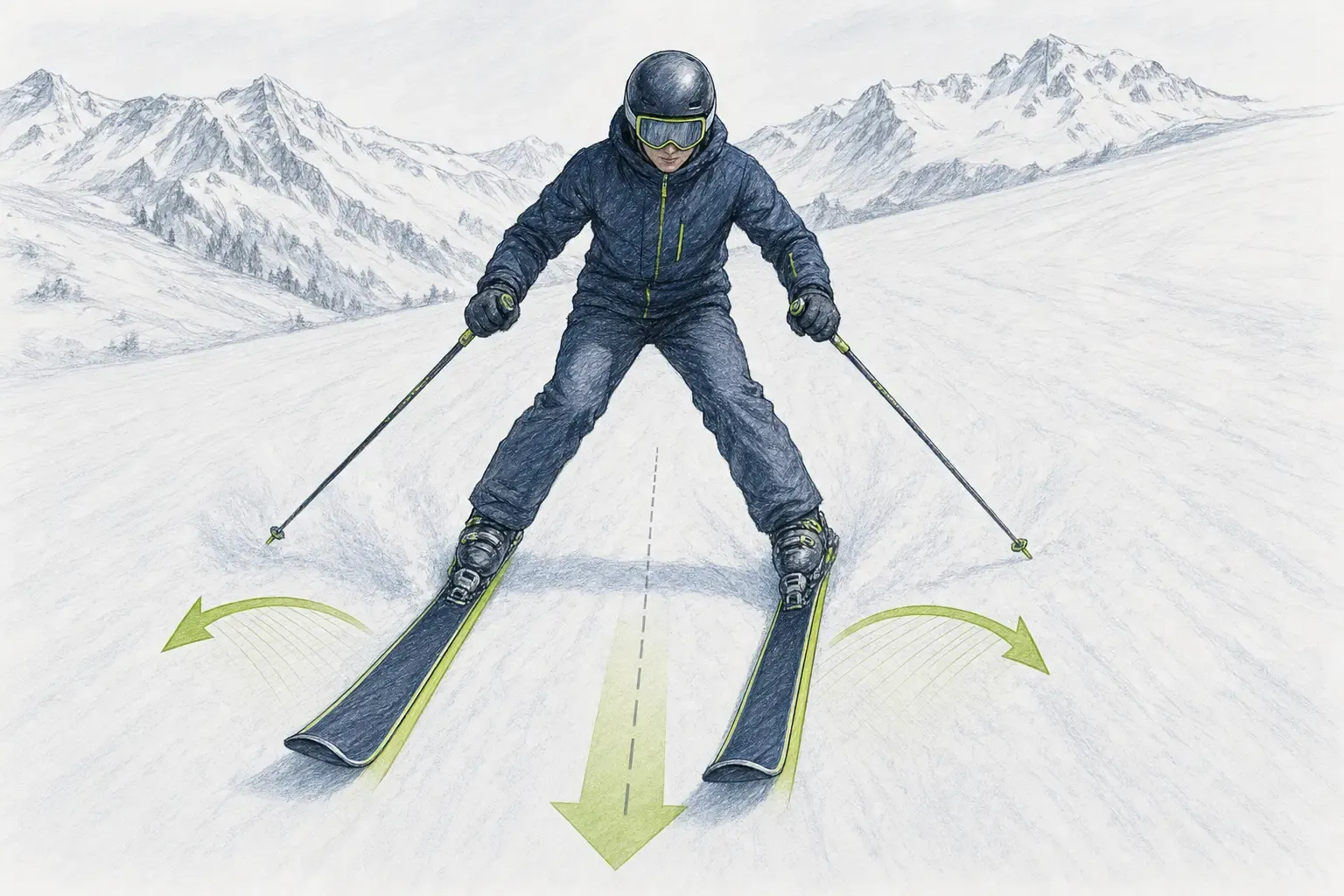
Snowplough is a ski position where the tips are closer together and the tails are farther apart. From above, the skis form the shape of a V opening toward the back. The tips should not touch or cross. Both skis are guided on opposite edges, meaning the inside edges; the amount of edging depends on whether the skier mainly wants to glide, brake, or turn.
A snowplough refers to the relative position of the skis, not a rigid position of the whole body. The skier should stay balanced above the support area between the feet, with ankles, knees, and hips flexed and springy. The upper body is calm and naturally oriented in the direction of travel.
Gliding and braking snowplough
In a gliding snowplough the skis are opened only slightly and edged at a small angle. The skier moves forward with only a small braking effect. This form helps a beginner get used to gliding, keep balance, and prepare for a change of direction.
In a braking snowplough the skier increases the skis’ resistance to the snow by controlled opening of the tails and more effective edging. But a very wide stance alone still does not guarantee good braking. Edge contact with the snow, appropriate pressure, and a balanced position are important. An overly wide snowplough is tiring, limits leg movement, and can lead to leaning back.
When skiing straight downhill, a snowplough is used to slow down or stop. In linked turns, however, speed should not be controlled only by constantly making the snowplough wider. Ski teaching methods especially emphasize speed control through the shape of the turn: the more the skier completes the turn across the slope, the more effectively speed is reduced without forceful braking.
How a turn in snowplough is created
The snowplough is created by leg movement: the skis turn and their tails move farther apart. The movement should come mainly from the hips and legs, not from forcefully pushing the knees inward. The upper body stays stable and should not start the turn with a sudden rotation of the shoulders.
In a snowplough turn both skis are guided into a new direction. Their edging and pressure distribution also change: the outside ski gradually provides more support, while the inside ski remains active and continues turning. The goal is not to shift all the weight onto one ski with a jump, but to guide both skis smoothly and keep balance.
A good snowplough turn has a clear shape, appropriate and even speed, and a smooth connection to the next turn. The snowplough does not have to be equally wide throughout the whole run, but it should not open and close sharply without purpose.
Wedge turn in teaching children
The wedge turn is one of the basic skills in children's skiing because it allows a child to slow down, stop, and choose a direction independently. Swiss teaching materials include it already at the first level together with gliding, climbing, and simple turning.
There is no universal age at which a child must master the wedge turn or move beyond it. Learning speed is influenced by balance, the ability to move the legs independently, awareness of the body, understanding of the task, fatigue, and previous movement experience. Some children look at their skis while forming the wedge because they still cannot reliably feel the position of their feet without visual control. The coach therefore uses short, easy-to-understand tasks and gradually brings the child's attention back to the direction of travel.
Practice belongs on a gentle, wide, clear slope with a safe run-out. The terrain must allow the child to slow down even without great muscular strength. A slope that is too steep often leads to a wide, tense wedge, leaning back, and fear. This is not proof of a lack of courage, but a sign that the task or the terrain is not appropriate for the current level.
The transition to parallel ski tracking does not need to be rushed just because the wedge seems beginner-like. At the same time, it is not appropriate to keep a child in a wide wedge longer than needed. Once they can control direction, speed, and balance, the coach gradually narrows the wedge and creates conditions for the skis to come naturally closer together.
Racing and training context
The wedge is not a target technique in competitive skiing. In training practice, however, it can serve as a simple exercise for turning the legs, feeling the edges, smooth pressure distribution, and controlling the shape of the turn. Even a more experienced skier can use it to show whether they can guide both skis without excessive upper-body rotation or forcing one side more than the other.
Using the wedge in training is a methodical choice, not a racing rule. The exercise must have a clear purpose and suitable terrain; mindless repetition of a wide wedge does not develop the dynamics needed for parallel and racing turns.
Typical mistakes
- too wide, tense wedge,
- bringing the ski tips together or crossing them,
- leaning back and pressing the calves against the back of the boots,
- forming the wedge by pushing the knees inward,
- starting the turn by rotating the shoulders instead of guiding the skis with the legs,
- sudden shifting of weight from one ski to the other,
- controlling speed only by making the wedge wider,
- practice on a slope that is too steep or too crowded.
Coach's view
The coach does not assess only whether the skis form a proper V. They mainly watch the result: balance, direction of movement, smoothness, edging, the shape of the turns, and the ability to stop safely. The instruction is adapted to the specific cause of the mistake. For one child the wedge needs to be smaller, for another the leg movement needs improvement or a gentler slope should be chosen.
The wedge has done its job when it gives the skier control without blocking further progress. It is a starting point for independent skiing and parallel turning, not a test with only one required body position.
Sources and Further Reading
- PSIA-RM Alpine Assessment Guide 2025–26
- PSIA-RM Individual Development Plan – Skiing, updated in November 2025
- PSIA-RM Alpine Level 1 Training and Development Guide
- Swiss-Ski and BASPO – Kids on Ski and Snowboard
- Swiss-Ski – Children's Sports
- PSIA-RM – Psychomotor: What The Heck is That?
- Swiss-Ski – Alpine Teaching Materials