What transition is
Transition is the movement phase that connects two consecutive ski turns. In it, the skier gradually releases the edges from the finishing turn, the skis pass through a zero or very small edge angle, and then tip onto the opposite edges. At the same time, the pressure distribution between the skis changes and the skier’s center of mass moves from the inside of the old turn to the inside of the new turn.
In biomechanical research, the narrower term turn change or turn switchis often used. It may refer to a specific moment, for example the edge change, the minimum ski load, or the crossing of the center of mass projection with the average ski path. A coach, however, usually sees transition more broadly: as the short phase from releasing the forces of the old turn to creating effective support in the new turn. Different coaching methods and measurement systems therefore may not define the start and end of transition in the same way.
Transition should not be confused with the long-term move of a child from wedge turns to parallel turns. In this entry, it means the transition between individual turns.
What changes during transition
At the end of a turn, the resulting force acts mainly through the outside ski and the skis are edged toward the turn. To begin a turn to the opposite side, the skier must reduce the edge angle, appropriately release pressure, and allow the legs and skis to move onto the new edges. The original outside ski then becomes the inside ski of the new turn, and the original inside ski becomes the new outside ski.
It is not just a simple “weight transfer.” Pressure under the skis depends on the skier’s movement, the shape of the line, speed, slope angle, and the snow’s reaction forces. During transition, the load is often reduced and then rebuilt toward the new outside ski. A quality transition therefore combines three tasks:
- release the support and edges of the old turn,
- move the skis and body through the neutral area between turns,
- prepare balance, edging, and pressure for the new turn.
Basic movement solutions
In transition with extension the legs extend more while moving between turns, and the center of mass also moves upward. This solution can make it easier for the skier to unload the skis and change edges, but too much extension leads to loss of contact with the snow or a delayed start of the next turn.
In transition with flexion, also called retraction or cross-under, the skier releases the old turn by flexing the legs and lets the skis pass under the body. The vertical movement of the center of mass is usually smaller. In practice, the two methods overlap, and their use depends on the turn radius, speed, terrain, the forces acting on the skier, and the intended line. There is no single transition suitable for every situation. Research also suggests that a strongly flexed transition may be more demanding on the muscles than a more upright solution.
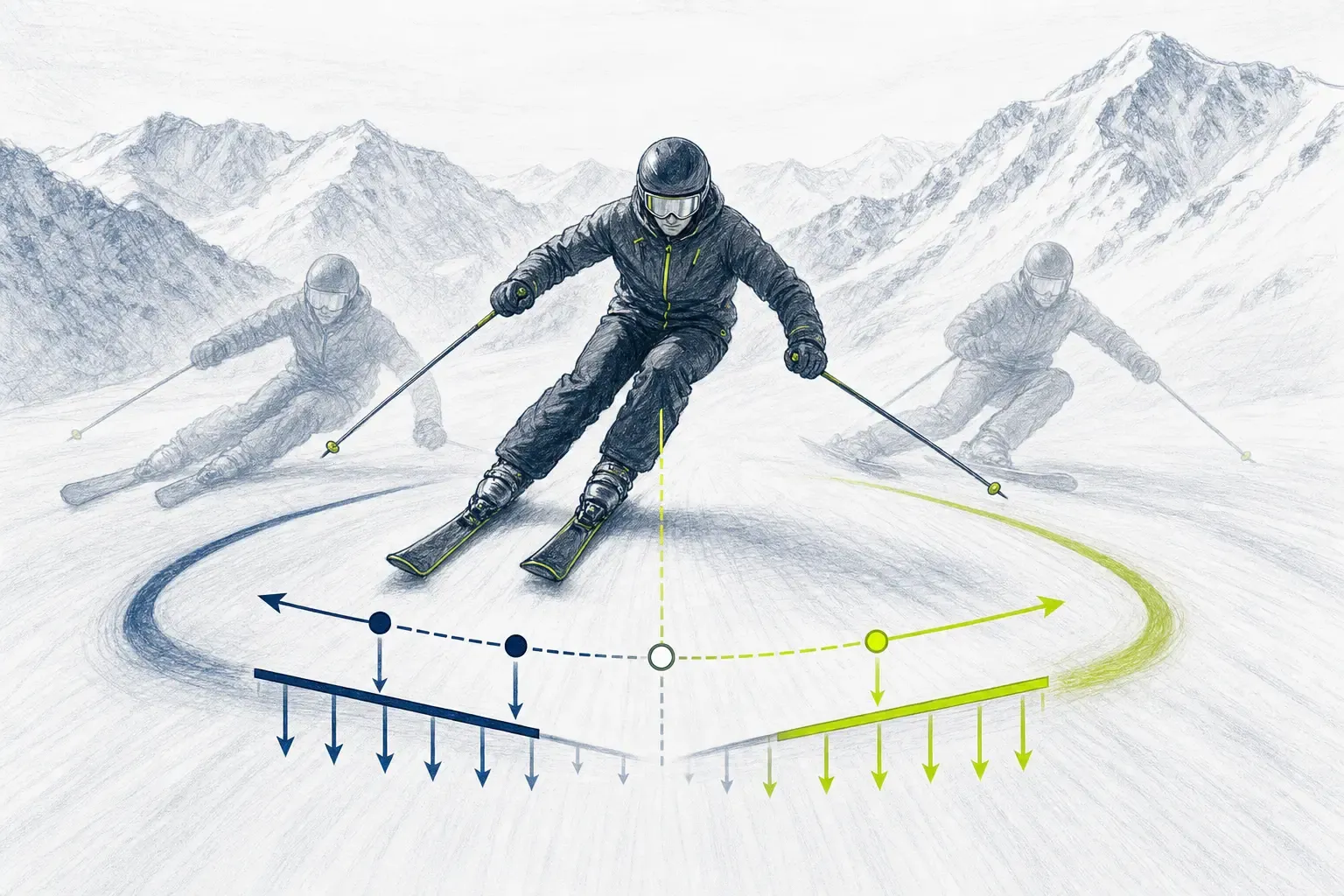
Term cross-over describes a situation in which the center of mass moves above the skis toward the new turn. In cross-under the skis pass more noticeably under the body. These are useful descriptions of the dominant movement, not two completely separate techniques.
Importance for children's skiing
A beginner in a snowplow does not need the edge change to be as visible as a skier in parallel turns. The transition may show mainly as a gradual release of one turn, a change in ski direction, and the creation of support for the turn to the opposite side. As skill increases, the leg movements become more independent, the edge change is more precise, and the transition can be shorter and more dynamic.
For children, smoothness, balance, and control of direction take priority over copying an extreme racing stance. Appropriate exercises are chosen according to motor skill level, terrain, and the child's current confidence, not just age. On a gentle slope, the focus can be on smoothly linking turns, gradually releasing the edges, and feeling support under the new outside ski. Fast retraction movements or practicing a pronounced push-off between turns are not universal exercises for every child.
Transition in racing skiing
In racing, the transition significantly affects the line and the timing of the next turn. Research in giant slalom identifies the straight section between two turns as the space where the racer can accelerate, open the trajectory, or shorten the path. The shortest or fastest transition is not automatically the best one, however: it must allow the next turn to be set up correctly with regard to gate placement, slope, terrain irregularities, and current speed.
In slalom, the transition is usually very short in time, while in a longer turn the neutral or more direct phase may be more noticeable. The racer uses the energy stored in the bent ski, but must regulate it so as not to be thrown backward, upward, or outside the planned line.
Typical mistakes and misunderstandings
- Staying on the old edges: the skier finishes the turn for too long, and the new turn has to start with a sudden movement.
- Jumping upward: too much extension unloads the skis more than the situation requires and can delay contact of the new edges with the snow.
- Falling into the new turn: the upper body moves inward before there is usable support on the new outside ski.
- Backseat: the feet and skis drift ahead of the body, and the skier has trouble controlling the front of the skis.
- Upper-body rotation: the new turn is initiated by a sharp twist of the upper body instead of coordinated leg action and edge change.
- Pause between turns: the skier perceives the transition as a static position, even though it is a continuous movement.
- Trying to find one “correct” position: the transition is an action, and its form changes depending on the task; it cannot be judged from a single photo.
Coach’s view
In the transition, the coach does not watch only the moment when the skis are flat. They assess whether the old turn has released without unnecessary braking, whether the skier stayed balanced, how the pressure changes between the legs, and whether the new outside ski can be loaded early and appropriately. Important signs are rhythm, smooth movement of the center of mass, a calm and functional upper body, and continuity with the intended line.
A good transition is not necessarily the fastest or the lowest possible. It is one that allows the skier to move safely and efficiently from one turn to the next without loss or compensatory movements.
Sources and further reading
- The EMG, NIRS, and RPE responses to two turn transition techniques in alpine skiing
- A Comprehensive Comparison and Validation of Published Methods to Detect Turn Switch during Alpine Skiing
- PSIA-Rocky Mountain – Integrating Fundamentals, Skiing Standards (2025)
- Kinetic analysis of ski turns based on measured ground reaction forces
- Influence of Line Strategy Between Two Turns on Performance in Giant Slalom
- Development of an Automatic Alpine Skiing Turn Detection Algorithm Based on a Simple Sensor Setup
- Course setting and selected biomechanical variables related to injury risk in alpine ski racing
- U.S. Ski & Snowboard – Athlete Performance Profile