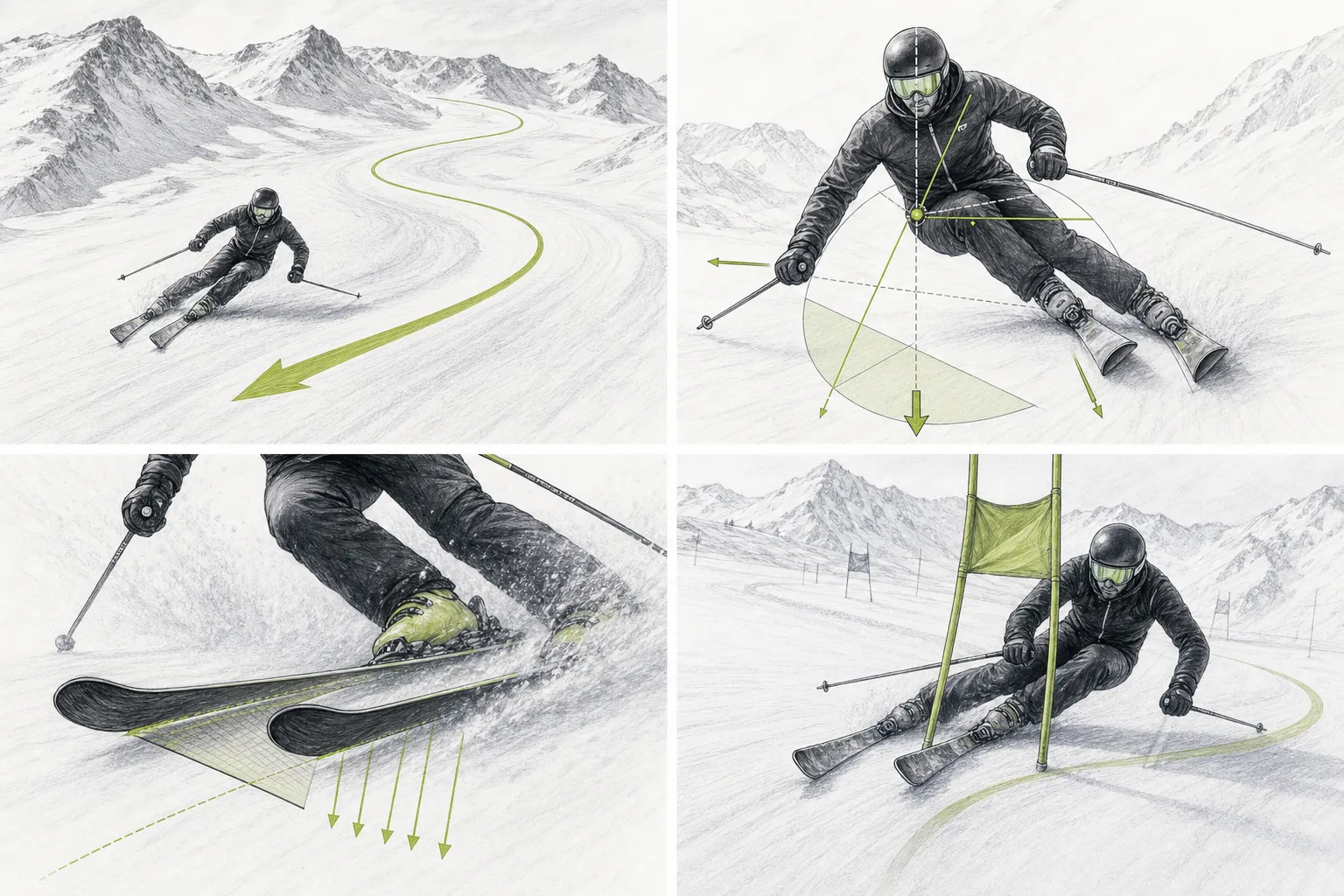
What is a turn
A turn is a controlled change of direction on skis. It is created by the forces between the skis and the snow, which the skier influences mainly by changing edge angle, ski direction, and pressure distribution. These components do not occur separately in a real turn: they complement one another, and their importance changes depending on speed, slope, terrain, and the skier’s intent.
A turn is not only for changing direction. It is also the main means of choosing the line and regulating speed. A more closed line, ending more across the slope, usually limits acceleration down the fall line. Skidding also dissipates part of the movement energy. A clean carved turn, however, can preserve speed well, so carving cannot automatically be considered a way of braking.
How a turn is created
From a methodological point of view, a turn can be divided into the transition between turns, the initiation and the lead-up to the finish. Other teaching methods use slightly different names or phase boundaries. This is not a FIS rule, but a guide for describing smooth movement.
- In the transition the edge angle of the old turn decreases, pressure distribution changes, and the body and skis move into the new turn.
- At the initiation the skis take on a new direction and the new edges begin to create support on the snow.
- In the lead-up the skier continuously adjusts the edge angle, ski direction, and pressure in order to achieve the required shape of the line, speed, and stability.
Research and coaching methods therefore describe a turn as a process, not as a single body position. Pressure under the skis changes during it and is created not only by consciously extending or bending the legs, but also by the influence of speed, the curvature of the path, the slope, and the reaction of the surface.
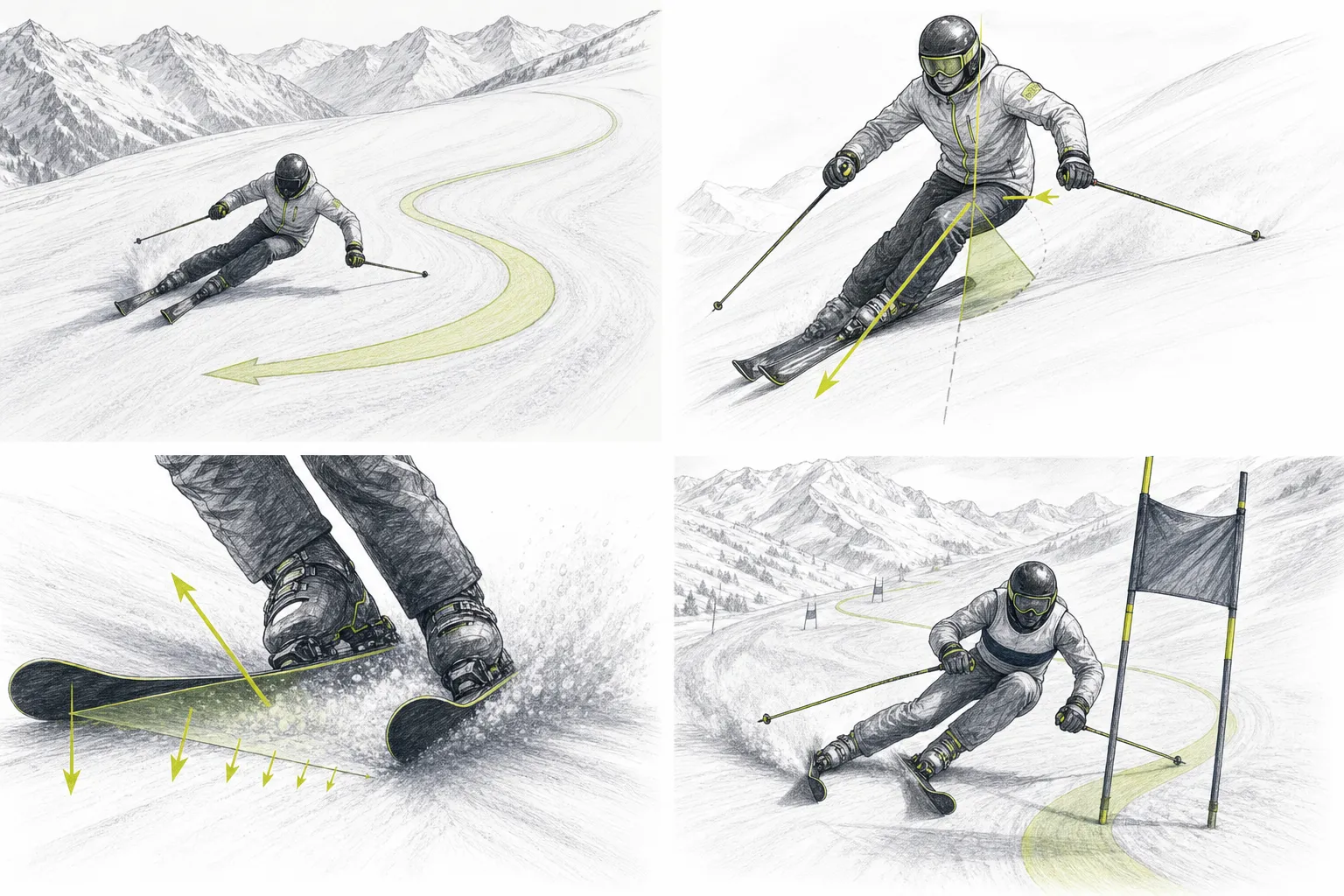
The radius of a real turn is determined by more than the number stated on the ski. Sidecut affects the ability of an edged and bent ski to turn, but the resulting line also depends on edge angle, ski camber, side slip, speed, pressure, and snow conditions. Two runs on the same ski can therefore have a very different radius.
Basic types of turn
The snowplough turn is performed with the skis in a wedge position. It allows a beginner to change direction and regulate speed at low speed. It is not just a “faulty parallel turn,” but a separate and commonly used part of introductory instruction. Mechanically, it uses the skis’ direction relative to the direction of movement, edging, and different pressure on each ski.
Parallel skidding or guided turn It is performed with skis roughly parallel, which, relative to their longitudinal axis, also move partly sideways. The amount of skid can be adjusted as needed. Such a turn is useful on steep, narrow, hard, or uneven terrain, and everywhere a quick change of direction or speed is needed.
Carved turn (carving) It occurs when a ski on edge and bent into an arc leaves a track with only a small sideways skid. The tip creates a groove that the rest of the ski more or less follows. Even in sport skiing, however, the goal is not to carve every turn in every condition.
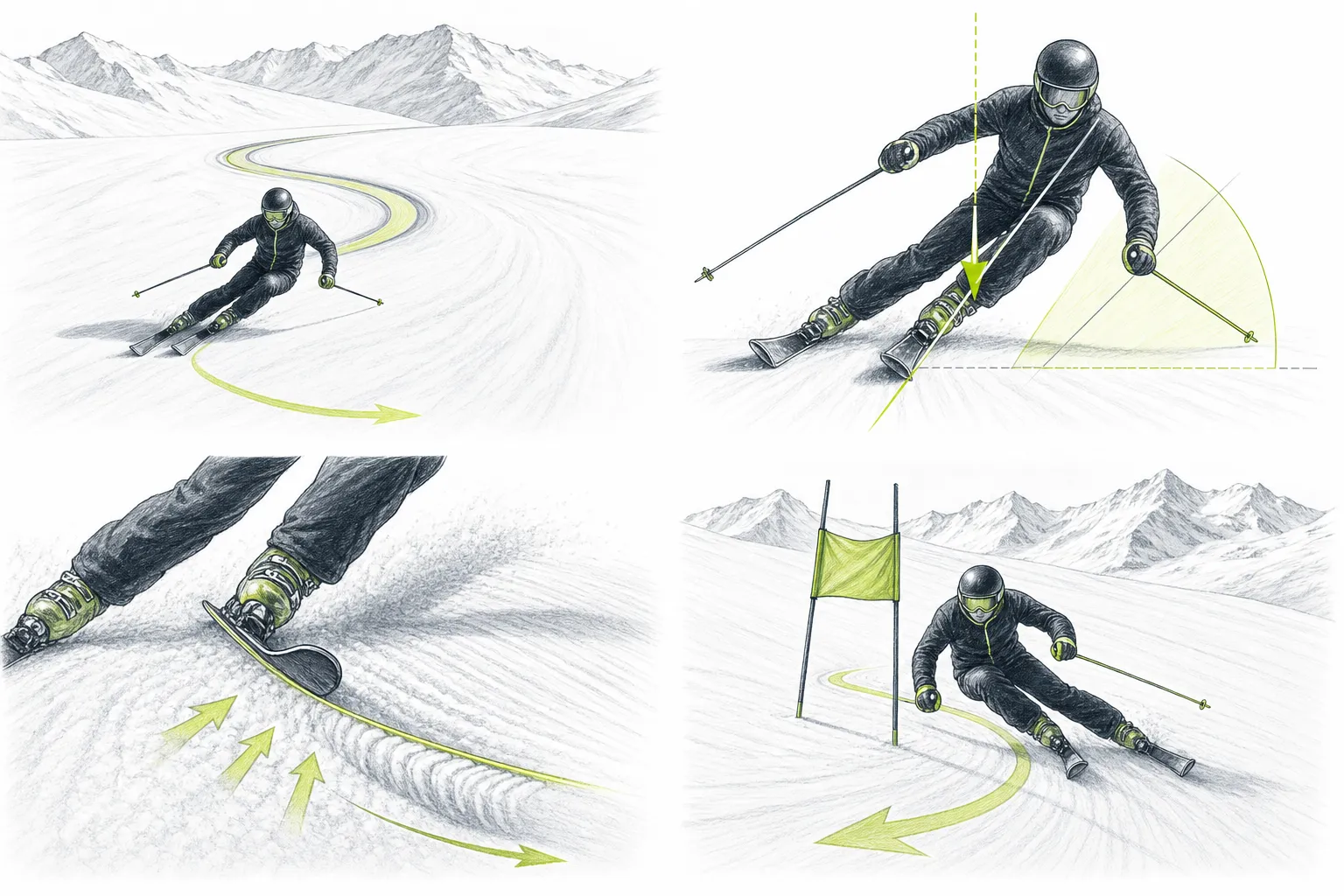
Turns are also described by length and shape as short, medium, or long, or as open and closed. These names mainly express the shape of the track and the rhythm of skiing; outside a specific teaching method or race rules, they do not represent universal fixed radii.
Turn in children
For a child, the quality of a turn is not judged only by whether the skis are parallel or whether they leave two clean tracks. What matters is whether the child can choose direction independently, link turns together, regulate speed appropriately, and react to the terrain and other skiers.
A wedge turn may be an appropriate solution until the child gains the necessary balance, orientation, and ability to work independently with the legs. The transition to parallel skiing should not be tied to a single age or forced just because of the appearance of the skiing. What matters is the readiness of the individual child and safe handling of the task. The development of skiing skills should progress from varied basic movements to more precise control of edging, direction, and weighting.
Training practice: The coach can change the width of the corridor, the spacing of the markers, the slope of the run, and the required track shape. In this way, the child learns to vary the turn according to the task instead of mechanically imitating one position. The difficulty of the terrain and the speed must match the child’s current level; a universal movement cue is not suitable for all children.
The turn in racing skiing
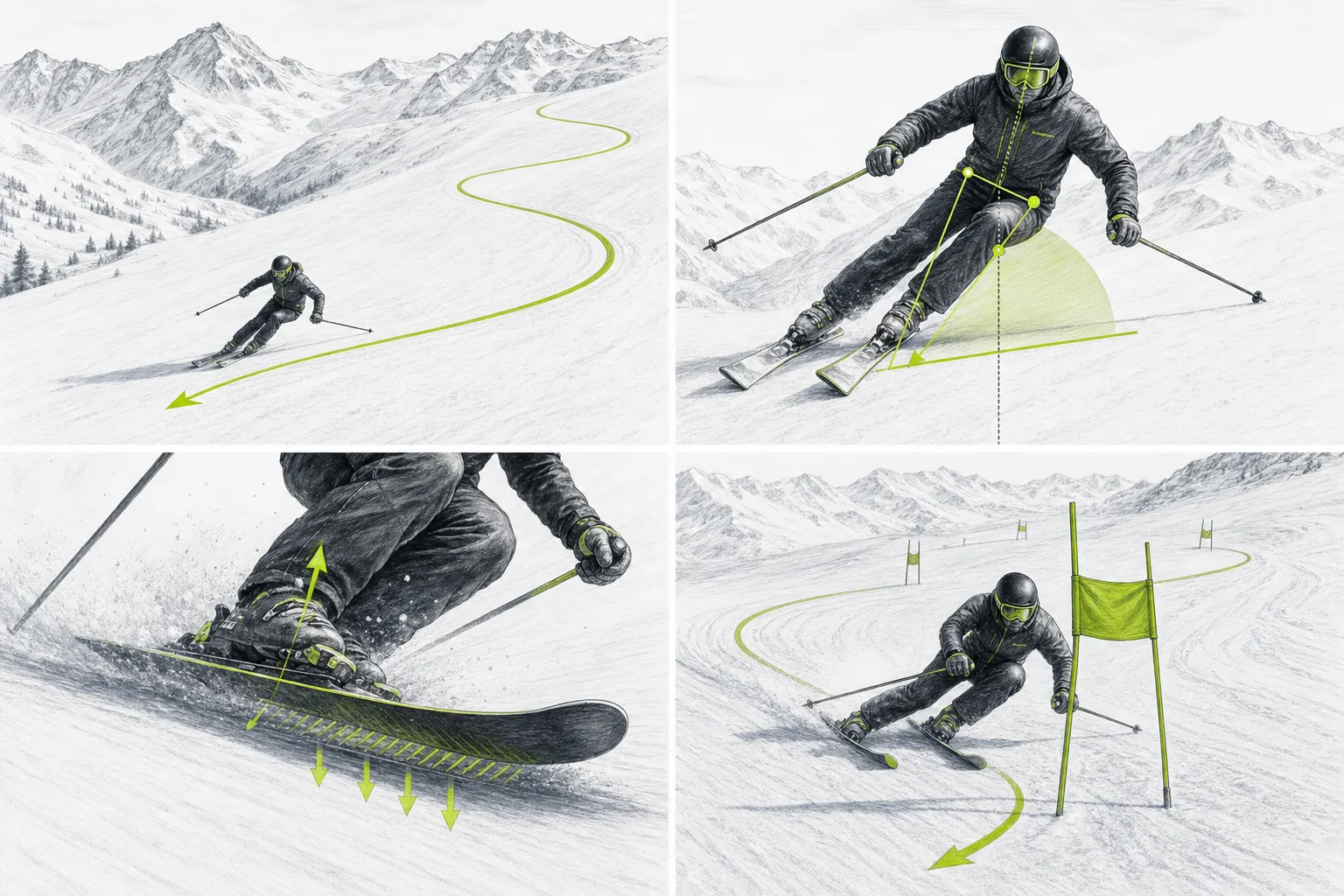
Rule: The FIS prescribes the correct passage of the set course and gates according to the specific discipline. However, it does not state that every turn must be made with a single technique or carved throughout. The current rules should always be checked in the valid edition of the International Competition Rules.
In racing, a turn is both a technical and tactical solution. The racer chooses the line, the point of edge change, the degree of ski rotation, and the way pressure is built according to the gate setup, terrain, and required exit speed. Slalom research shows that a ski can move from skidding to a more distinctly carved line during one turn. Even elite skiers use controlled slipping or quicker ski rotation at the start or through the middle of some turns when the situation requires it.
Common misconceptions
- A turn does not arise only by turning the shoulders. Movement of the upper body can influence the skis, but the basis is coordinated work of the lower limbs and balance over the support.
- Greater edging does not automatically guarantee a better or shorter turn. The result also depends on speed, loading, ski rotation, ski construction, and the snow.
- Carving is not the only sign of good technique. A purposeful skier can adjust the balance between carving and skidding according to the situation.
- The sidecut radius number on a ski is not the radius of every turn. Expresses the geometry of the sidecut, not the skier’s actual path.
- Loading the outside ski does not mean the inside ski must be completely off the snow. The load distribution changes throughout the turn; what matters is stable support and the ability to guide the ski effectively.
Coach’s view
The coach does not evaluate only the body’s position at a given moment. They mainly watch the shape and continuity of the track, where the turn starts, the smoothness of the transition, pressure control, appropriate speed, and the skier’s ability to change the solution. Tracks in the snow help distinguish carving from skidding, but they do not by themselves say whether the chosen line was safe and tactically appropriate.
The goal of learning is therefore not one “perfect turn,” but a broader repertoire of turns. A young skier should gradually learn to vary their size, rhythm, degree of closure, and the proportion of skidding and carving without losing control. Only this adaptability creates a usable technique for recreational and race skiing.
Sources and further reading
- FIS – Alpine Documents and International Competition Rules, current documents 2026
- U.S. Ski & Snowboard – Alpine Training Systems
- U.S. Ski & Snowboard – Athlete Performance Profile
- Sports Engineering – Mechanics of wedge turns in alpine skiing
- Frontiers in Sports and Active Living – Alpine Ski Motion Characteristics in Slalom
- Sports Engineering – Technique-Dependent Relationship between Local Ski Bending Curvature, Roll Angle and Radial Force
- British Journal of Sports Medicine – Sidecut radius and the mechanics of turning
- Frontiers in Physiology – Recent Kinematic and Kinetic Advances in Olympic Alpine Skiing
- Frontiers in Sports and Active Living – Development and Validation of a Gyroscope-Based Turn Detection Algorithm
- Journal of Science and Medicine in Sport Plus – The EMG, NIRS, and RPE responses to two turn transition techniques in alpine skiing