What are snow conditions
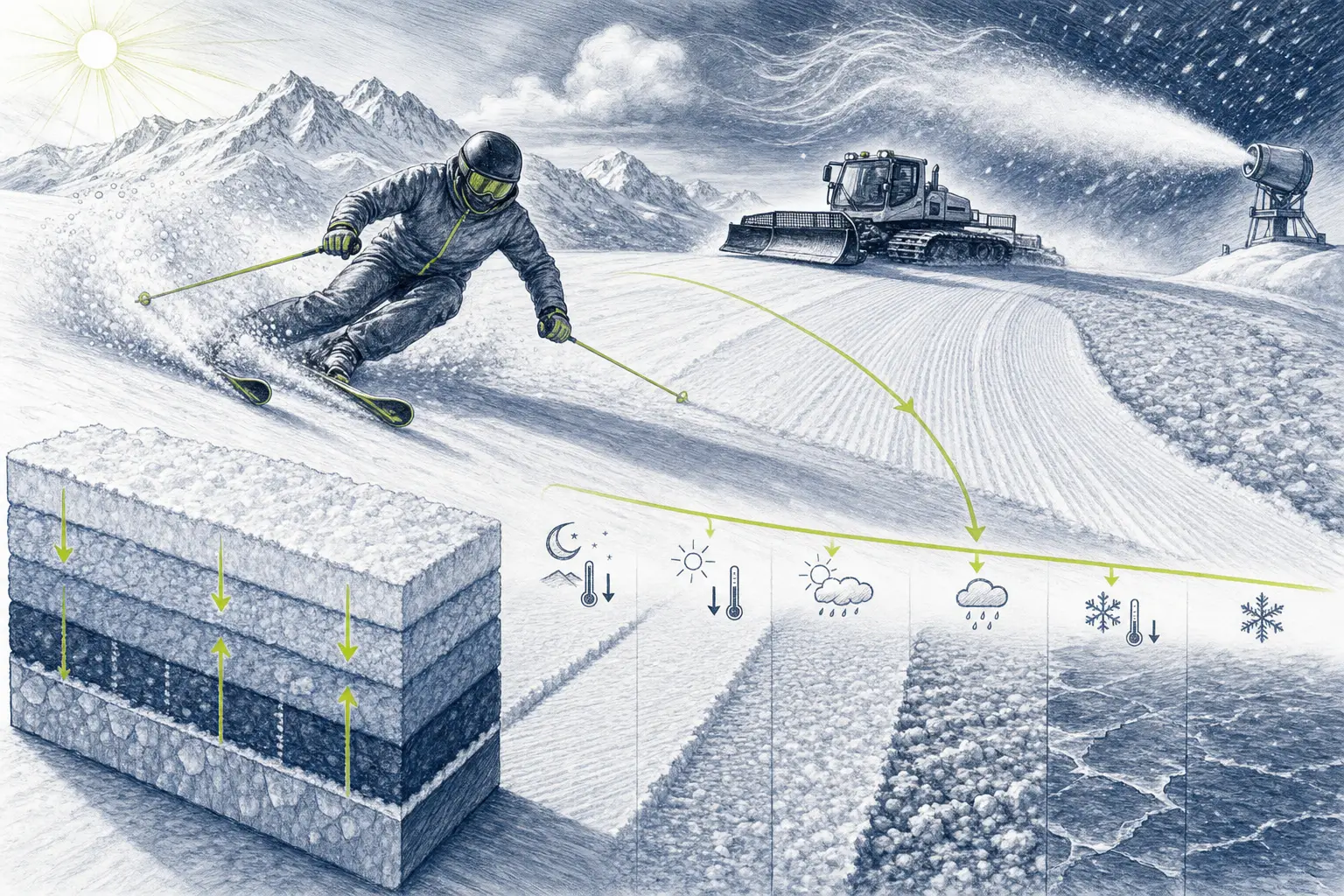
Snow conditions are a summary of the properties of snow on a ski slope or in open terrain. These mainly include the amount and distribution of snow, surface hardness, moisture, the consistency of individual layers, compaction, slope grooming, and local differences. The snow depth alone therefore does not tell you how it will ski on the slope.
Conditions can change within a single day. The surface is affected by temperature, sunlight, wind, new snow, rain, repeated freezing and thawing, grooming by snowcat, and the tracks left by skiers. After a cold night, the slope may be hard in the morning, then soften later and contain wet or chopped-up snow in the afternoon. A wet snow layer can form a solid or brittle crust after cooling.
The most common forms of snow on a slope
- Fresh dry snow is soft, moves easily, and skis sink into it more. On an ungroomed or chopped-up surface, it can create uneven resistance.
- Groomed compact snow has a smooth and packed surface. Its hardness, however, depends on temperature, moisture, and the snow’s previous development.
- Hard or polished snow deforms less under the ski. It requires more precise ski control and effective edge contact. The common term “ice” does not always mean a continuous layer of ice; often it is very hard snow or snow polished by repeated passes.
- Wet and slushy snow contains liquid water, moves more easily, and can form piles, grooves, or spots with different resistance.
- Snow crust forms when the surface hardens, often after melting and then freezing again. It may support a skier or break unevenly under the skis.
- Chopped-up snow and bumps are not a separate meteorological type of snow. They are a surface changed by skiers passing over it, which increases the demands on balance and line choice.
Both natural and machine-made snow can be groomed, packed down, and repeatedly exposed to thawing or freezing. For a skier, the current state of the surface is therefore more important than the origin of the snow itself. When preparing a race course, a compact and sufficiently durable base is deliberately created so it can withstand a large number of runs and provide as comparable conditions as possible.
Importance for children's skiing
A child is still learning how skis respond on different surfaces. A change from soft snow to a hard patch, or from a smooth base into a pile of wet snow, can upset balance even when the child skis confidently on an even slope.
When choosing terrain, it is important to consider not only the color and steepness of the slope, but also its current condition. A hard, steeper section can be more demanding than a gentler slope with a uniform, well-groomed surface. Deeper, heavy, or changing snow also increases the demands on mobility, stability, and independently releasing the skis.
A good training practice is first to check the conditions at a lower speed and on an easier section. The coach can adjust the size of the turns, speed, spacing, and difficulty of the tasks according to the age, level, and reactions of the group. The goal is not to create fear of hard or soft snow, but to gradually broaden movement experience in a controlled environment.
A common mistake is to demand the same skiing style regardless of the surface. On hard snow, a child mainly needs calm and precise ski guidance without sudden movements. In soft and uneven snow, it is important to respond flexibly with the legs and maintain a stable position. The specific task, however, must match the child's abilities; it is not a universal technical rule.
Race context
In alpine skiing, snow conditions are part of the safety and fairness of races. The organizer prepares the course so that it has a sufficient snow base and as even conditions as possible for the starters. Before major events, FIS carries out snow inspections, and a lack of snow can lead to cancellation of the race. During the event, it is also assessed whether the conditions allow the competition to take place safely and properly. The current binding wording is set by the relevant FIS rules.
A race course therefore does not have to feel the same as a recreational downhill slope. A compact, harder surface must withstand repeated runs and limit the formation of deep ruts. But that also increases the demands on technique, equipment readiness, course inspection, and the coach's decisions.
Typical misunderstandings
- “Fresh snow is always safer.” It can hide a hard base, an uneven spot, or a place with different resistance.
- “A hard slope is automatically poorly prepared.” Hardness can result from weather, freezing, traffic, or the deliberate preparation of a race course.
- “One report applies to the whole area.” Snow can differ by altitude, slope orientation, shading, and the time of observation.
- “Good conditions on the slope mean safe conditions off it as well.” The condition of a prepared course and the avalanche situation are two different pieces of information. Off marked and secured trails, you need to follow the official avalanche forecast and respect local restrictions.
From a coach's point of view, snow conditions are not just an obstacle. They are an important part of skiing literacy: a young skier learns to observe the surface, adjust speed appropriately, and recognize when they need easier terrain or an adult's help.
Sources and further reading
- FIS – Alpine Skiing Documents and current competition rules
- FIS – Snow controls explained
- FIS – Preparing the perfect slope for the FIS Alpine World Ski Championships Saalbach 2025
- UK Met Office – Snow: formation and the difference between dry and wet snow
- WSL Institute for Snow and Avalanche Research SLF – Interpretation Guide for the Avalanche Bulletin
- WSL Institute for Snow and Avalanche Research SLF – Snow profiling and snow-cover classification, C. Pielmeier
- FIS Athlete Health Corner – Injury and Return