What course inspection is
Course inspection (English course inspection) is a time- and organization-defined inspection of the marked race course before the competition run or official training. During it, the racer is not competing or testing the course at racing speed. Their task is to understand the line of the course and prepare a plan for the run.
The inspection concerns the layout of the gates, not just the slope itself. The same course can look different every time depending on how the gates are set. In slalom and giant slalom, when the second run is reset, a separate inspection is carried out according to the program and the jury’s instructions.
What the rules say
According to the current FIS international rules, the jury decides how the inspection is carried out. The course should be ready for racing from the start of inspection, and any work on it must not prevent racers from inspecting it. The time, duration, and any restrictions are announced through the official program or at the team captains’ meeting.
Racers must wear their start bib during inspection, move on skis, and respect the instructions of the jury and organizers. They must not race through the course, ski through the gates, or imitate a competition run. In practice, the course is usually inspected by side-slipping slowly or in another controlled way set by the jury. If the rules are broken, the jury may impose a penalty depending on the nature of the offense; however, this is not an automatic disqualification for every minor mistake.
In downhill, it is important to distinguish inspection from official training. Before the first official training run, racers are expected to complete a full inspection of the course. Only the later training run is used to ski the course at the speed and in the manner set by the competition rules.
What the racer pays attention to
During inspection, the racer builds a picture of the course section by section. They pay close attention to:
- the first gates and space to accelerate from the start,
- the rhythm, spacing, and side movement of the gates,
- changes in rhythm and sudden changes of direction,
- horizons, breaks in the slope, side slopes, and terrain waves,
- hard, icy, soft, or broken-up spots,
- visibility, shadows, and transitions between light and shade,
- the space needed before a difficult combination,
- the right place to start and finish a turn,
- the last gates, the finish line, and a safe area to stop.
The goal is not to remember every gate as a separate picture. More important is breaking the course into clear sections: where a smooth rhythm can be maintained, where the skier needs to prepare earlier, and where they may lose height, balance, or control of speed.
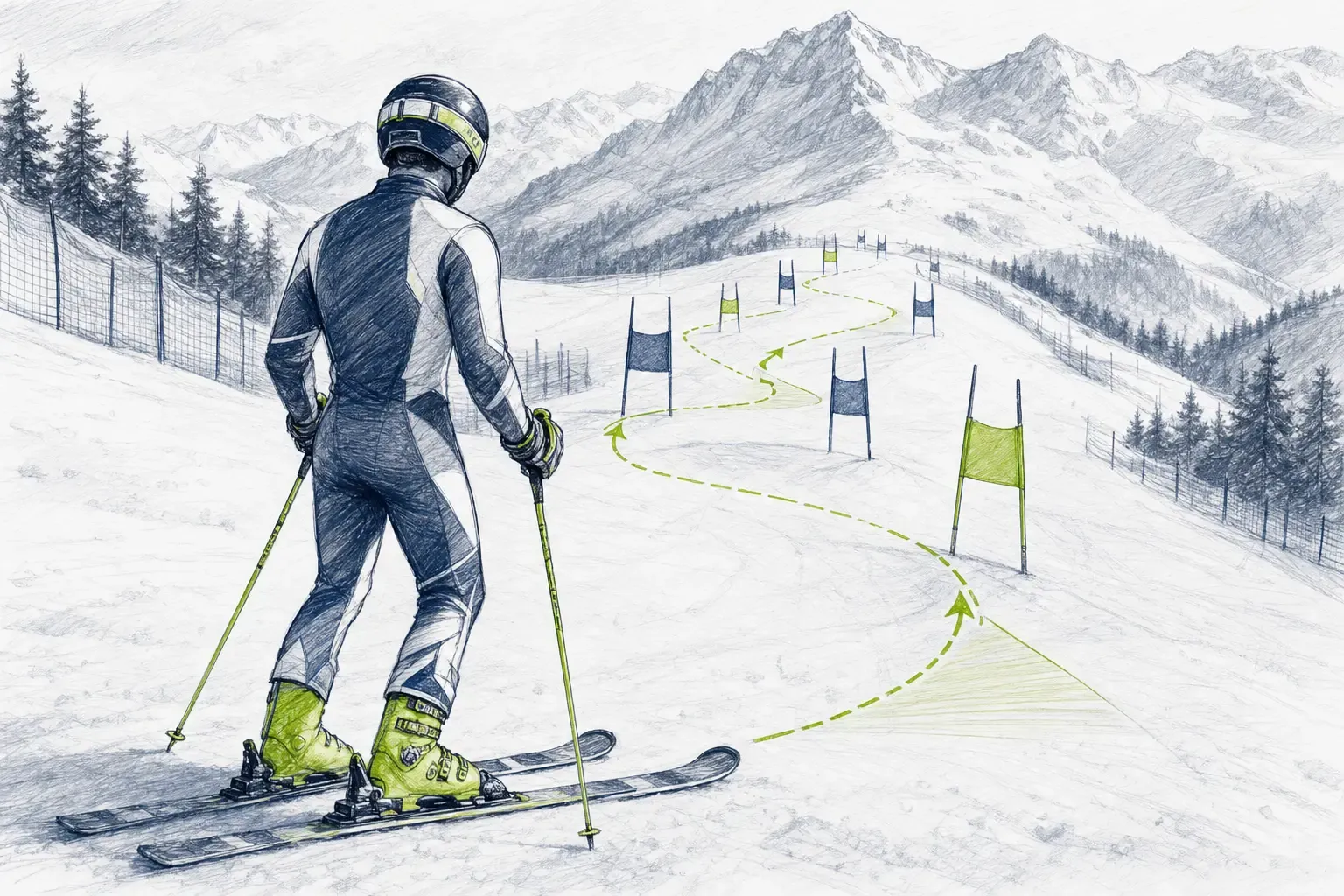
Children’s course inspection
A child needs a task suited to their age, experience, and ability to stay focused. For a beginner or younger racer, a coach will usually choose only a few clear reference points. These might be a change in rhythm, a more difficult gate beyond a crest, and the finish entry. A more advanced skier can already compare more line options and plan the transition between full sections.
A coach should not overwhelm a child with too many instructions or ask them to copy another racer’s line without thinking. A useful training practice is to have the child describe in their own words where the rhythm changes, where they need to set up the turn in advance, and which spot they consider the most demanding. The coach can then see whether the child really understood the course.
Safety comes before tactical analysis during inspection. A racer should not stop below a crest, block the passage of others, suddenly cross the course, or stand in the landing zone or the expected skiing line. Before moving across the course, they must make sure nobody is coming from above and respect closed sections.
Typical mistakes and misunderstandings
The most common mistake is treating inspection as a warm-up run. Trying to ski through several gates in rhythm, accelerate sharply, or practice turns damages the course, endangers others, and may break the rules.
Another mistake is looking only at the gates without perceiving the terrain and snow. A gate shows the required line through, but the way a skier reaches it is strongly affected by the slope, surface, and space of the next section. It is equally wrong to prepare only one fixed line regardless of the fact that conditions may change between inspection and start.
From a coach’s perspective, quality inspection is an independent racing skill. Its goal is not to give the racer as much information as possible, but to help them create a simple, workable, and safe plan for the run that matches their technical level.
Sources and further reading
- FIS – Alpine Skiing Documents: International Competition Rules, edition 6. July 2026
- U.S. Ski & Snowboard – 2026 Alpine Competition Guide
- U.S. Ski & Snowboard – Alpine Competition Officials Education Resources
- U.S. Ski & Snowboard – Alpine Officials’ Manual: The Racecourse
- U.S. Ski & Snowboard – Alpine Course Setting Specifications
- U.S. Ski & Snowboard – Alpine Course Homologation Rules
- U.S. Ski & Snowboard – Alpine Course Homologation