What correct gate passage means
Correct gate passage is a passage that meets the rules of the given discipline. In general, the prescribed gate line must be crossed by both ski tips and both feet of the competitor. In single-pole courses, the tips and feet must pass around the turning pole or turning gate on the correct side, according to the natural line of the course.
The term also has a second, training meaning. A passage may be valid under the rules but technically inefficient — for example, too late, too wide, unstable, or ending with a loss of speed. The coach therefore distinguishes a valid passage from an effective racing passage.
What the rules decide
The FIS rules for correct passage are set out in article 661.4 of the International Competition Rules for Alpine Disciplines. The current ICR used when preparing this entry was published by FIS on 6 July 2026.
In downhill, super-G, and giant slalom with full gates, the gate line is the imaginary shortest connection between the turning pole and the outer gate at snow level. In slalom with a pair of poles, it is the imaginary shortest connection between the turning pole and the outer pole.
For a passage, the position of the head, torso, or hands is not judged. What matters are the ski tips and feet. They do not have to pass exactly through the middle of the physical space between the poles. If they are in the air, they must cross the corresponding vertical plane of the gate line.
If a competitor displaces or knocks over a pole before their ski tips and feet cross the gate line, the original position of the pole is judged, usually according to its place or mark in the snow. Knocking down the pole alone is therefore not automatically a fault, but it also does not create an easier substitute line.
If one ski is lost without a prior incorrect passage, the tip of the remaining ski and both feet are judged. This is a rule-based exception, not something the skier should try to exploit.
Single-pole slalom and giant slalom
On a course with one turning pole or one turning gate, there is no physical pair between which the skier passes. Both ski tips and both feet must pass on the same, correct side of the turning element, as determined by the natural continuation of the course.
A typical mistake is straddling the pole (Engl. straddle) one ski passes on one side of the pole and the other on the opposite side. The contact with the pole does not have to be obvious. What matters is the position of both tips and both feet, not whether the racer fell or continued without any visible hesitation.
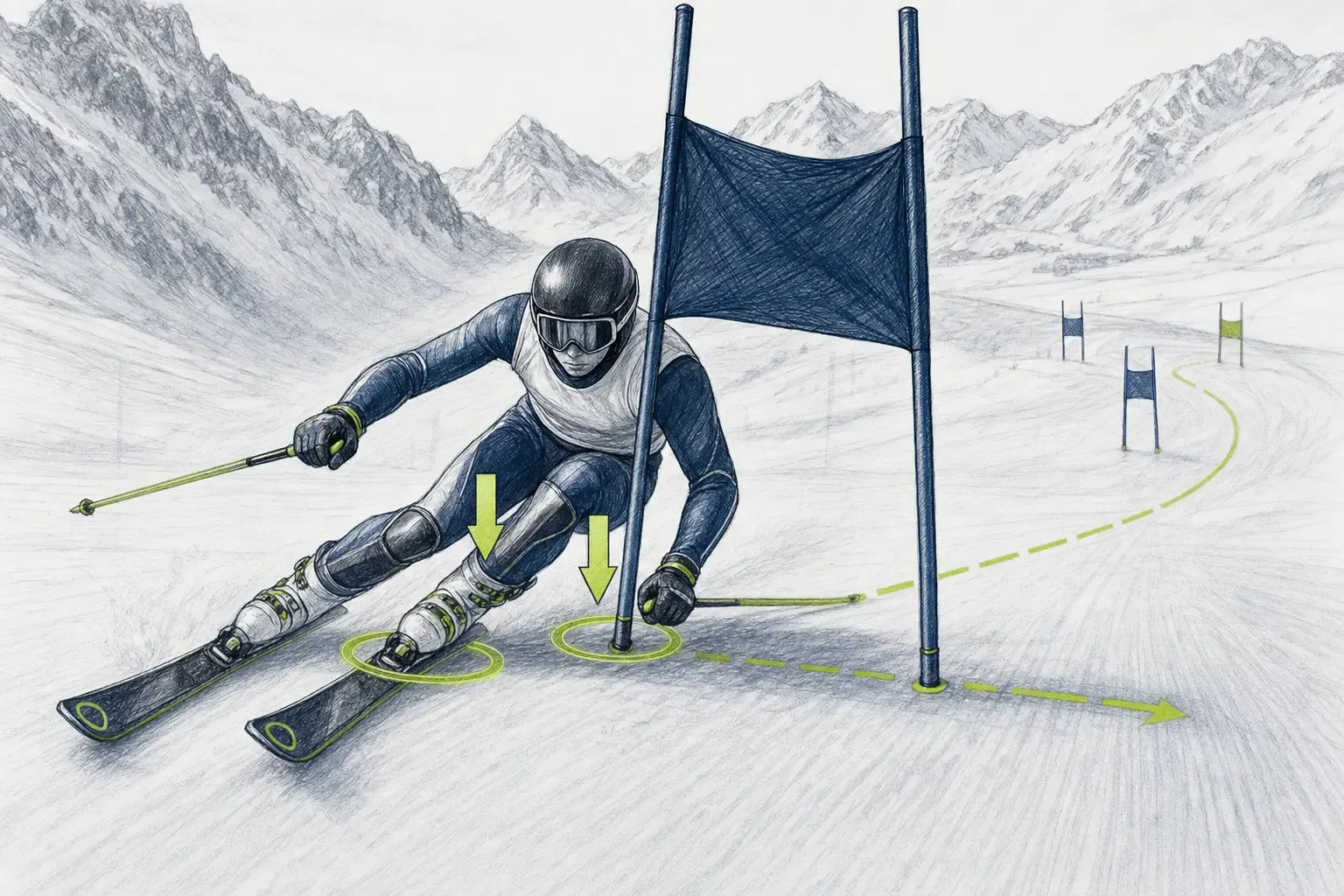
Technically good passage
The rules say where the skier must pass, but they do not define one universal ideal line. That depends on the discipline, gate setup, slope, terrain undulation, snow quality, speed, and the racer’s abilities.
A technically effective passage usually means that the skier:
- approaches the gate with a sufficiently prepared turn,
- keeps balance and support on the skis,
- does not look only at the current pole, but follows the continuation of the course,
- chooses a line from which they can start the next turn without an emergency correction,
- adjusts speed and turn shape to their abilities and the conditions.
The shortest path right by the pole does not have to be the fastest. If the skier arrives late, they may pass the gate just on the correct side, but behind it they must brake sharply, rotate their upper body, or move across the slope. The result is often a loss of balance and an even later entry into the next gate.
Contact with the pole is also not a requirement for a good passage. In slalom, deflecting flexible poles is a normal part of advanced technique, but it should be the result of the chosen line, not a goal in itself. Deliberately aiming the body at the pole without controlled balance increases the risk of straddling, falling, or hitting the hand or face.
Children’s and training context
A beginner does not need to focus first on the tightest possible passage. More important is recognizing the correct side of the gate, starting the change of direction in time, and skiing the course in a controlled rhythm. The coach can use wider spacing, soft training aids, or simple corridors to help the child understand the line without unnecessary fear of the poles.
As the level improves, the focus shifts from simply “hitting the gate” to linking turns. The instruction should match the child’s age and motor development. A young skier is often helped more by a simple task – looking at the next gate, starting the turn earlier, or exiting the gate in balance – than by correcting many details at once.
Full slalom poles, higher speed, and practicing deflecting them belong in supervised training with suitable equipment and protection according to the discipline, age, event rules, and the instructions of a qualified coach.
Common misunderstandings
- “It’s enough that I passed the pole on the correct side.” Not always. What matters is the position of both ski tips and both feet.
- “I have to pass exactly between the poles.” At a complete gate, the skier must cross the gate line; the rules do not require passing through its middle.
- “If I knock the pole down, it no longer counts.” Its original position is assessed.
- “Touching the pole means a mistake.” The contact with the pole itself, or knocking it over, is not an automatic error.
- “The closer to the pole, the faster.” An overly direct line can lead to a late turn and a loss of speed after the gate.
From a coach’s point of view, a correct run through the gate is the result of reading the course, turning in time, and staying balanced. The gate is a checkpoint on the way, not a target where technique starts or ends.
Sources and further reading
- FIS – Alpine Documents: International Competition Rules (ICR), edition from July 6 2026
- U.S. Ski & Snowboard – 2026 Alpine Competition Guide
- U.S. Ski & Snowboard – Alpine Competition Officials Education Resources
- U.S. Ski & Snowboard – Rules & Equipment
- U.S. Ski & Snowboard – 2023 Alpine Competition Guide, article 661.4 and gate line diagrams
- U.S. Ski & Snowboard – Alpine Officials’ Manual: Gate Judges