What an open gate is
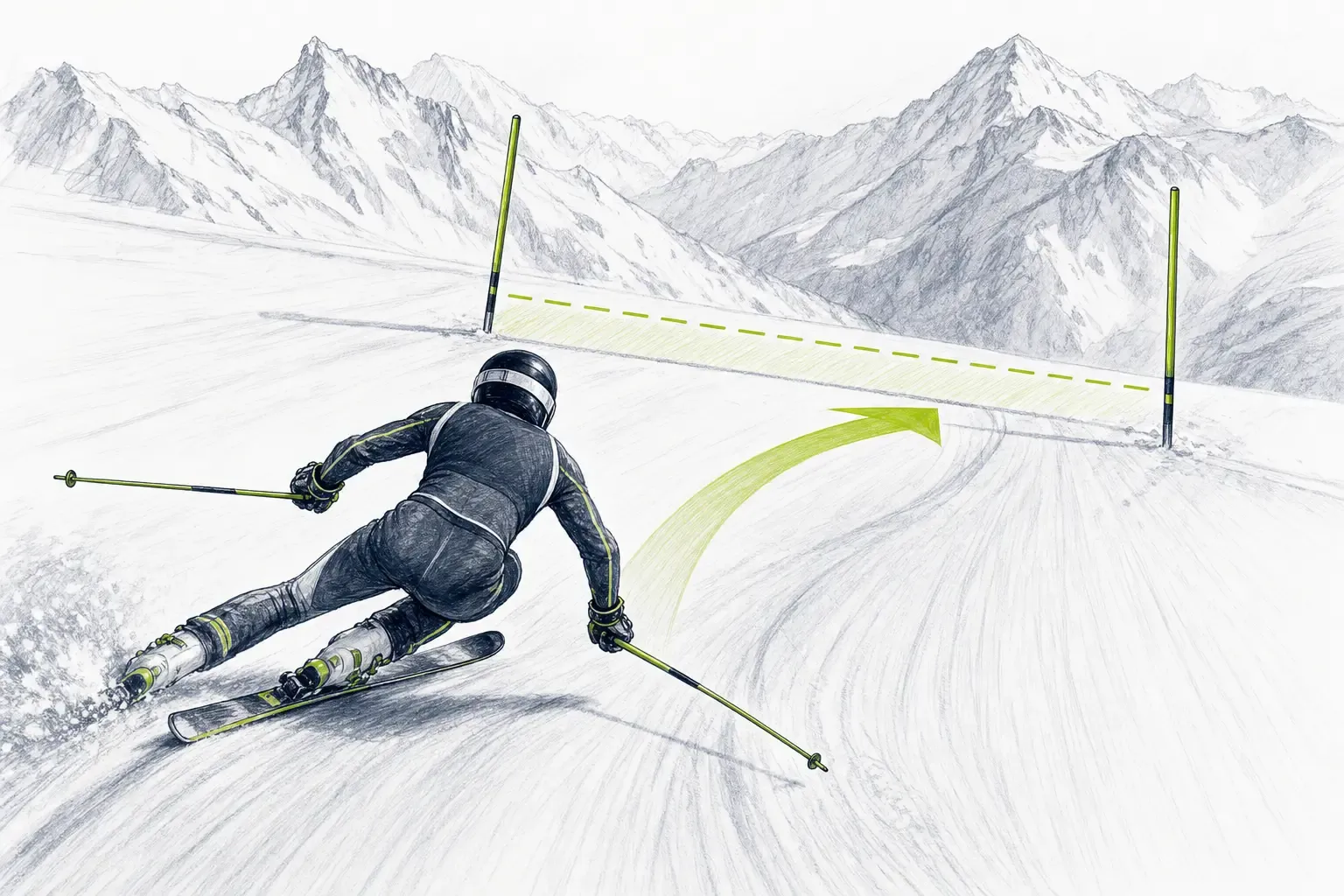
An open gate is a slalom gate oriented mostly across the slope. In the English wording of the FIS rules, the term horizontal (open) gate, that is, horizontal or open gate, is used. In the classic marking with two poles, the turning pole and the outside pole lie roughly next to each other across the fall line. The line connecting the poles is therefore closer to the contour line than to the fall line.
The opposite is a closed, or vertical gate (vertical or closed gate), whose poles or corresponding turning points are arranged more in the direction of the fall line. An open gate must not be confused with a vertical combination, hairpin, or offset gate. The FIS rules require slalom to include both open and closed gates and the prescribed combinations.
The word “open” does not mean that the gate is optional, easy, or unusually wide. It primarily refers to its orientation and the way it guides the racer through the course.
Correct passage
According to the rules, the key is the gate line. In a gate marked with two poles, this is the shortest imaginary line between the turning pole and the outside pole. The racer must correctly cross it with the tips of both skis and both feet.
In slalom with one pole, the outside pole is missing at standard gates. The racer must then pass the turning pole on the correct side with both feet and the tips of both skis, following the normal race line and the imaginary line between successive turning poles. Touching or knocking down the spring-loaded pole alone does not mean the gate was passed correctly.
From a practical point of view, it is not enough to aim for the geometric center of the gate. The skier needs to recognize which pole is the turning pole and choose a line that allows them to finish the turn and prepare for the next change of direction. An open gate can be smooth and fast, but with a large sideways offset it may require a pronounced turn across the slope.
Children’s and training context
For children, an open gate is used to learn orientation in the course, the timing of turns, and linking individual changes of direction. The coach must adapt the spacing, slope angle, and speed to the child’s age, skiing ability, snow quality, and the goal of the drill. This is training practice, not a universal rule valid for every child.
For a beginner, a simple distinction can help:
- the turning pole determines the point of direction change,
- the outside pole or the imagined gate line shows the space for the correct passage,
- the gaze should move toward the next gate, not stay fixed on the pole by the skis.
Only after the course can be recognized reliably does it make sense to shorten the line and deliberately train a tighter passage around the turning pole. Forcing a child too early into a straight racing line often leads to a late turn, loss of balance, or straddling the pole.
Typical mistakes and the coach’s view
The most common misunderstanding is the idea that every open gate must be passed straight between the visible poles, no matter the direction that follows. The racer then deals only with the current gate and reaches the next one too late. Another mistake is confusing the color of the pole for the side of the passage without following the whole course line.
The coach sees an open gate as part of a connected sequence: they watch where the turn starts, the crossing of the gate line, the body position above the skis, and readiness for the next gate. The goal is not just to “hit the gap,” but to pass the gate correctly by the rules, smoothly, and with control appropriate to the young skier’s ability.
Sources and further reading
- FIS – Alpine Skiing Documents: current International Competition Rules and technical documents
- U.S. Ski & Snowboard – 2026 Alpine Competition Guide
- U.S. Ski & Snowboard – Alpine Competition Officials Education Resources
- U.S. Ski & Snowboard – Alpine Officials
- U.S. Ski & Snowboard – Alpine Competition Guide 2021, rules for open and closed gates
- U.S. Ski & Snowboard – 2025–26 Alpine Precisions
- FIS – International Competition Rules for Para Alpine Skiing, October 2025