What is a gate combination
Gate combination is a group of consecutive gates set up so that the skier has to handle them as one unit. We most often encounter this term in slalom. While open gates usually create more regular individual turns, a combination shortens, lengthens, or shifts the rhythm and requires a precisely prepared entry and exit.
A combination is not just several gates placed close together. It is a specific course task with a set order of passage and gate lines. The racer must read it during inspection as one sequence, not as a set of isolated poles.
The term should not be confused with children’s races Kombi, which can combine elements of slalom and giant slalom or giant slalom and super-G. A gate combination is a course element; Kombi is a race format.
Basic types in slalom
Hairpin
Hairpin (hairpin) consists of two tightly connected closed gates. It creates a short sequence of quick direction changes. The key is to enter it at the right height and with the skis under control, so the racer does not have to brake sharply at the second gate or return to the correct line.
Vertical
Vertical or vertical combination (vertical combination, flush) is a line of three or four gates placed close together, usually in one line heading down the slope. The skier makes short, quick edge changes between them. It is not a full separate turn at every pole, but a flowing movement in a narrow corridor.
Delayed gate combination
Delayed gate (delayed gate) breaks the regular rhythm with a stronger offset and lengthens one section of the line. It leads the racer farther across the slope or changes the place from which they return to the next rhythm. It requires early recognition of the direction; looking only at the nearest pole often leads to a late turn.
FIS rules framework
The current FIS ICR rules for alpine disciplines, published 6. July 2026, define the geometry of slalom gates and the required use of combinations. In a standard FIS slalom, the gate width is 4 to 6 meters. The distance between the turning poles of consecutive gates is usually 6 to 13 meters. In a hairpin and vertical, the distance between gates is 0,75 to 1 meter, and the gates should be set in a straight line.
According to the general FIS rules, the course includes open and closed gates, one to three verticals made up of three or four gates, at least three hairpins, and one to three delayed gate combinations. For children’s, national, or special competitions, additional rules and different limits may apply. Therefore, the decisive factors are always the race regulations and the rules of the relevant category, not a size taken from ordinary club training.
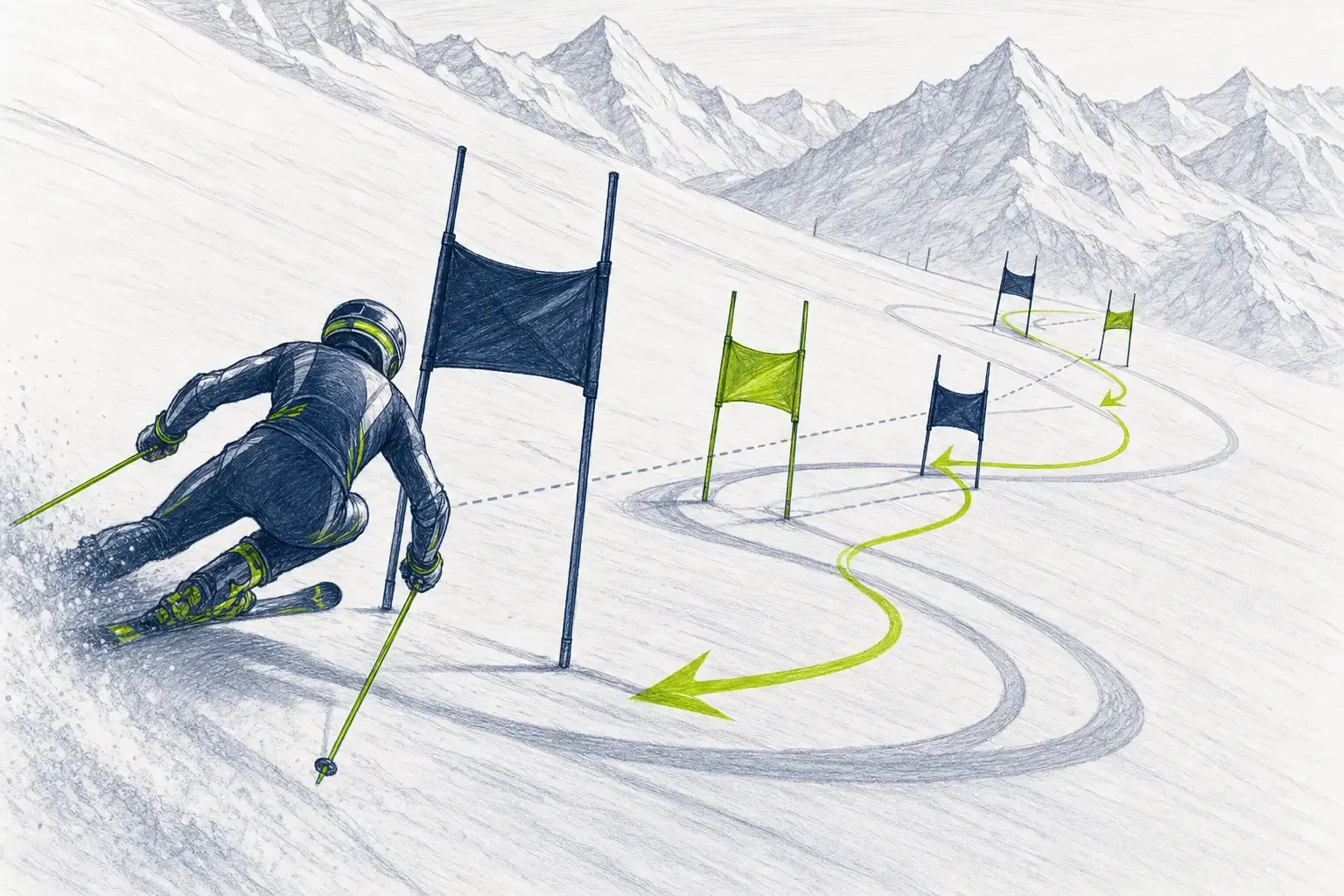
The racer must pass through the gates in the prescribed order. The basic condition for a correct passage is that the gate line is crossed by the tips of both skis and both feet. In single-pole slalom, some gate lines are treated as imaginary connections between the turning poles; in combinations and gates with an outside pole, it is necessary to know the actual geometry of each gate. Stepping on the turning pole, missing a gate, or passing on the wrong side can mean a mistake and a subsequent disqualification if the racer does not return and correct the error according to the rules.
How to ski a combination
The result is often decided before the first pole. The racer must choose an entry line that leaves enough room for the whole sequence, especially for the exit. An entry that is too direct may look fast, but at the next gate it leads to delay, leaning back, braking, or stepping on the pole.
In a combination, it helps to:
- look ahead to the flow of the entire sequence,
- stay balanced over the skis and not get ahead of them with the upper body,
- make quick but calm edge changes,
- adjust the size of the turns to the smaller space,
- plan the exit already when entering the combination,
- after the last gate, smoothly continue into the next rhythm without unnecessary hesitation.
Contact with the pole is not the goal. Blocking a slalom pole only makes sense when it comes from the correct line and does not disturb balance. A child who focuses mainly on hitting the poles may lose foot precision and the line of the course.
Children's and training context
For children, combinations are introduced gradually according to the skier's level, not just their age. First, brushes, short poles, or a simple corridor on a gentle to medium slope can be used. This is followed by a two-gate hairpin and only then a longer vertical or linking the combination with open gates.
The Alpine Canada methodology recommends varying the transition from longer to short turns, entry, exit, and adaptation to different combinations during practice. Course setting should change according to the skiers' reaction, the terrain, and the training goal. That is training practice, not a universal rule for spacing. Competition dimensions and the number of combinations always follow the valid rules of the given event.
Typical mistakes are a late entry, watching only the nearest pole, making a separate big turn at each gate, rotating the shoulders, leaning back, sudden braking in the middle of the combination, and releasing too early after the last pole. The coach therefore does not watch only whether the child passed the gates on the correct side. They also evaluate the entry preparation, leg rhythm, upper-body stability, line of sight, and linking into the next section of the course.
A well-skied combination looks smooth. The racer does not have to save the line after every pole and exits the combination in balance, ready for the next gate.
Sources and further reading
- FIS – Alpine Skiing Documents: International Competition Rules (ICR), 6. July 2026
- U.S. Ski & Snowboard – 2026 Alpine Competition Guide
- U.S. Ski & Snowboard – 2026 Alpine Competition Guide, full PDF
- U.S. Ski & Snowboard – Alpine Competition Officials Education Resources, season 2026
- Alpine Canada Alpin / Canadian Ski Coach Federation – Drills & Exercises Handbook
- U.S. Ski & Snowboard – 2025–26 Alpine Precisions
- U.S. Ski & Snowboard – Rules & Equipment