Definition
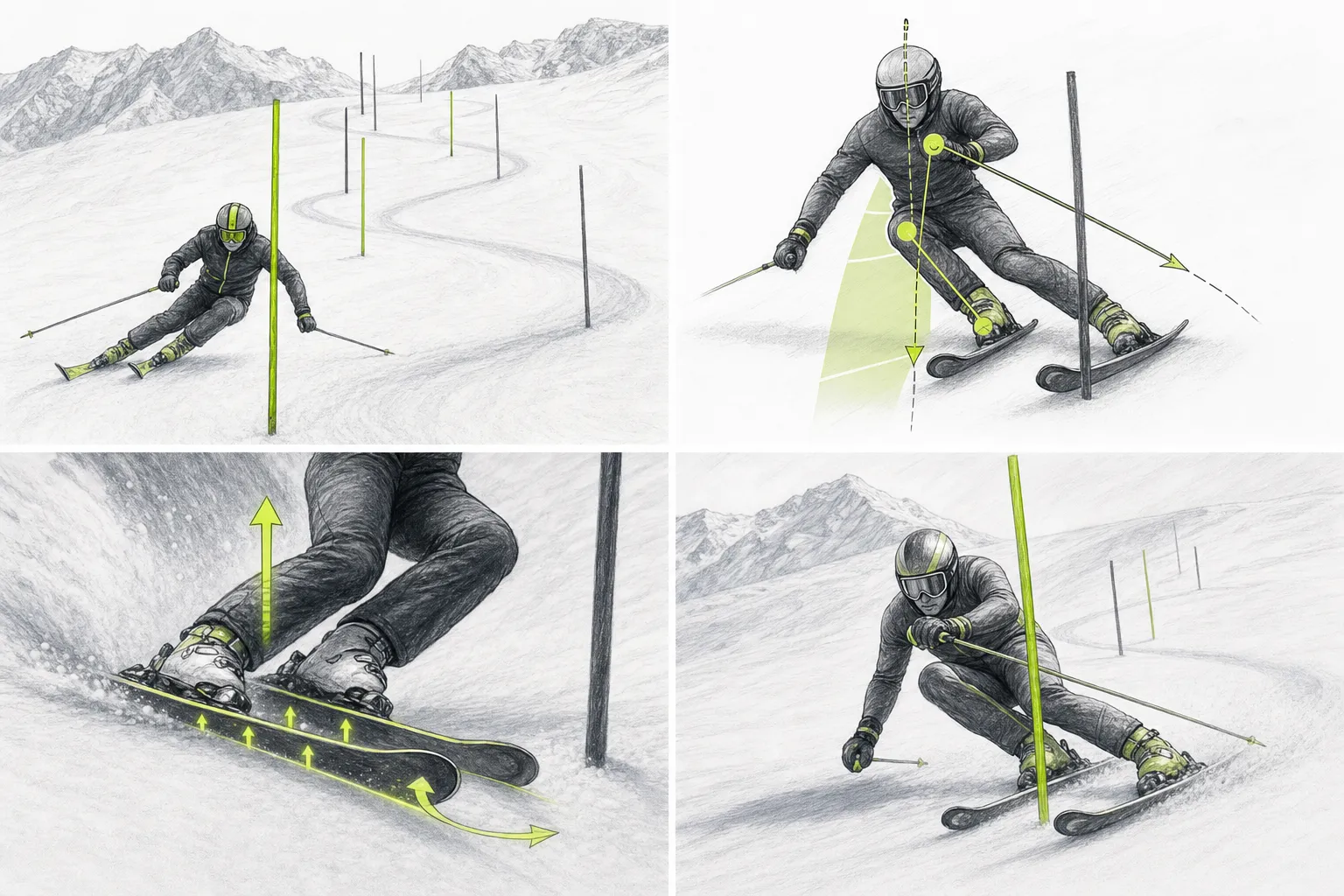
Slalom, abbreviated as SL, is a technical alpine skiing discipline. The racer skis the course in the prescribed order through red and blue gates. Compared with giant slalom, direction changes are more frequent and turns are shorter, so slalom requires quick footwork, precise timing, and immediate adaptation to the course rhythm.
Slalom is not just skiing between poles. The result comes from combining the correct line, balance, ski control, pressure management, course awareness, and the ability to keep the rhythm even after a mistake.
What a slalom course looks like
In modern slalom, most gates are marked by a hinged turning pole fixed in a joint mechanism. Special parts of the course, such as the first and last gate or some combinations, may also have outside poles. The course includes open gates, vertical combinations, and delayed gates, which change the rhythm and test the racer’s ability to recognize the next direction in time.
Rules framework: the racer must pass all gates in the correct order. Missing a gate without a correct correction under the rules leads to disqualification. In the standard FIS format, slalom is skied in two runs on differently set courses, and the final time is the sum of both runs. The exact requirements for the course, start order, qualification for the second run, and equipment depend on the level and category of the race; the current competition rules always decide.
What determines speed
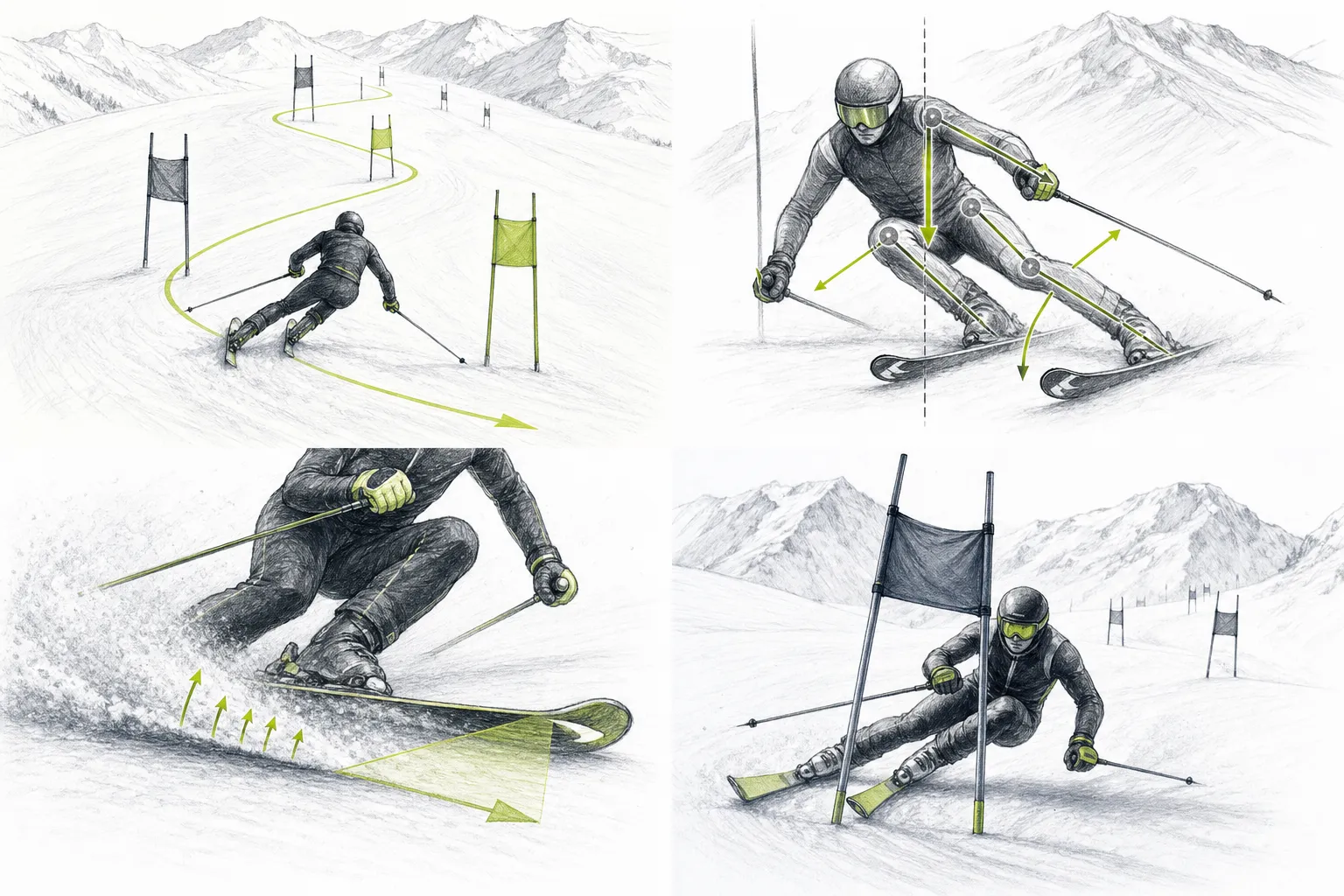
A fast slalom skier does not simply ski as close as possible to every pole. They need to create a line that lets them change direction on time and then accelerate toward the next gate after passing it. A line that is too direct often leads to a late turn, a sharp brake under the gate, and a loss of rhythm.
The most important are:
- reading the course early and keeping the eyes on the next gates,
- stable balance over the skis,
- independent and quick work of the legs,
- a controlled torso without unnecessary rotation,
- a smooth transition from one turn to the next,
- appropriate use of edges and pressure,
- the ability to continue after a small mistake without panic.
Contact with the pole, also called blocking or cross-blocking, is a result of a tight and well-timed line. It is not the main goal of the technique. A racer who focuses only on hitting the poles may lose balance, twist the shoulders, or steer the skis too straight.
Slalom in children's skiing
For children, full slalom is not placed at the start of instruction. First they need to master the basic stance, turning to both sides, speed control, ski guidance, and orientation in space. Only then does it make sense to add a precise rhythm and gate passage.
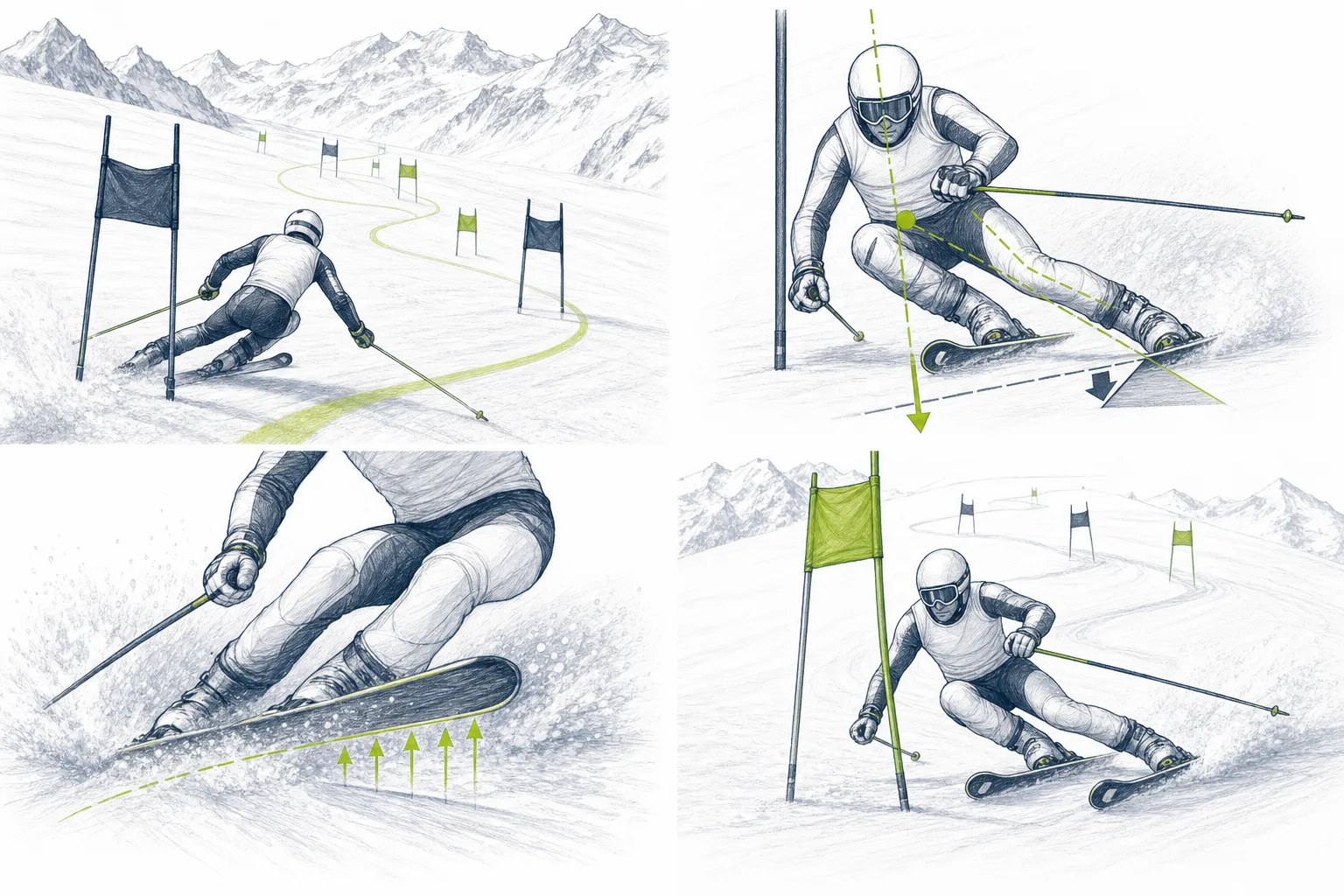
Common training practice progresses from free skiing and simple corridors through cones, brushes, and short hinged poles to full slalom poles. The coach can vary the spacing and rhythm according to age, technical level, snow conditions, and the goal of the training. There is no universal rule, and children of the same age may not be ready for the same course.
For a young skier, it is more important to ski the course in balance and rhythm than to forcefully hit every pole. Early imitation of the aggressive blocking of adult racers can hide shortcomings in line and footwork. Slalom exercises should develop bilateral skills, reaction, coordination, and decision-making, not just memorizing one way of passing through.
A run that is not finished does not necessarily mean failure in itself. The coach also watches where the child lost rhythm, where they were looking, whether they could recognize the combination, and how they reacted after a mistake.
Equipment and safety
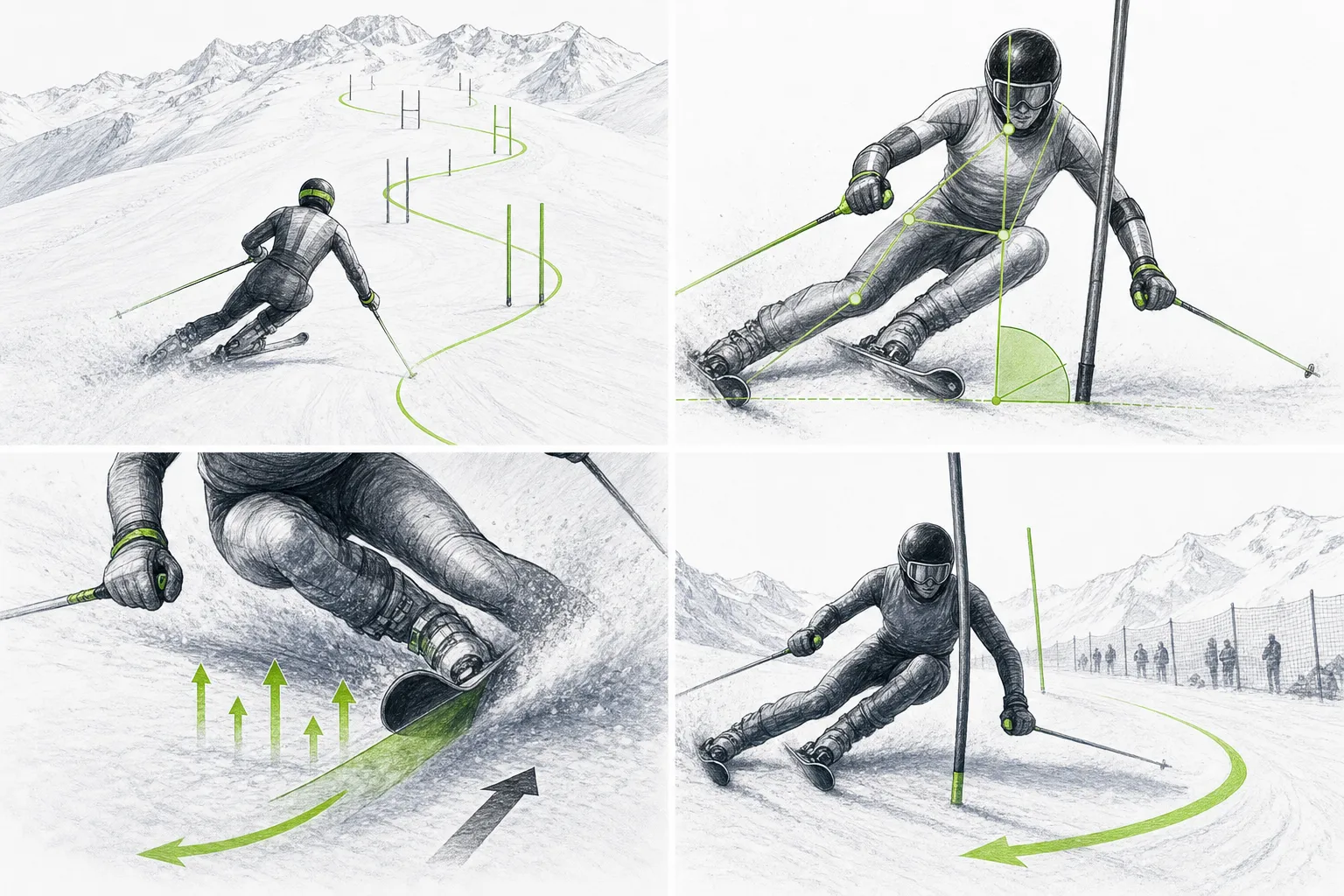
Slalom skis are designed for short, quick-turning arcs. FIS rules set requirements for competition skis and other equipment parts according to age category, gender, and competition level. The exact length of children's skis cannot be determined by age alone; height, weight, strength, technical level, and the recommendation of the coach or a professional ski service are taken into account.
When training with full gates, shin guards, gloves with protection, forearm guards, and a helmet with a compatible face guard are commonly used. Not all of these items are automatically mandatory at every event, so it is important to distinguish between the rules of a specific competition and common protective practice. The helmet, face guard, and other parts must be compatible with one another and used according to the manufacturer's instructions.
Binding settings, equipment mounting, and assessing compliance with the rules belong to a qualified service or technician. Slalom training should take place on a closed or adequately secured course under the supervision of a coach.
Typical mistakes and misunderstandings
- “The shortest line is always the fastest.” Too straight a run can cause a late turn and braking under the gate.
- “A good slalom skier must hit every pole.” The decisive factors are a correct gate passage and smoothness, not the force of contact.
- “Fast feet mean as many movements as possible.” Too many movements hurt balance; what is needed is a quick but purposeful change of edges and direction.
- "Slalom skis will fix your technique." Specialized equipment highlights movement habits, but it cannot replace solid fundamentals.
- "Every course should be skied the same way." Gate placement, slope, surface, and visibility require constant adjustment.
Coach’s view
In slalom, the coach does not judge only the final time. They watch whether the skier starts the turn at the right moment, keeps pressure on the outside ski, looks far enough ahead, and can connect individual gates into a smooth line. For children, technical quality, safety, and long-term motor development take precedence over immediate results or copying an adult racer’s technique.
Sources and further reading
- FIS – Specifications for Alpine Competition Equipment 2026/27, document page
- FIS – Specifications for Alpine Competition Equipment 2025/26, edition of 14. July 2025
- FIS – Specifications for Alpine Competition Equipment 2025/26, update from October 2025
- FIS – Alpine Skiing and Para Alpine Skiing Timing Booklet, document page
- FIS – What is homologation in Alpine Skiing, and why is it important?
- FIS – Calendar and Results: Alpine Skiing