What is parallel slalom
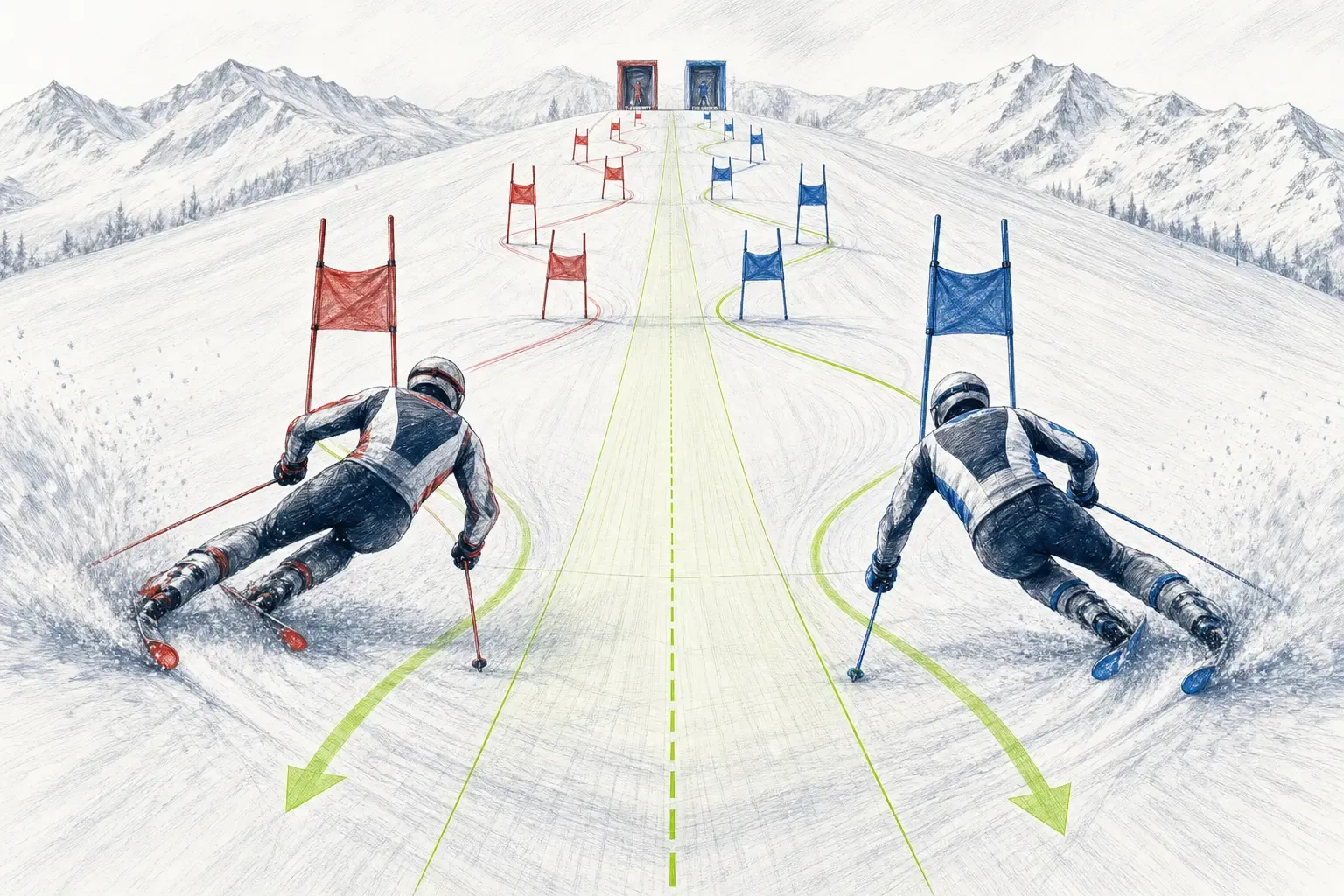
Parallel slalom is a racing format in alpine skiing in which two racers start at the same time on two adjacent courses. One is usually marked in red and the other in blue. The courses should be as comparable as possible in terrain, gate setting, course length, and snow preparation.
Unlike classic slalom, the goal is not always simply to post the best time in the entire field. The skier usually competes directly against the racer in the neighboring course, and the result of the run determines what happens next. The exact system may include qualification, a knockout bracket, one run, or two runs with course changes. In team competitions, the results of individual duels are counted toward the team.
The term parallel slalom is used quite broadly in skiing practice. However, the official event name and rules may refer to an individual parallel race, parallel giant slalom, or mixed team parallel race (Mixed Team Parallel). So it is not automatically a classic slalom transferred onto two courses.
How the race works
Both skiers start from separate start devices. Each must ski only their own course, correctly pass all required gates, and cross the finish line on their side. Electronic timing records each racer’s performance separately.
The winner is not necessarily decided only by who reaches the finish first in a single run. In a two-run duel, the time difference from both runs may be evaluated, with the racers swapping the red and blue courses. Different rules apply in single-run knockout rounds or team formats. The competition schedule and the relevant rules must therefore clearly define the seeding, the progression system, how ties are resolved, and the consequences of not finishing a run.
Rule: An incorrect gate passage, a false start, entering the opponent’s course, or blocking an opponent may result in a penalty according to the rules of the specific event. The exact sanction cannot be determined from the general name of the discipline alone.
For the season 2026/2027, FIS publishes the general International Competition Rules (ICR) and also special regulations for World Cup parallel races, the mixed team parallel format, and junior top-level competitions. Rule details must therefore always be checked in the current document valid for the given competition level.
What the parallel format tests
Parallel slalom places high demands on the start, quickly finding a rhythm, and precision in a short time. The racer must keep their own line even when they can see or hear the opponent right beside them. It is important to look ahead, set up the turn in time, and continue according to plan without rushing the pace.
The difference between the courses cannot be completely removed in natural terrain. The slope, snow quality, light, or tracks that form over time may differ slightly. Swapping sides in two-run duels is one way the formats address the possible advantage of one course.
Equipment is determined by the racer’s category, the level of the competition, the event schedule, and the current FIS or national federation rules. The term parallel slalom alone does not mean that the same skis and the same technical parameters are automatically used at every event as in classic slalom. The child’s equipment selection and setup belong to the coach and qualified service staff; bindings must not be adjusted based only on a general description of the discipline.
Parallel slalom for children
In children’s training, a parallel course can be useful for developing rhythm, orientation, reaction to the start signal, and mental resilience. However, a child should first be able to control speed safely, ski the marked course independently, and stop in the designated area. What is appropriate depends not only on age, but also on skiing level, experience, and motor development.
Training practice: A coach can begin with separate runs in both colored courses. Only then is the simultaneous start of a pair added, initially without emphasis on winning. Distances, gate rhythm, speed, and the finish area are adapted to the group’s abilities and the slope conditions. Such a training model is not a competition rule or a universal regulation.
With children, special attention must be paid to safe separation of the courses, controlled starts, enough run-out space, and organizing the return to the start. A head-to-head duel can motivate a child, but it can also lead them to take risks or watch the opponent instead of their own course. The coach’s job is to evaluate mainly the quality of the run, not just the order at the finish.
Typical mistakes and misunderstandings
- The skier watches the opponent and reacts too late to their own gate.
- After an aggressive start, they lose balance or rhythm already in the first turns.
- They try to copy the opponent’s line, even though the neighboring course is not exactly the same.
- They assume the first across the finish line is always the winner of the whole duel, even though the format consists of two runs.
- They mistake a parallel race for two skiers riding in one shared corridor.
- They base their choice of skis and guards only on the word slalom, not on the valid schedule and rules.
From a coach’s point of view, a quality parallel run is above all an independent technical performance under the distracting influence of an opponent. The best instruction is therefore often not beat the skier next to you, but keep your own rhythm, look ahead, and finish your course.
Sources and further reading
- FIS – International Competition Rules (ICR), Alpine Skiing, edition 6. July 2026
- FIS – Alpine Junior World Ski Championships: Alpine Mixed Team Parallel Rules
- FIS – Alpine Skiing and Para Alpine Skiing Timing Booklet, June 2026
- FIS – Specifications for Alpine Competition Equipment 2026/2027
- FIS – results database, Mixed Team Parallel, Borrufa children's competition 2026