What is a start signal
Start signal is the starter's instruction that tells the competitor they may begin the run. It is part of a precisely controlled starting procedure and must not be confused with calling the competitor to the start or with starting the electronic timing.
The following description is based on the FIS alpine skiing rules published on 6. July 2026 and checked as of 2. September 2026.
How the signal sounds in races
In races with a fixed start interval the starter warns the competitor ten seconds before the scheduled time with the words "10 seconds". Five seconds before the start, the countdown follows: "5, 4, 3, 2, 1" and the command "Go!". An automatic sound signal and start clock may also be used, which the skier watches to see the remaining time.
According to Article 613.7 of the FIS rules, with a fixed interval a start is valid within five seconds before to five seconds after the official start time. This tolerance is not an invitation to play for time. The competitor's task is to react to the countdown and start smoothly at their assigned time.
Slalom has its own procedure. When the starter has approval for the next start, they warn the competitor with the command "Ready" and a few seconds later give the signal "Go!". According to Article 805.3, the competitor must start approximately within ten seconds after this command. In parallel competitions, a separate procedure and starting device set by the rules of the given competition are used.
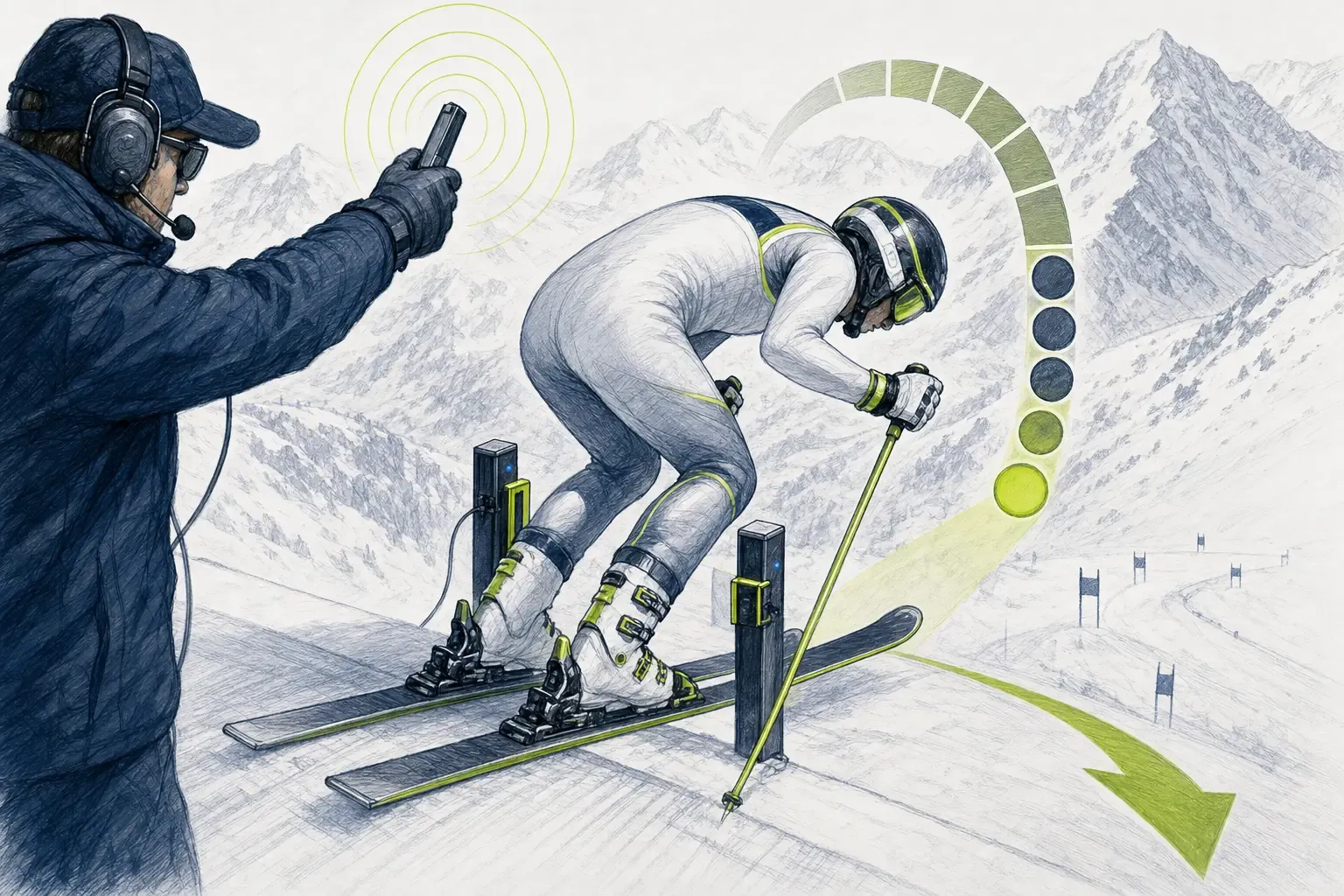
The signal and the start of timing
The word "Go!" on its own usually does not start the final time. In ordinary electronic timing, the start impulse is created only when the skier opens the timing wand by moving their lower legs. The signal therefore determines the permitted departure, while the device records the actual moment the start line is crossed.
At the starter's command, the competitor has their poles placed in front of the start line or at the marked spot. They may push off using ski poles; gaining an advantage by pushing off from the start posts or with help from someone else is forbidden. Starting too early before the signal, deliberately delaying, or not respecting the starting procedure may lead to a penalty under the rules and the jury's decision.
Children's and training context
Children first learn to distinguish three phases: preparation, countdown, and permitted start. At a simple training start, the coach may use a clear agreed command, but before the first races the young skier should also know the official sequence and be able to watch the starter or the start clock.
A common mistake is to set off already at the number "one", or to stay motionless after the signal and only then begin preparing the push-off. The coach therefore does not watch only the speed of the first metres. What matters is a calm starting position, poles ready, attention on the starter, and movement begun without a premature jerk. For smaller children, practice should be appropriate to their ability to react to the signal, without pressure for a forceful or technically difficult start.
Sources and further reading
- FIS – Alpine Skiing Documents, International Competition Rules, edition 6. July 2026
- U.S. Ski & Snowboard – 2026 Alpine Competition Guide
- U.S. Ski & Snowboard – 2026 Alpine Competition Guide, full PDF
- FIS – Timing & Data, Alpine Skiing Timing Booklet
- U.S. Ski & Snowboard – Alpine Competition Officials Education Resources 2025/26
- U.S. Ski & Snowboard – 2025/26 Alpine Precisions