What is the start procedure
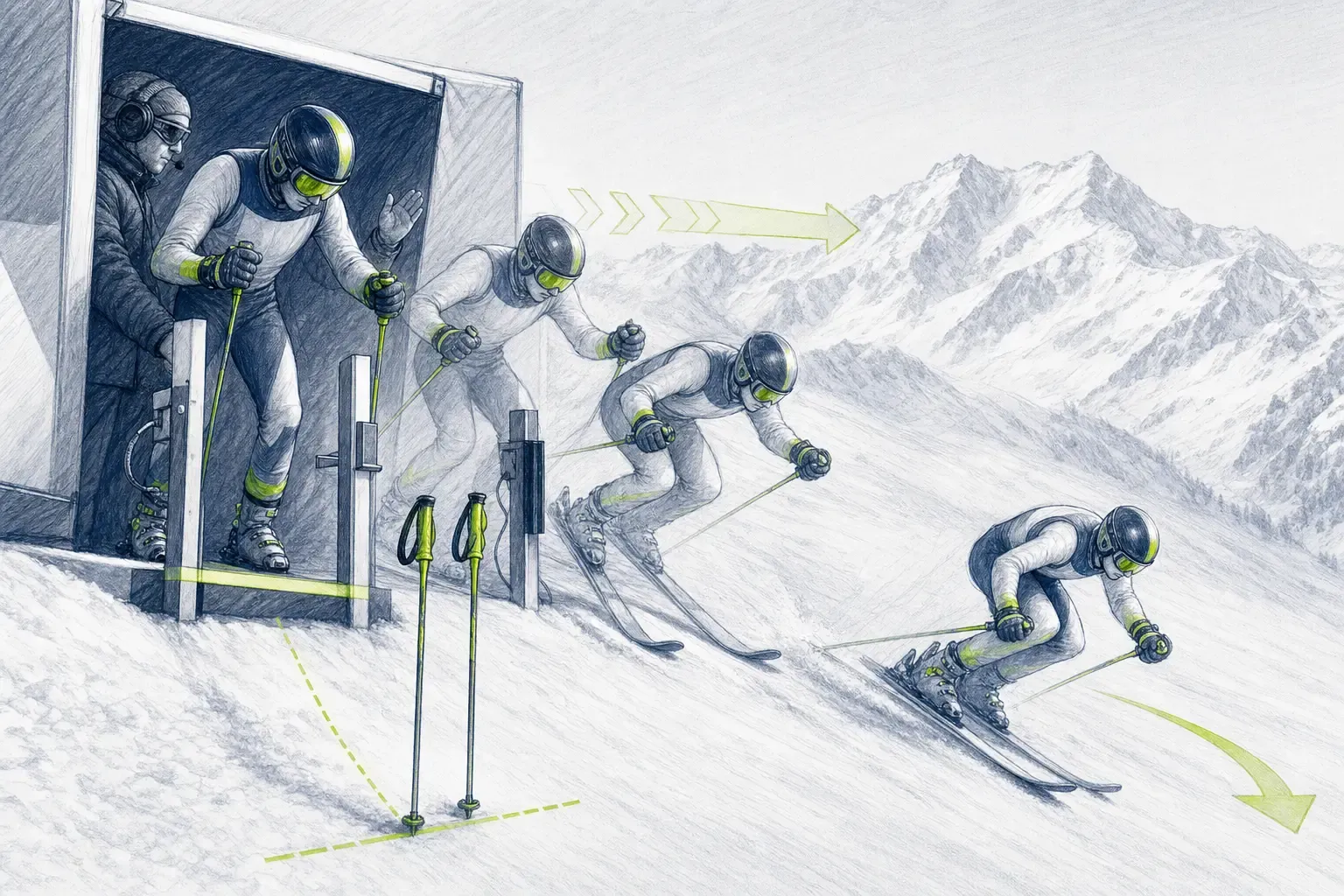
The start procedure includes all actions from calling the racer to the start until they leave the start gate. This includes the racer’s readiness, position in the start area, communication with the starter, the start signal, the permitted departure time, and the start of timing.
So it is not just about technique of movement. The rules determine when and how a racer may start; training practice deals with how to handle that moment safely, calmly, and effectively.
Basic start sequence
The racer must arrive at the start on time, with equipment on and fastened, and follow the instructions of the starter and the official at the start. Before leaving, they place the poles in front of the start line or in the marked spot as instructed.
During the actual start, FIS rules say in particular the following:
- the racer must not receive physical assistance;
- the starter must not hold them or touch them at the start;
- it is not allowed to push off from the start posts or any other fixed structure;
- the skier may use their own poles for the push-off;
- timing begins when the start gate contact opens as the racer leaves.
In FIS races, homologated start devices connected to the main and backup timing system are used. The technical setup and gate check are the responsibility of the timekeepers and officials, not the racer or coach.
Commands and start interval
In downhill, super-G, and giant slalom, fixed start intervals are used. If there is a timing display at the start with an automatic sound signal, the racer must be able to see it. When such a system is not used, the starter announces “10 seconds” ten seconds before the start, then counts down “5, 4, 3, 2, 1” and gives the command “Go,” or its language equivalent.
With a fixed interval, the start is valid if the racer leaves no earlier than five seconds before and no later than five seconds after their official start time. The countdown is therefore not just a rough reminder.
Slalom has irregular intervals. After a signal from timing, the starter tells the racer to be ready and, a few seconds later, gives the start command. The racer then has to start roughly within ten seconds. They do not have to wait until the previous skier reaches the finish; the interval is managed by the starter, timing, and the officials.
Parallel disciplines have a special method of joint start and signaling. The current discipline rules and the jury’s instructions are decisive.
Delayed and false start
A racer who is not ready at the designated time or leaves outside the permitted time window violates the start rules. In slalom, ignoring the procedure and the time set for the slalom start is also a violation. The result may be disqualification.
However, not every delay is judged the same automatically. If an exceptional circumstance arises, the start referee may allow a delayed or provisional start, and the jury will then review the matter. The racer and coach cannot choose a substitute place in the order themselves. They must immediately follow the instructions of the start referee.
Start for children
For young skiers, safety and consistency come before maximum explosiveness. A child should first master a simple routine: arrive on time, check that the helmet and goggles are fastened, stand the skis steadily, place the poles correctly, listen to the command, and set off safely toward the first gate.
The number and force of push-offs are not prescribed universally. They depend on age, body proportions, coordination, the slope of the start ramp, snow quality, and the distance to the first gate. For smaller children, a too aggressive double push-off can upset balance more than help the final time.
Coach’s view
The coach does not follow only the reaction to the sound signal. They assess the whole connection from the start into the course: a stable position, timing of the push-offs, quick move into ski stance, direction of gaze, and preparation for the first turn.
Typical mistakes include arriving at the last minute, inattention to commands, opening the start gate too early, pushing off the structure, continuing to push off for too long, and preparing too late for the first gate. Rather than changing instructions before every run, it is more useful to create a short, always identical pre-start routine and practice it first without race pressure.
At specific races, valid rules, the race schedule, the start program, and the jury’s instructions always take priority.
Sources and further reading
- FIS – Alpine Skiing Documents, official rules and documents
- FIS – Timing & Data; Alpine Skiing Timing Booklet, version 2.67, June 2026
- FIS – Precisions and Instructions for Alpine Skiing, 21. July 2025
- U.S. Ski & Snowboard – 2026 Alpine Competition Guide
- U.S. Ski & Snowboard – 2026 Alpine Competition Guide, full PDF
- U.S. Ski & Snowboard – Alpine Competition Officials Education Resources
- U.S. Ski & Snowboard – official resources for alpine racing