What a race line is
Race line (Engl. race line) is the planned and actually skied trajectory of a skier through a series of gates. It includes where the turn begins, the direction of movement above the gate, passing the gate, finishing the turn, and linking into the next change of direction. So it is not judged only by the distance of the skis from one pole, but by the whole run through the section.
A race line is above all a tactical and coaching term. The FIS rules define the correct passage of gates and other conditions for a valid run, but they do not prescribe one mandatory “ideal” trajectory. A racer can choose a different line as long as they ski the course correctly according to the rules. The current international FIS alpine discipline rules are published among the official FIS documents; as of 2 September 2026, the ICR edition from 6 July 2026 is listed there.
The shortest line is not always the fastest
When choosing a line, there is a basic trade-off between path length and maintaining speed. A straight line can shorten the distance between gates, but it often requires a sharper turn, more braking, or a sudden correction below the gate. A more arcing line is longer, but it can allow smoother ski pressure, less loss of mechanical energy, and a better exit.
Research on giant slalom describes the full range of strategies. On one side is a longer, straighter phase between turns followed by a sharper change of direction, sometimes called the Z strategy. On the other side is a smoother, more continuously curved trajectory similar to the letter S. The results do not confirm one universally fastest strategy for all skiers and all sections. More successful racers were marked mainly by their ability to limit energy loss while using different line shapes.
So a line is not assessed in isolation at a single gate. A racer may cover a slightly longer distance at one gate if it brings higher speed or a better line into the next two or three turns. On the other hand, a tight pass around the pole may look aggressive, but be slow if it is followed by skidding, strong edging across the slope, or a delayed next turn.
What the line depends on
The choice is influenced mainly by:
- the horizontal and vertical distance between gates,
- the slope, side slope, and changes in terrain,
- the hardness, bumps, and grip of the snow,
- the entry speed and approach direction,
- the radius, stiffness, and behavior of the skis,
- technical level, strength, balance and reaction ability of the skier,
- the required direction and space for the next gate.
Even apparently the same stance may require a different line on a steep or gentle slope, or on hard and soft snow. A record of the trajectory therefore matters most when combined with speed, time, the skier’s movement, and the place where stability or energy is lost. Modern analyses combine video, the skier’s position and biomechanical data precisely because the image of the track alone does not explain the whole performance.
Higher and straighter line
At a higher or earlier line the skier begins preparing the change of direction earlier above the gate. That way, they can pass the gate already with the skis aimed into the next section. The advantage is usually more space to build the turn and a calmer exit. However, if the line is unnecessarily high or wide, it lengthens the course and can reduce speed.
Straighter or later line shortens the approach to the gate and keeps the skier pointing downhill for longer. However, it requires a faster and more precise change of direction. If the racer cannot handle it technically, the pressure and turn shift below the gate. The result is often skidding, braking, loss of height, and an even later arrival at the next gate.
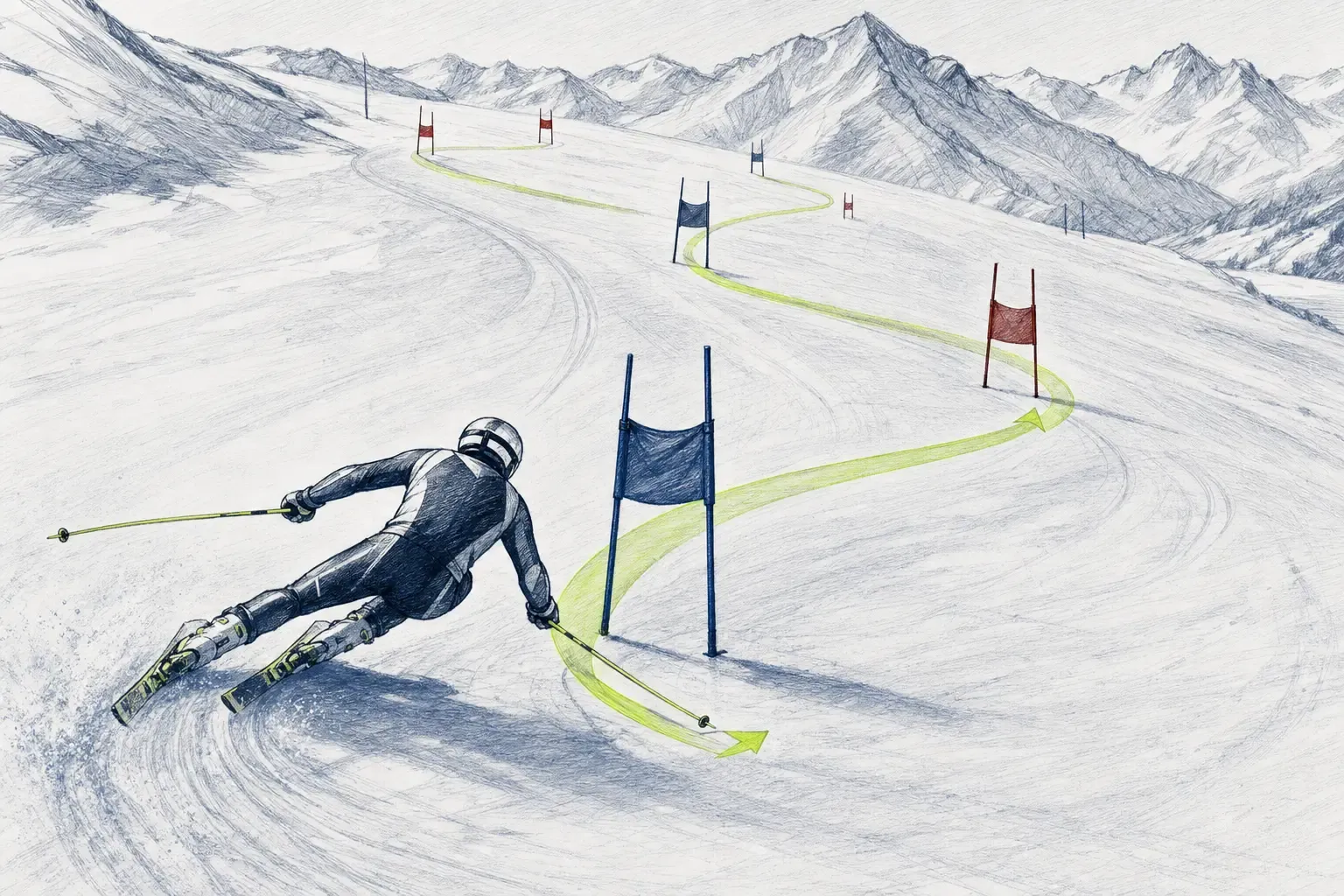
The terms high, low, early or late line are relative. A coach must use them to name a specific part of the turn, not just the skier’s position in one still frame.
Differences between disciplines
In slalom, the line is linked to short time gaps between direction changes, rhythm, and the ability to quickly prepare the next turn. Even a small loss of height can carry over through several following gates.
In giant slalom, the compromise between a shorter path and keeping speed is clearly visible. The shape of the whole turn, the timing of loading the skis, and the direction of the exit are important.
In super-G and downhill, high speed, terrain waves, jumps, gliding sections, and safety space all come into play. The choice of line in speed disciplines cannot be transferred to children’s training without an appropriate course, gradual preparation, and guidance from a qualified coach.
Race line for children
Younger skiers should not be taught the line as an instruction to “go as close to the pole as possible.” First, they need to understand the direction of travel, rhythm, early preparation of the turn, and a safe exit. A suitable goal is a line that a child can repeat reliably without emergency braking and without losing control.
In training practice, simple corridors, brushes, short poles, colored markers, or lines in the snow are used. They help show the space for starting and finishing the turn, but they are not the goal in themselves. Official U.S. Ski & Snowboard materials include tactics, course inspection, visualization, and drills with marked lines in the broader development of technique and decision-making.
An older and more technically advanced racer can already compare more options: a safer arcing line, a straighter attacking line, or a deliberate adjustment of the approach for the next section. The key is whether they can execute the chosen trajectory at real speed, not whether they copy the track of an adult elite racer.
Typical mistakes and misunderstandings
- Chasing the gate: the child aims straight at the pole and only starts turning at it or below it.
- Judging by closeness: passing very close to the pole is automatically considered fast without checking the exit and time.
- The same line everywhere: the skier does not react to changes in rhythm, slope, snow, or the next combination.
- Focus only on the nearest gate: there is no plan for the next two to three direction changes.
- Confusing carving with speed: a clean track can be too long; in some situations, a controlled skid can be a tactical correction.
- Copying elite racers: the same line may be unsuitable for a young skier at their speed, strength, and technique.
Coach’s view
The coach does not assess only where the skier went, but also why they went there and what followed. They watch entry speed, where the turn starts, outside-ski support, pressure build-up, exit direction, and the ability to link the next arc. Video or a marked track is useful when compared with split times and the repeatability of the run.
A good race line is not the prettiest or tightest line at one gate. It is a trajectory suited to the course and the skier, allowing the whole section to be skied quickly, smoothly, by the rules, and with manageable risk.
Sources and further reading
- FIS – Alpine Documents: International Competition Rules and current rules
- FIS – Alpine Skiing Technical Officials Education
- Delhaye et al. – Influence of Line Strategy Between Two Turns on Performance in Giant Slalom
- Cross et al. – Force output in giant-slalom skiing: A practical model of force application effectiveness
- Recent Kinematic and Kinetic Advances in Olympic Alpine Skiing: Pyeongchang and Beyond
- Wearable Biomechanics and Video-Based Trajectory Analysis for Improving Performance in Alpine Skiing
- U.S. Ski & Snowboard – Using Dye Lines for Tactics
- U.S. Ski & Snowboard – Level 200 Alpine Technique & Tactics Course Outline
- U.S. Ski & Snowboard – Alpine Competition Officials Education Resources
- Special Olympics – Alpine Skiing Coaching Resources