What a race course is
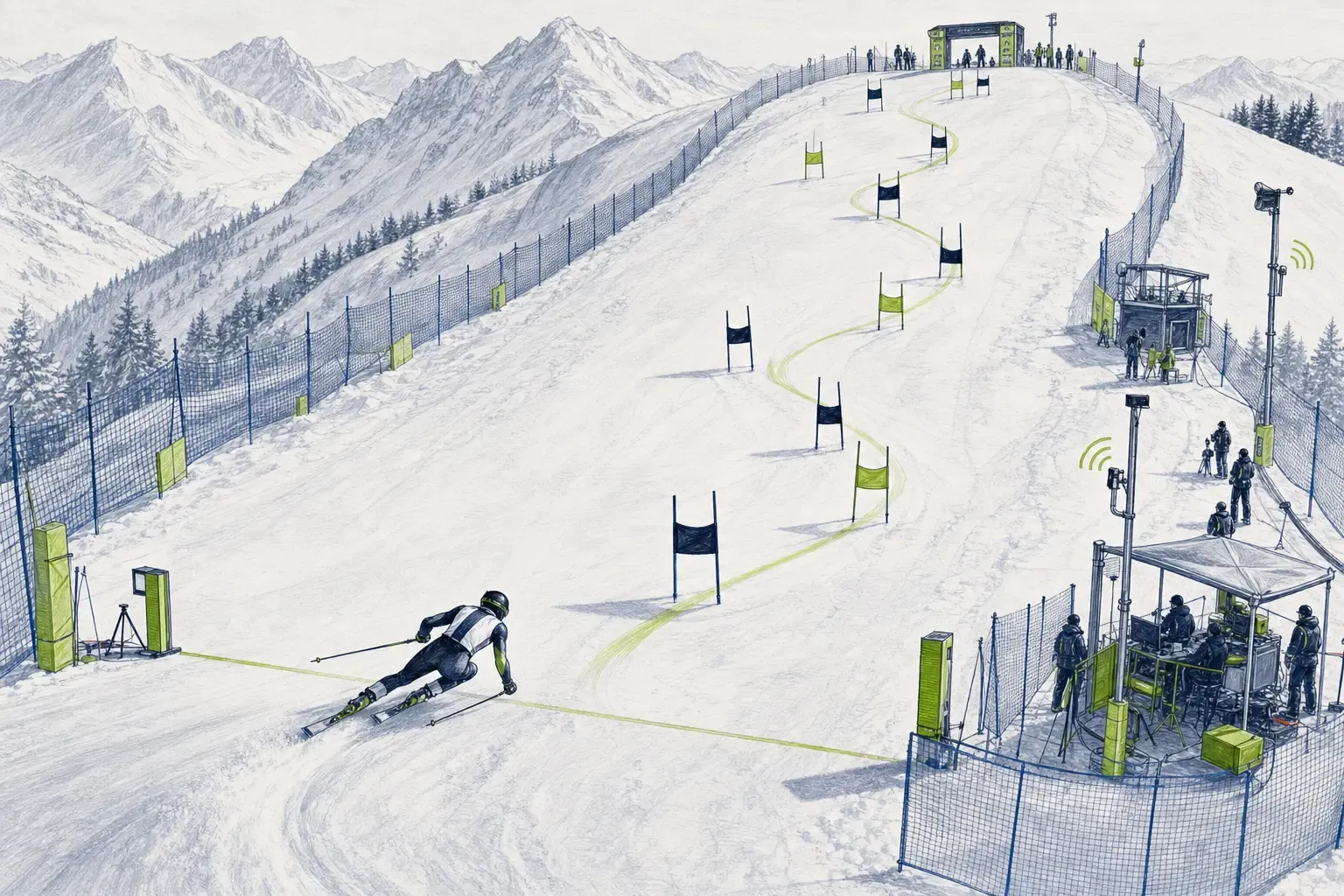
Race course is a prepared, set, and secured section of a ski slope between the start and the finish where a competitive run takes place. In a narrower sense, it refers to the line marked by gates. In a broader practical sense, it also includes the terrain and snow surface, the start and finish areas, safety nets and other safety equipment, timing, signaling, communications, and the space needed for referees and course staff to work.
A race course should therefore not be confused with a ski slope. A ski slope can be open to the public during normal operations, while a race course is a controlled area with restricted access for the duration of a competition or organized training.
Slope, homologation, and course setting
At official FIS races, a slope with valid homologation for the relevant discipline and competition level is used, unless the rules specify an exception. Homologation is a professional assessment of the slope’s basic characteristics, such as its profile, elevation change, width, start, finish, and safety options. FIS keeps a database of homologated courses by location, discipline, and category.
A homologated slope is not yet a finished race course. The actual setting is carried out by the appointed course setter according to the discipline rules. The course is then assessed by the jury, which takes into account the setting, snow conditions, visibility, protection of dangerous areas, readiness of the start and finish, and the current conditions. Homologation therefore does not confirm that the slope is automatically safe in any weather or with any course setting.
How the discipline changes the character of the course
The character of a race course depends on the discipline:
- slalom uses short turns, quick changes of direction, and pronounced rhythm changes;
- giant slalom has wider gate spacing and requires precise turn control at higher speed;
- super-G combines high speed with long turns, terrain transitions, and gliding sections;
- downhill uses a long slope profile, high speed, jumps, compressions, and gliding passages;
- parallel disciplines use two courses set side by side according to special rules.
FIS rules set requirements for each discipline regarding elevation change, the number or spacing of direction changes, gate width, the method of course setting, and other parameters. The specific values may differ according to the discipline, gender, age category, and competition level, so they are always assessed according to the currently valid rules and national regulations.
A gate is not just a place the skier must approach. The rules define its gate line and the correct way to pass through it. In principle, both ski tips and both feet of the racer must cross it; the rules also address the special situation after losing one ski. A wrong pass or missing a gate can lead to the run not being classified, or to disqualification, according to the decision of the relevant judges and jury.
Preparation and safety
The course surface should provide the most even conditions possible for the starters. As needed, the organizer adjusts the snow, removes loose buildups, and repairs damaged areas. In longer races, the condition of the surface changes naturally, so course workers smooth out tracks and restore the area around the gates between runs.
Risk areas are secured according to the expected speed, the direction of a possible fall, the terrain, and obstacles nearby. Protective nets, mats, and other approved equipment are used in particular. However, the presence of a net alone does not replace proper course setting, appropriate speed, or the jury’s decision on whether the course is fit for racing. Technical requirements also apply to flexible poles and gate banners.
Course time is measured between the start and finish impulses. Official competition requires a primary and backup timing system, correctly placed equipment, and timing documentation according to the level of the event.
Race course for children
For children, the course is not adjusted only to body height. Age category, skiing level, experience with gates, ability to read the terrain, snow quality, and expected speed are also important. National and international regulations may set special course and equipment parameters for youth categories. The racer’s equipment and the course parameters are two separately regulated areas.
In club training, not every drill has to be a race course under competition rules. A coach may use brushes, short poles, corridors, or only a few gates. This is training practice, whose goal is to develop a specific skill. A beginner first needs a clear line, enough time to react, and a safe space to stop. Difficulty increases gradually, not just by reducing spacing or adding rhythmic traps.
Typical misunderstandings
- More gates do not automatically mean a harder course. Difficulty is also influenced by terrain, speed, visibility, rhythm, and snow quality.
- Homologation is not a daily safety inspection. Responsible officials and the jury decide whether a particular course is ready.
- A course inspection is not a training run. During it, the racer reads the terrain, rhythm, tricky spots, and possible lines in the mode set by the jury.
- There is no single line that suits everyone. The choice of line also depends on technique, speed, physical predispositions, and the current condition of the surface.
- A harder course is not always better. Especially with children, inappropriate setting can encourage defensive movements and loss of control instead of technical development.
Coach’s view
A good training or race course has a clear purpose. The coach watches whether the children can see the gates in time, link turns smoothly, keep their balance, and control their speed. Particular attention is paid to the first gates after the start, transitions over terrain breaks, exits from steeper sections, and the space for a safe stop at the finish.
The course setter should not surprise the racer with an unreadable or unnecessarily dangerous situation. Their job is to create a sporting test appropriate to the discipline and level of competition. For children, a good course is one that challenges them but also allows them to use the technique they are learning at their age and stage of development.
Sources and further reading
- FIS – International Competition Rules for Alpine Skiing, edition from 6. July 2026
- FIS – What is homologation in Alpine Skiing, and why is it important?
- FIS – Database of homologated alpine ski courses
- FIS – Timing & Data, Alpine Skiing Timing Booklet
- FIS – Specifications for Alpine Competition Equipment 2026/27