What is course inspection
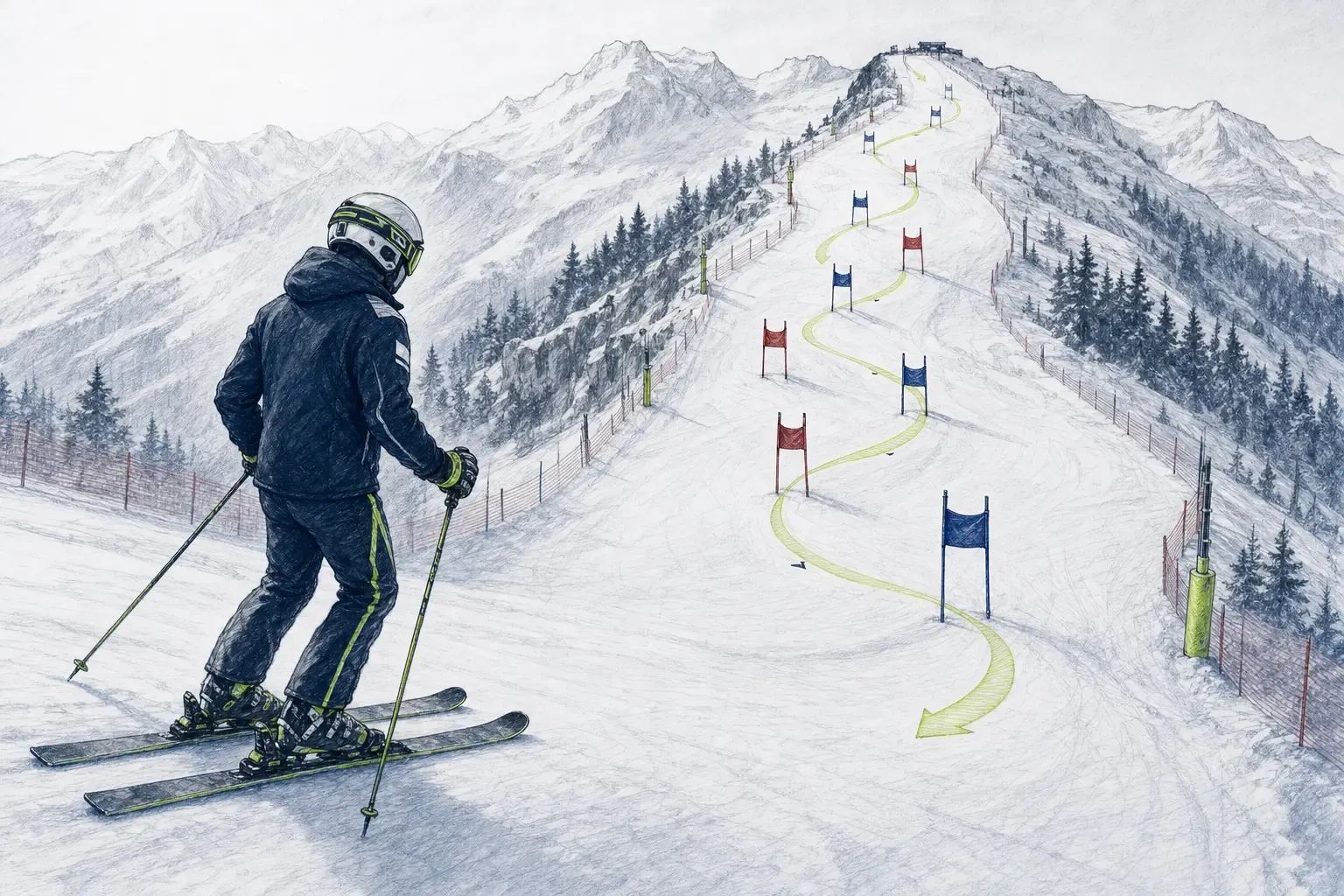
Course inspection, often also called a course preview or course viewing, is a time-limited introduction to the final course before the race run. During it, the skier looks at the placement of gates, changes in rhythm, the terrain, the slope, the snow surface, visibility, and the start and finish areas. The result should be a clear race plan, not practice of the course at race speed.
Inspection must be distinguished from free skiing, warm-up runs, and the official downhill training. It is not even homologation inspection, during which an authorized inspector assesses the suitability of the slope and its compliance with technical and safety requirements.
How it works according to the rules
At FIS races, the jury checks the course first. For race day, it assesses whether the course is ready and confirms the program. The racers’ inspection follows only after the jury opens the course. Its time, duration, and any special method are decided by the jury and announced at the team captains’ meeting. In bad weather or extraordinary conditions, the jury may choose an adjusted format.
Under normal circumstances, racers inspect the course from top to bottom. The rules allow slow skiing along the edge of the course or controlled sideways sliding through the gates. Passing through the gates as in a race and practice turns copying the course setup are not allowed. The racer must wear a bib number, respect fenced-off or closed sections, and leave the course, including the finish area, by the end of the set time. Entry on foot without skis is not allowed by the rules.
At national and children’s competitions, the relevant national rules or the jury’s decision may adjust the organizational details. What matters, therefore, are always the instructions announced at the team captains’ meeting and at the entrance to the course.
What the racer watches for
Inspection is meant to combine technical reading of the gates with perception of the whole slope. Together with the coach, the racer mainly watches:
- the direction and rhythm of the course, including places where the spacing or direction of the gates changes more noticeably,
- steeper and gentler sections, terrain changes, cross slopes, and uneven spots,
- combinations of gates and places where the next turn needs to be prepared in time,
- the quality of the surface, hard or softer sections, and possible worsening of the course,
- light, shadows, visibility, and landmarks,
- a safe exit from the start, the last gates, and the run through the finish.
A specific line is not the only fixed solution. It must match the discipline, the skier’s ability, their bib number, and the current condition of the course. During the race, the surface can change, so the plan must be simple enough and adaptable.
Inspection with children
A younger skier cannot process the same amount of information as an experienced racer. The coach therefore selects only a few key spots and uses clear reference points: a terrain break, a distinct combination, a change of rhythm, or the entrance to the finish. The appropriate number of instructions depends on the child’s age, experience, and ability to keep focus.
At the first races, it is more important that the child understands the direction of the course, knows where to slow down during the inspection, and knows the procedure at the start and finish than that they memorize every gate. The coach organizes the group so that the children do not block the course, do not stop below an obscured spot, and remain under supervision. This is a training and safety practice; the exact procedure at a specific race is determined by the jury.
Typical mistakes
The most serious misunderstanding is to treat inspection as a chance to try out race skiing. Fast skiing, passing through gates, or imitating the course with turns goes against the purpose of the inspection and may violate competition rules.
A common mistake is also to watch only individual gates without perceiving the terrain and the sequence of turns. For children, too many instructions that compete with one another are a problem. An equally ineffective approach is the mechanical attempt to copy the line of a more advanced racer regardless of one’s own speed and technical level.
Coach’s view
A good inspection creates a simple answer to three questions: Where does the rhythm change? Where should the turn preparation start earlier? Which place may decide safe completion of the run? The coach should not overwhelm the child with a full breakdown of the course. Instead, they help set priorities, check understanding, and create a plan that the young skier can use independently.
Inspection ends with a mental run-through of the course, not with more gate practice. Its quality is judged not by how many details are memorized, but by whether the racer understands the key places and can respond safely to changing conditions.
Sources and further reading
- FIS – Alpine Skiing Documents: current International Competition Rules and related documents
- U.S. Ski & Snowboard – 2026 Alpine Competition Guide
- U.S. Ski & Snowboard – 2026 Alpine Competition Guide, PDF
- U.S. Ski & Snowboard – Alpine Competition Officials Education Resources
- U.S. Ski & Snowboard – Alpine Course Homologation Rules
- FIS – International Competition Rules for Alpine Skiing, edition 2024, archived reference document
- FIS – Para Alpine Skiing Rules and Regulations: rules for course inspection in para alpine skiing