What Is Alpine Skiing
Alpine skiing is a way of skiing in which the skier descends a snow-covered slope on skis with the heel firmly fixed in the binding. Direction and speed are controlled mainly by linking turns, edging the skis, turning them, and adjusting pressure. The term refers both to recreational skiing on downhill runs and to the sport discipline governed internationally by the FIS.
In everyday speech, alpine skiing is often called downhill skiing. However, in precise sports terminology, downhill is only one of the racing disciplines. Alpine skiing is a broader term.
Racing Disciplines
The basic individual disciplines include:
- slalom (SL) – a technical discipline with short turns, quick changes of direction, and small distances between slalom poles,
- giant slalom (GS) – a discipline with longer turns and wider distances between gates,
- super-G (SG) – a speed discipline that combines high speed with a technically set course,
- downhill (DH) – a speed discipline on a long course, usually with terrain changes, gliding sections, and jumps,
- combined, team, and parallel formats – their inclusion and exact form depend on the program of the specific competition and the current rules.
Rule: In races, it is not enough to post the fastest time. The competitor must correctly complete the prescribed course, start, and finish in accordance with the rules. Details of gate passage, start, finish, reruns, equipment, or disqualification are determined by the current rules of the respective competition. For FIS events, the decisive document is the valid edition of the International Competition Rules.
Times at official races are measured with an approved timing system. The result is therefore not based on a coach’s estimate or on the time from ordinary watches.
Basic Movement Tasks
A skier is constantly dealing with three interconnected tasks while skiing:
1. maintaining balance over moving skis, 2. changing the direction and size of the turn, 3. regulating speed and pressure between the skis and the snow.
How these tasks are solved changes depending on the slope, terrain, snow quality, speed, and chosen turn radius. That is why there is no single fixed body position that works in every situation. Good technique allows the skier to keep adjusting movement without losing control.
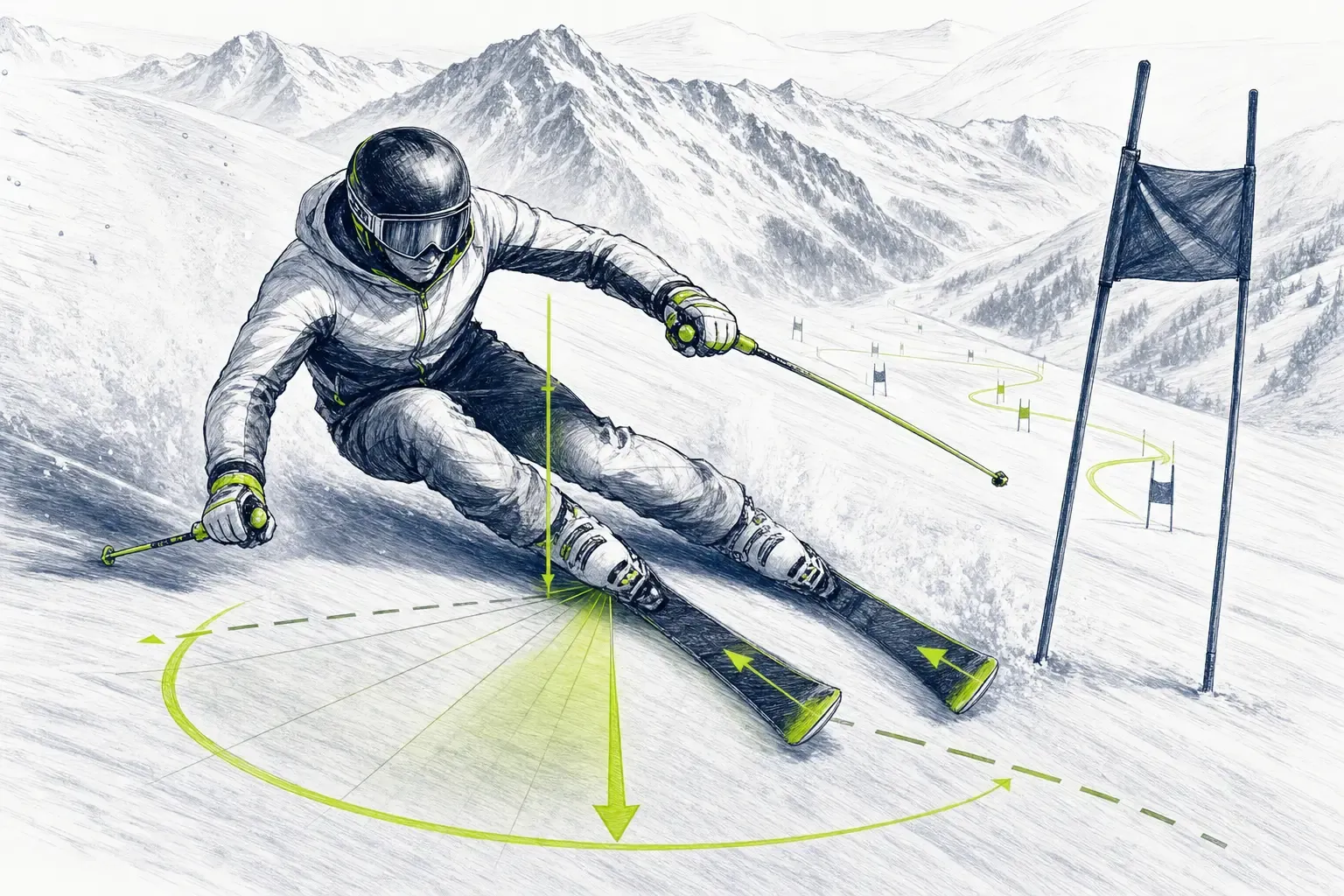
Carving, that is, guiding the skis mainly on edge with only a little sideways skidding, is just one way to make a turn. Controlled skidding remains an important skill for regulating speed, in narrow spaces, in difficult snow, or when stopping.
Children’s alpine skiing
For beginners, controlling the run is more important than how the stance looks. A child should gradually learn to stop safely, turn both ways, regulate speed, get up after a fall, and handle an appropriate slope independently. The difficulty of the terrain and tasks is adapted not only to age, but also to experience, physical development, fatigue, and current conditions.
Training practice: With younger children, skills are often developed through play, skiing in different tracks, changes in turn radius, and simple orientation tasks. Gates can help set direction and rhythm, but they should not serve only for mechanically going around poles. Demanding large edging angles, an excessively low position, or speed too early can hide weaknesses in balance and ski control.
In race training, general skiing skills are joined by course inspection, line choice, rhythm, correct passage through gates, start, and finish of the run. Speed disciplines require a specially prepared and secured course, suitable equipment, experienced expert supervision, and gradual preparation. They cannot be imitated by free fast skiing on a public downhill slope.
Equipment and safety
The basic equipment consists of alpine skis, ski boots, and bindings with a firmly attached heel. Depending on the environment and level of skiing, poles, a helmet, and other protective elements are used. Race equipment may be subject to special technical rules of the FIS or the national association.
The binding must match the ski boot and the skier and must be properly mounted, adjusted, and checked. The release force value cannot be determined safely only by age or body weight. Adjustment belongs to qualified service according to the skier’s data, technical procedures, and the manufacturer’s instructions.
A helmet or protectors do not eliminate the risk of collision or fall. The basis of safety remains appropriate speed, enough distance, the ability to stop, and respect for closures and instructions from staff or the coach.
Common misunderstandings
- A faster skier is not necessarily technically better. What matters is whether they can control speed and repeatedly follow the chosen line.
- Carving is not all alpine skiing. A skier needs more ways to regulate the turn and speed.
- Gate training does not automatically fix technique. An unsuitable course can rather reinforce a mistake.
- Children’s technique is not a smaller copy of an adult racer’s technique. Both tasks and equipment must respect the child’s development and abilities.
- Better equipment does not replace skill. Improperly chosen or poorly adjusted equipment can make learning harder.
Coach's view
The coach watches not only the final body position, but above all how the skier keeps balance, controls direction, and reacts to changes in terrain. The goal of children's training should be an all-around, independent skier who can safely vary rhythm, turn radius, speed, and line. Racing specialization builds on this foundation; it should not replace it.
Sources and further reading
- FIS – Alpine Documents: current alpine skiing rules and documents
- FIS – Alpine Skiing Calendar & Results: competition disciplines and categories
- FIS – The Organization: the role of FIS and the management of sports disciplines
- FIS Statutes 2025: the place of alpine skiing among FIS disciplines
- FIS – Timing & Data: official timing and data documents
- FIS – Alpine Skiing Officials Education: education and roles of technical officials