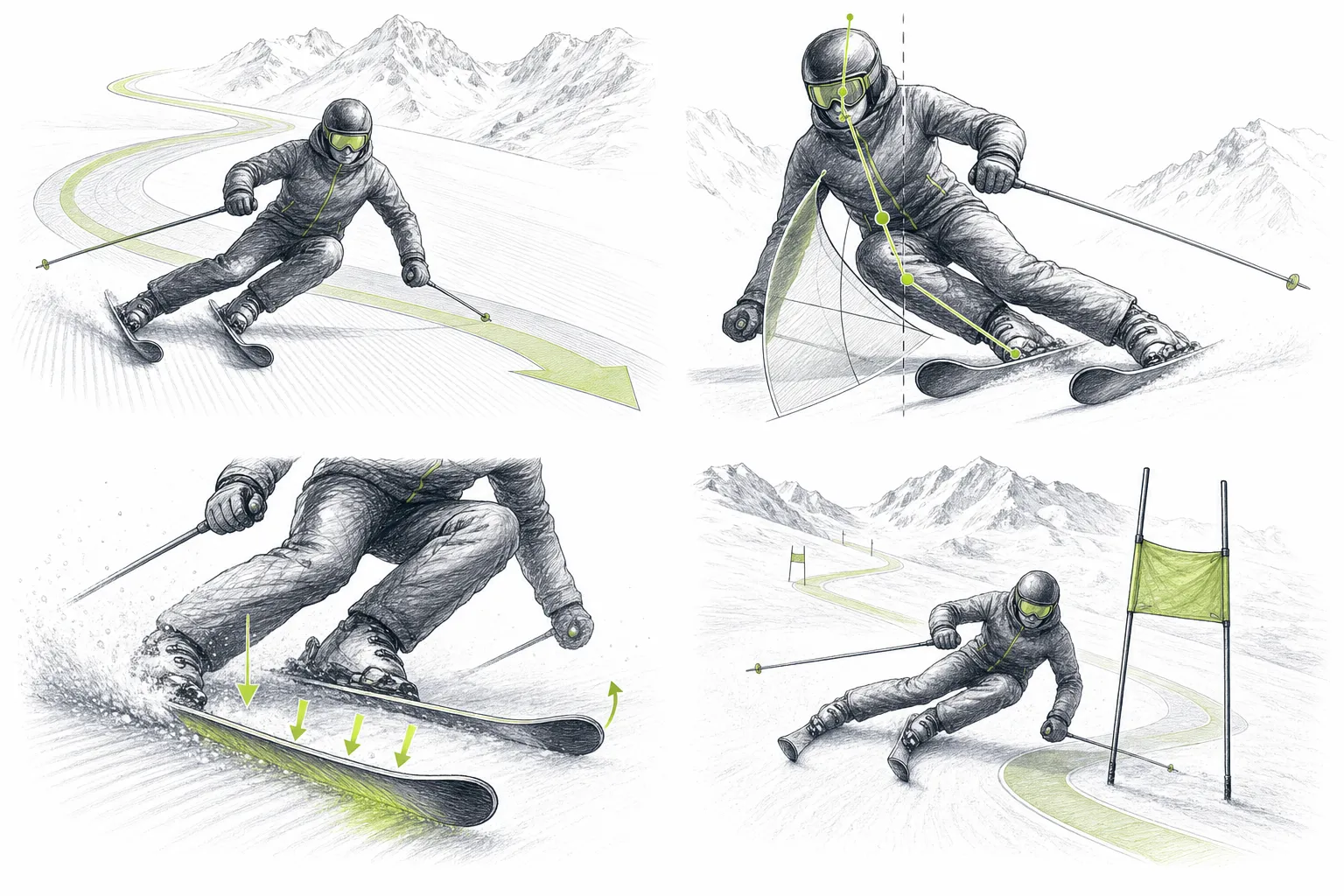
Edging is a controlled change in the ski’s crosswise angle relative to the snow surface. It includes tipping the ski onto its edge, increasing or decreasing the edge angle, and releasing it before entering the next turn. Carving is used in Slovak coaching language mainly for actively setting the ski on edge or for the state when the edge creates side support in the snow.
Both terms are often used as synonyms. For teaching, however, it is useful to distinguish between edging as an ongoing movement and carving as its result or a specific phase. It is not a separate definition in the FIS competition rules, but a methodological term for the technique.
What happens with an edged ski
When a ski is flat on the snow, the angle between its base and the snow surface is roughly zero. By tipping the ski, this angle increases and the steel edge engages the snow more strongly. An edged and loaded ski can create a lateral reaction force that helps guide the skier along a curved path and reduces sideways skid.
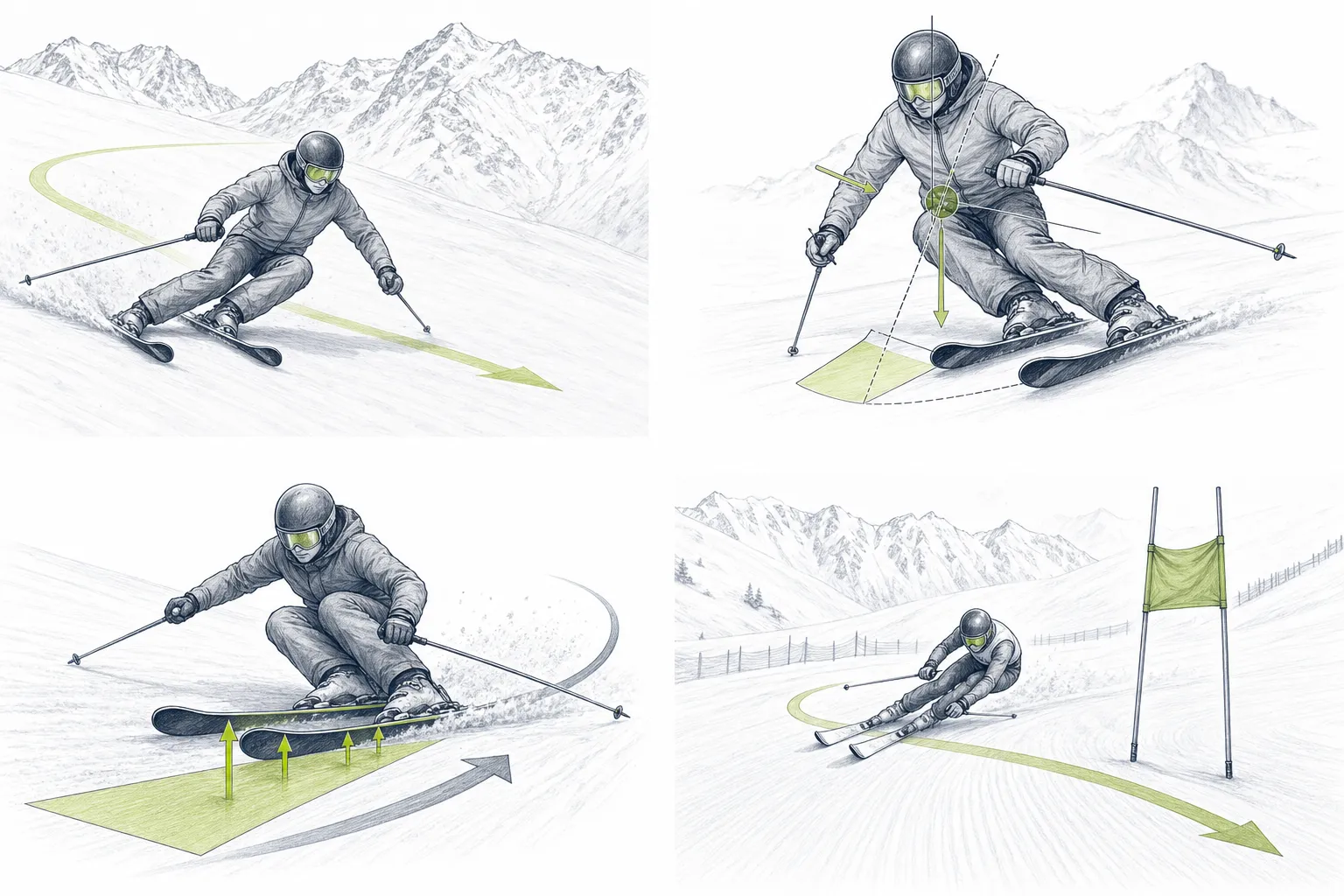
In a carved turn, the ski bends under load and its edge follows a curved track. A greater edge angle can allow a smaller turn radius, but it does not guarantee it on its own. The result also depends on:
- the load and pressure distribution along the ski,
- the skier’s balance,
- the ski’s direction relative to its line of travel,
- the ski’s geometry and stiffness,
- speed, slope gradient, and snow conditions,
- the condition and tuning of the edges.
An edged ski therefore does not have to be carving. If it moves partly sideways, it can slide in a controlled way on the edge. Such a skid is not automatically a technical error: when regulating speed, in short turns, or in difficult terrain, it can be an intentional solution.
How a skier creates edge angle
Edge angle is created by combining the inclination of the skier’s whole body into the turn and angulation, that is, the appropriate alignment of body segments, especially in the ankles, knees, and hips. The exact ratio changes according to speed, turn radius, terrain, and the intention of the run.
Edging should not be a one-time sharp movement. In most turns, the edge angle changes smoothly: the old edges are released, the skis move toward a flat position during the transition, tip onto the new edges, and their angle is then built up further according to the needed support. So just as important as edging is un-edging, that is, reducing the angle and releasing the edges.
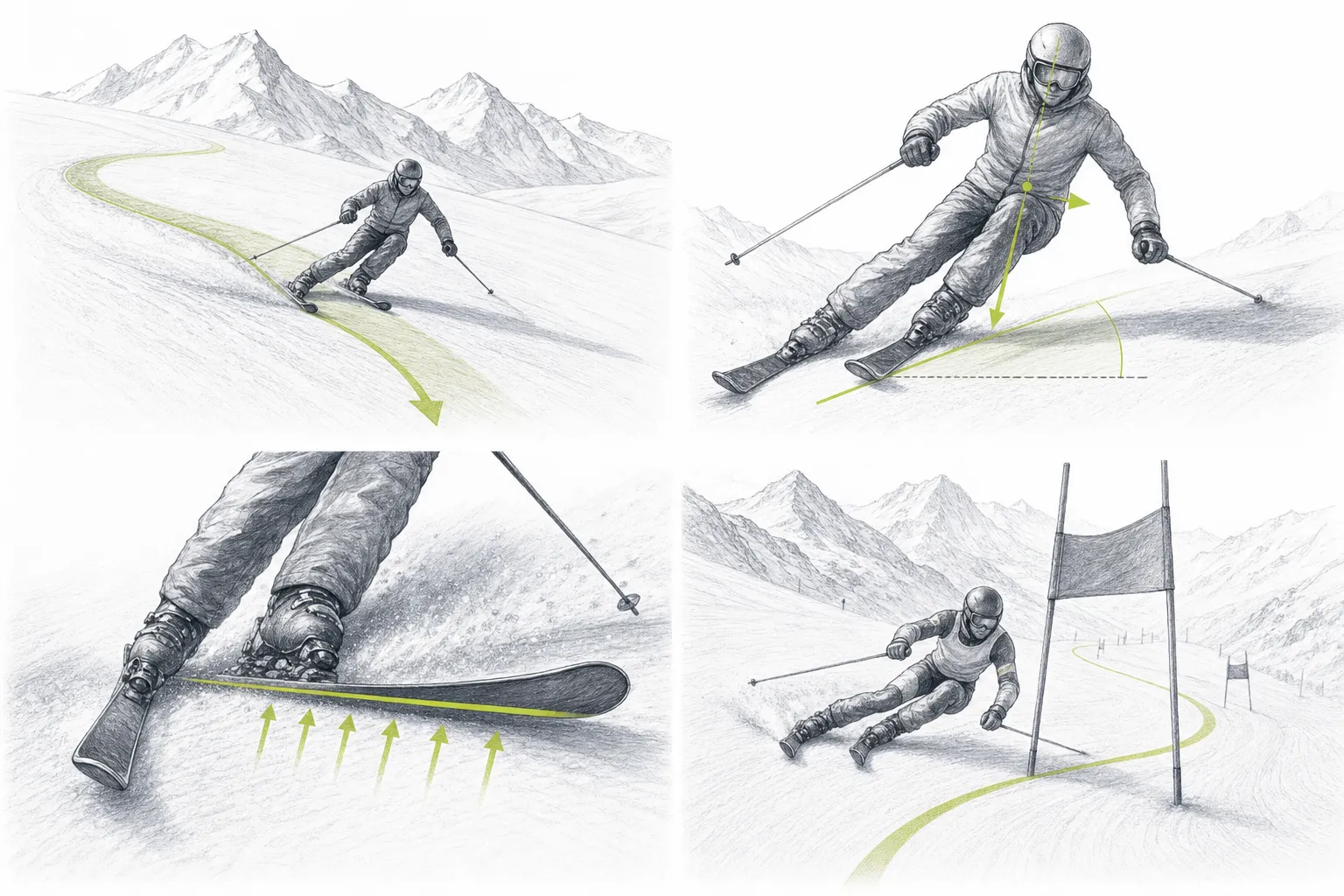
The instruction “move your knees inward” is incomplete and, if done improperly, can lead to unnatural positioning of the lower limbs. The coach watches the whole movement chain, the support of the feet in the ski boots, and whether the skier stays above the skis in dynamic balance.
Edging in teaching children
With children, the goal is not to achieve the greatest possible edge angle. First they learn to recognize the difference between a flat ski and an edged ski and to safely regulate the amount of skidding. Suitable tasks on a gentle, clear slope may include traversing, changing the height of the track, turns with different amounts of skidding, or comparing a narrow and a wider track in the snow.
The difficulty must match the child’s age, motor skill level, speed, and equipment. Boots that are too stiff or too large, an unsuitable ski length, or fatigue can limit the ability to change edge angle smoothly. The coach therefore does not evaluate only body position, but also whether the child can intentionally engage and then release the edges again.
Race significance
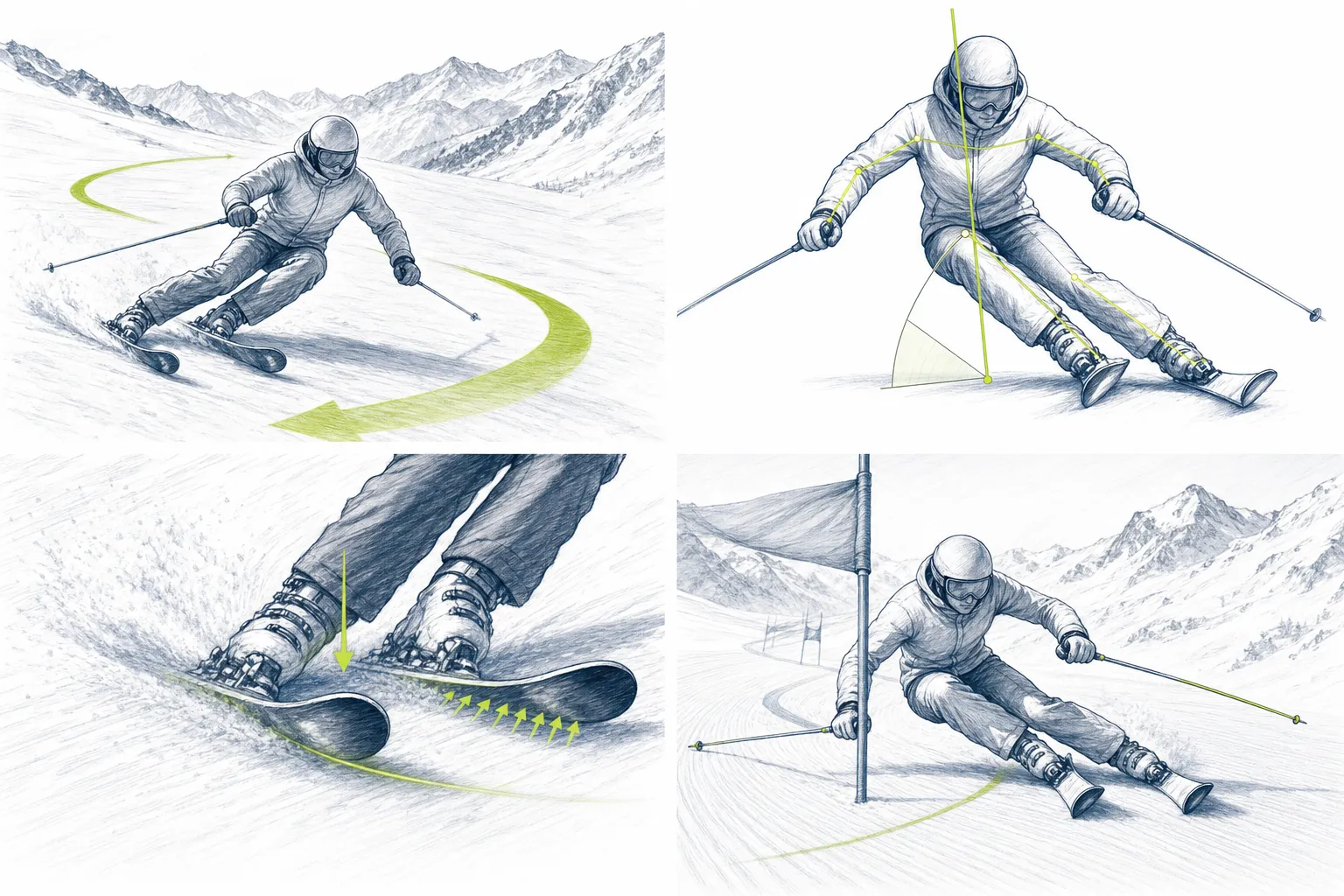
In race skiing, edging affects ski grip, turn radius, line choice, and the ability to transfer forces between skier and snow. The edge angle changes during the turn; the optimal timing cannot be determined by one general instruction. It depends on the discipline, gate spacing, surface, speed, and tactics.
A sudden edging movement can cause a sharp increase in forces or an unwanted change of direction. Conversely, delayed edging can lead to a wide line, loss of height, and the need to finish the turn abruptly. The racer therefore needs to engage the edges progressively, relying mainly on the outside ski, and to release them in time once the turn task is complete.
Typical misunderstandings
- The bigger the angle, the better the turn. A large angle without proper loading and balance may not create effective support.
- Edging means carving. Even an edged ski can skid in a controlled way.
- Edges are created only by the knees. The movement arises from the cooperation of the whole body and must respect joint alignment.
- You should hold the edge for as long as possible. Without timely un-edging, the transition and the start of the next turn worsen.
- The edge angle while skiing is the grinding angle. These are two different terms. Service angles of the ski base and side edge belong in the hands of a professional service shop and must respect the equipment and the manufacturer’s recommendations.
Coach’s view
A coach does not assess edging only by how much the body is tilted. They watch the whole arc, the ski track, the amount of skid, balance, where support is created, and how smoothly the edges are released. A narrow, clean track may indicate carving, while a wider, smeared track indicates skidding; however, correctness always depends on the assigned task. Good edging means, above all, the ability to change the edge angle precisely, smoothly, and at the right time – not to achieve the most striking position possible.
Sources and further reading
- Snyder et al.: Connected skiing – validation of edge angle and radial force estimation
- Reid et al.: Alpine Ski Motion Characteristics in Slalom
- Sahashi and Ichino: Carving-turn and edging angle of skis
- Mössner et al.: Mechanics of wedge turns in alpine skiing
- Mössner et al.: Mechanics of side-slipping in alpine skiing
- Spörri et al.: Sidecut radius and the mechanics of turning
- U.S. Ski & Snowboard: Alpine Coaching Manual, Level 100
- Canadian Adaptive Snowsports: Ski Instructor Manual