What a line of travel is
Line of travel is the skier’s spatial path down the slope. It can be tracked by the ski tracks, foot movement, or the trajectory of the center of mass. These paths are not completely identical: with strong edging and angulation, the skis can pass closer to the gate than the body’s center of mass. Technical analyses therefore often distinguish between the ski trajectory and the center-of-mass trajectory.
In free skiing, the line is influenced mainly by the slope’s pitch and width, terrain changes, snow quality, other skiers, the required turn radius, and the ability to control speed. On a race course, it is also determined by the gate setup — their spacing, lateral offset, and the sequence of the individual combinations.
The shortest line is not always the fastest
A direct line shortens the distance covered, but it can require a very sharp turn at the gate. If the skier does not have enough space, technical confidence, or grip for it, they must brake the skis in a skid, or they may end up below the gate and make the next turn more difficult. A rounder, higher line is longer, but it can allow a smoother change of direction and better speed retention.
Research in giant slalom shows that results are not created by the length of the line alone. What matters is also the radius and timing of the turn, the loss of mechanical energy, entry speed, and how one turn’s line prepares the skier for the next section. The optimal trajectory therefore depends on the specific course and the skier’s abilities.
In coaching language, for example, the term higher line, where the change of direction begins earlier above the gate, or more direct line, which leads to the gate in a shorter path, is used. These are not strictly separate techniques. They are descriptive names for a strategy, and their suitability changes from turn to turn.
Line on a race course
A racer does not choose the line only to the nearest gate. They follow the sequence of several gates, changes in rhythm, terrain beyond the crest, and the place where speed will need to be released or controlled. Especially important is the exit line: the direction and position after passing the gate often decide whether the next turn can be started in time.
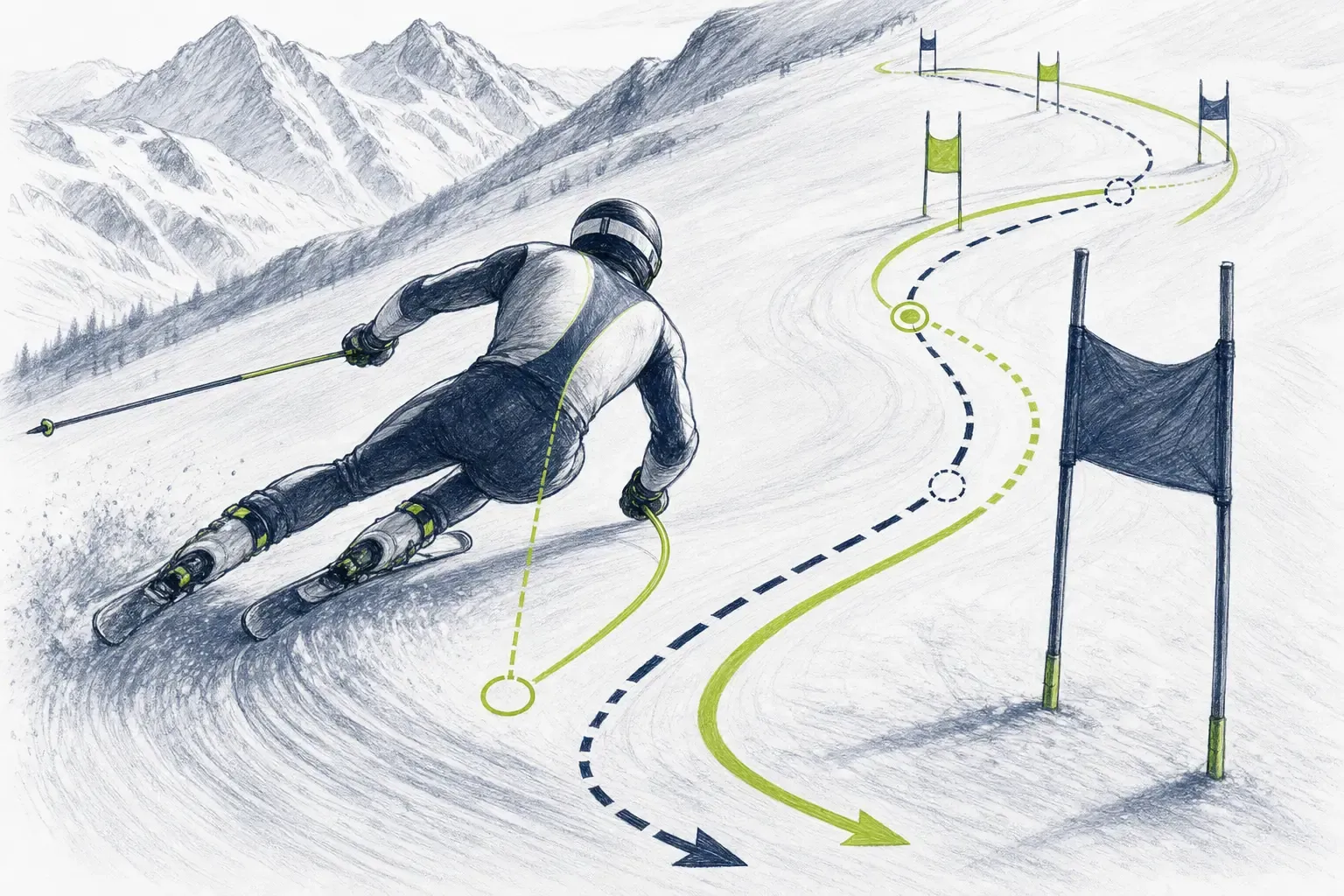
According to FIS rules, the basic condition for a correct passage through a gate is crossing the gate line with both ski tips and both feet, with details depending on the discipline and gate type. However, the rules do not define one mandatory race line. They set out the correct way through the course; choosing a fast and safely manageable trajectory is the tactical task of the skier and coach. Current international rules should always be checked in the valid edition of the FIS ICR.
Course setting affects not only performance, but also load and speed. Research in speed disciplines therefore examines the relationship between gate setting, trajectory, speed, and racer safety.
Children and learning the line
A beginner child first learns to deliberately change direction and choose a safe line, not copy an adult racer’s line. Good options are wide corridors, cones, brushes, lane-change drills and simple courses with plenty of space. The task should match the child’s age, speed, motor skill level and ability to look ahead. The lane-change drill is also used in its coaching video library by U.S. Ski & Snowboard.
For younger skiers, a task like “go through this space and get ready for the next marker” is more useful than the abstract instruction “take a higher line.” In race preparation, precision is increased gradually, but only after balance, speed control and linking turns have been mastered.
Typical mistakes and misunderstandings
- Trying to stay as close as possible to every gate. A tight passage is worthless if it ruins the direction and speed into the next turn.
- Starting the direction change too late. The skier then finishes a large part of the turn under the gate and often has to brake sharply.
- Confusing a straight line with a fast line. A shorter path can lead to a tighter turn, more skidding and greater energy loss.
- The same line in every situation. The trajectory must be adapted to the rhythm of the course, the slope, the surface, visibility and current speed.
- Judging only by the ski tracks. The coach also watches the movement of the center of mass, the exit direction, where speed is regulated and the preparation for the next turn.
Coach’s view
A racing line is the result of tactics, reading the course and the skier’s technical abilities. The coach therefore does not correct only the position at one gate. They assess where the skier started to change direction, what speed they entered the turn with, where skidding or braking occurred, and whether the exit prepared the next section. Video, position measurement or trajectory recording can make the analysis more precise, but they do not replace observing the whole run and giving an appropriate training task.
Sources and further reading
- FIS – Alpine Documents: International Competition Rules (ICR), edition 6. July 2026
- U.S. Ski & Snowboard – Freeski with Lane Changes, Alpine Guide to Ski Fundamentals
- Supej et al. – Influence of Line Strategy Between Two Turns on Performance in Giant Slalom
- Gilgien et al. – Injury Prevention in Super-G Alpine Ski Racing Through Course Design
- Fasel et al. – Estimating Center of Mass Trajectory in Alpine Ski Racing
- Dynamic Analysis and Trajectory Optimization for the Nonlinear Ski-Skier System
- Hirano – Quickest Descent Line During Alpine Ski Racing
- Wearable Biomechanics and Video-Based Trajectory Analysis for Improving Performance in Alpine Skiing