What Linking Turns Is
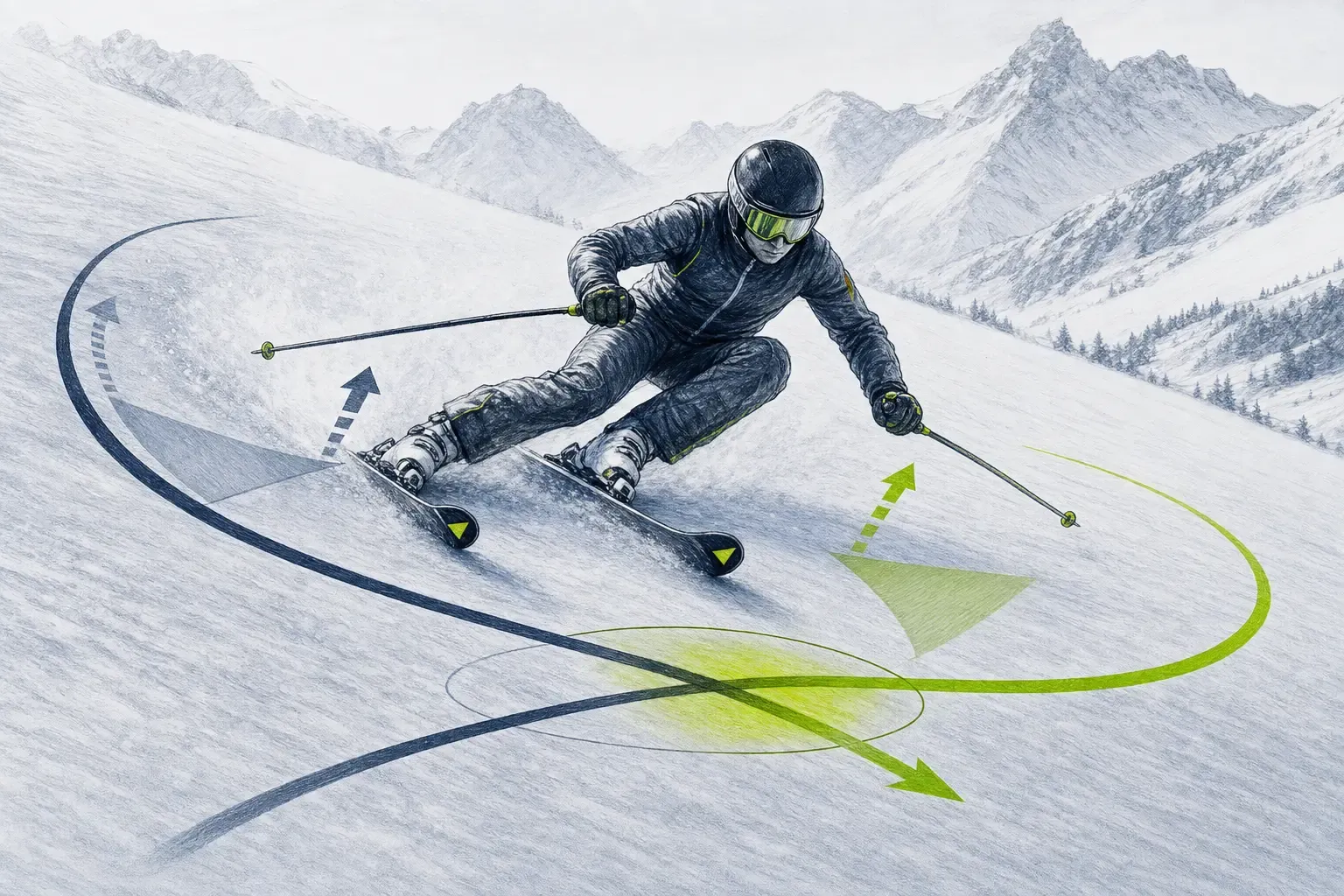
Linking turns is the ability to move smoothly from a turn to one side into a turn to the opposite side. It is not just a quick flip of the skis from edges to edges. The transition includes releasing the original edging, changing support between the legs, moving the skier into the new turn, and gradually creating a new direction for the skis.
The end of one turn and the start of the next partly overlap. In modern racing technique, a turn is therefore not understood as a movement that ends completely and only then another begins. The way the transition is made depends on speed, slope steepness, turn radius, snow conditions, and the skier’s intention.
Practical Importance
Good linking allows the skier to keep balance, rhythm, and speed control throughout a series of turns. The movement does not always have to be equally quick or symmetrical. On open terrain, the rhythm may change according to the slope, and in a race course according to the gate setup.
Linked turns can include wedge turns, parallel skidded turns, and carved turns. The term is therefore not a synonym for carving. What matters is the movement and directional continuity between turns, not whether the skis leave a clean carved track.
A pole plant can support rhythm, stability, and timing in some types of turns, but it is not a general requirement for linking turns. Small children in particular can learn to connect turns smoothly even without poles.
Linking Turns in Children
For a beginner child, an important step is the transition from one separate turn or stop to repeated turns to both sides. Appropriate quality is not judged by the look of adult racing technique, but by whether the child:
- can alternately change direction to both sides,
- stays balanced and within the chosen space,
- adapts the shape of the turns to the steepness of the slope,
- keeps a speed that they can safely control,
- does not need to stop or traverse for a long time after each turn.
The terrain and task must match the child’s age, experience, and motor level. In training practice, wide corridors, reference points, simple rhythm tasks, changes in turn size, and skiing along various easy lines are used. The goal is not to force one movement pattern, but to develop the ability to adapt the transition to the current situation.
Race Context
In racing skiing, linking turns affects the smoothness of the run and the loss or retention of speed. The racer must release the original edging in time, move into the next turn, and create support suited to the new line. With changes in rhythm or gate spacing, the length and character of the transition also change.
Smoothness does not mean that the skier must be completely unweighted between turns or that they must always make a pronounced upward movement. The amount of leg extension and flexion changes according to the discipline, terrain, speed, and chosen style of skiing.
Typical Mistakes and Misunderstandings
In training practice, a long passive traverse across the slope after each turn often appears. Another problem is holding the original edges for too long, followed by a delayed and abrupt start of the next turn. Flow can also be disrupted by rotating the whole torso instead of purposeful leg work, excessive arm movement, or losing support on the outside ski.
Another mistake is confusing smoothness with maximum frequency. Rapid alternation of short movements does not yet mean good linkage if the skier cannot regulate direction and speed.
Coach’s view
The coach watches not only the instant between turns, but also the movements that come before it. A late or tense transition can be the result of an unsuitable line, excessive braking, loss of balance, or too much pressure built up in the wrong part of the previous turn.
For children, it is better to change terrain, corridor, radius, and rhythm than to repeatedly demand one exact body position. Good linking shows when the skier can continue from turn to turn calmly, purposefully, and with room left for the next decision.
Sources and further reading
- U.S. Ski & Snowboard – Alpine Level 100 Manual (PDF)
- U.S. Ski & Snowboard – Alpine Training Systems (PDF)
- U.S. Ski & Snowboard – Athlete Performance Profile
- U.S. Ski & Snowboard – Alpine Guide to Ski Fundamentals: The Turn Model
- U.S. Ski & Snowboard – Level 100 Updates: Carving and Transitions
- U.S. Ski & Snowboard – Alpine Ski Fundamentals Instructor Manual (PDF)