What Ski Steering Is
Ski Steering is the ongoing control of the skis’ direction and path while skiing. It lets the skier decide where the turn begins, what shape and radius it will have, how it ends, and how much speed is regulated in the process.
The term can be understood more broadly as controlling the skis throughout the whole turn, or more narrowly as the guided part between the start and the finish. It is not a single movement. In every turn, three basic actions combine in different proportions:
- turning the skis – changing the orientation of their longitudinal axis,
- edging – changing the angle between the ski base and the snow surface,
- pressure control – changing the amount and distribution of forces acting between the skis and the snow.
In a normal turn, these actions cannot be fully separated. A coach can practice them individually, but while skiing they must be timed and coordinated.
How Skis Change Direction
Turning requires a sideways reaction from the snow. The skier mainly influences this through the edging angle, the ski’s orientation relative to the direction of travel, and how much pressure is applied to the ski. Also important are sidecut, the ski’s longitudinal and torsional stiffness, speed, and the properties of the snow layer.
In a carved turn the edged and bent ski moves roughly in the direction of its longitudinal axis. Its shape and deformation create a self-steering effect. That does not mean, however, that it is enough to simply tip the skis onto edge. The skier must maintain balance, change edging appropriately, and regulate pressure throughout the entire turn.
In a guided skidded turn the ski’s longitudinal axis forms a certain angle with the direction of its actual movement, known in biomechanics as the angle of attack. The ski moves forward and partly sideways at the same time. The amount of skid can be small and precisely controlled, or more pronounced if the skier needs to change direction or speed more quickly.
Skidding is therefore not automatically a technical mistake. It is mainly a mistake when it happens unintentionally, is abrupt, and causes the skier to lose the chosen line or stability.
Outside and inside ski
In most guided turns, the main supporting role is taken by the outside ski. However, the load is not fixed, nor is it always borne exclusively by one ski. It changes between phases of the turn and depends on speed, terrain, snow, and the intended line. The inside ski remains an active part of balance and must be guided in harmony with the outside ski.
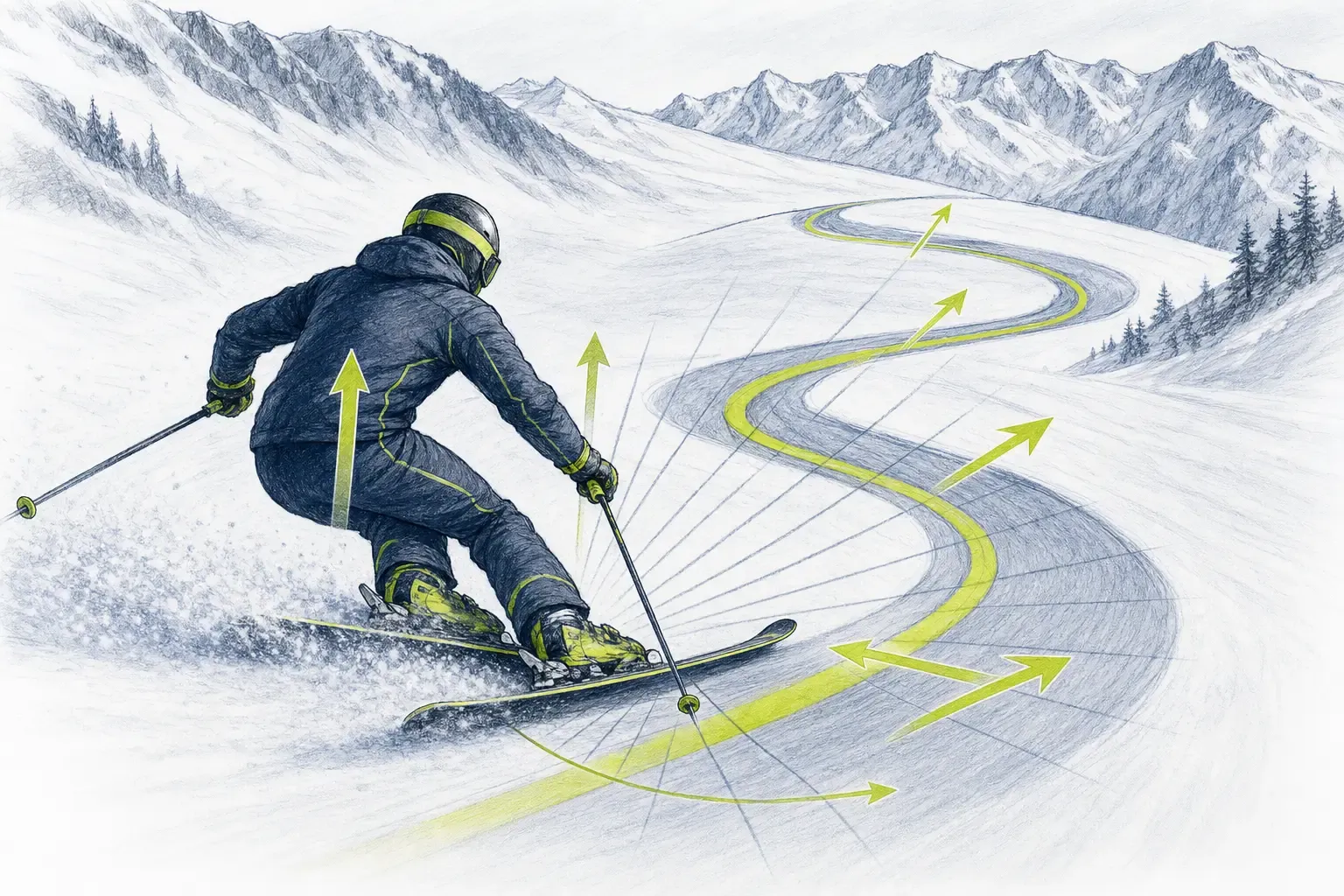
The cue “shift your weight” is therefore only a simplification. A sideward movement of the body by itself does not reliably steer the skis. What matters is how the skier creates support against the snow, releases the old edges, and smoothly engages the new ones.
Ski guidance in children
In children’s skiing, ski guidance develops gradually together with balance, spatial awareness, and the ability to control the lower limbs independently. The appropriateness of the tasks is assessed according to skiing skill and motor maturity, not just age.
In training practice, it is helpful for a child, on a safe and appropriately gentle slope, to notice the difference between:
- a larger and a smaller turn,
- smooth and abrupt steering of the skis,
- riding on a flatter and a more edged ski,
- smooth guidance and a sudden pushing out of the tails,
- support on the outside ski and falling into the turn.
The goal for a beginner is not the earliest possible “clean carving.” First, they need to change direction safely, stop, adapt speed to the space, and manage several ways of guiding the skis. A rigid imitation of a race stance without mastered balance usually does not help.
Racing significance
In racing skiing, ski guidance is judged by whether the athlete can combine the chosen line, the shape of the turn, and the preservation of speed. The racer changes the turn radius by edging, steering the lower limbs, and regulating pressure. Depending on the gate set-up, they may use pure carving, a light drift, or more pronounced controlled steering of the skis before engaging the edges.
The shortest geometric line is therefore not necessarily the fastest, and a visible skid is not automatically a mistake. What matters is whether the intervention is intentional, precisely timed, and allows the skier to continue on an appropriate line without unnecessary loss of speed.
Typical mistakes and misunderstandings
- Turning the whole body into the turn: the shoulders and torso pull the movement, the skis often turn abruptly, and support on the outside ski weakens.
- Pushing out the tails: instead of smooth guidance, the skier sharply pushes the rear parts of the skis sideways. The result is usually a brief braking and then passive riding.
- Too early and rigid edging: a large edge angle without corresponding balance and pressure can lead to the edge catching or to a loss of support.
- Passive waiting for the ski to carve: ski geometry helps you turn, but it does not replace control of balance, pressure, and line.
- Constant loading of the inside ski: it limits the ability to build a solid platform on the outside ski and makes it harder to adjust the turn radius.
- The idea that a good turn must always be carved: a skilled skier can smoothly vary the balance between carving and skidding depending on the situation.
Coach’s view
The coach does not look only at the position of the skis at one moment. They assess the whole sequence: releasing the old edges, entering the new turn, the direction of the center of mass, engagement of the outside ski, smooth edging, and the point where the greatest pressure builds.
Good ski steering shows up as a clean, appropriately rounded line, controlled speed, and the ability to change radius without sudden corrections. But the way the skis are guided is always judged in relation to the specific task. A child in their first turns needs a different solution, a skier on a steep slope needs another, and a racer in a slalom course needs another.
Sources and further reading
- U.S. Ski & Snowboard – Alpine Training Systems
- U.S. Ski & Snowboard – Athlete Performance Profile
- U.S. Ski & Snowboard – Alpine Guide to Ski Fundamentals: The Turn Model
- U.S. Ski & Snowboard – Alpine Ski Fundamentals Instructor Manual, Level 100
- Sports Engineering – Mechanics of wedge turns in alpine skiing
- Frontiers in Physiology – Recent Kinematic and Kinetic Advances in Olympic Alpine Skiing
- Frontiers in Sports and Active Living – Alpine Ski Motion Characteristics in Slalom
- Journal of Sports Sciences – Comparisons of the ski turn techniques of experienced and intermediate skiers