What is a direction change
A direction change is a deviation of the skier’s and skis’ path from the direction they had been following until then. It is the basic result of the turn. It arises when the force acting between the skis and the snow deflects the skier’s movement from the original straight line into a curved path. The skier influences this interaction mainly by steering and guiding the skis, edging, regulating the load, and maintaining balance.
A direction change is not the same as turning the skis or changing edges. In a skidded turn, the skis may be turned before the skier’s actual path deflects in the same direction. An edge change is the transition from one set of edges to another; at that moment, the path itself may still briefly continue in the direction of the previous turn.
How skis change direction
In a carved turn an edged ski bends and its edge creates a curved track in the snow. The ski’s longitudinal axis remains roughly aligned with the direction of travel, and side slip is minimal. The radius of the resulting path, however, is not determined only by the ski’s sidecut. It is also influenced by the edging angle, ski flex, load, speed, snow firmness, and the skier’s movements. A larger edging angle therefore does not automatically mean a better or always shorter turn.
In a guided or skidded turn the longitudinal axis of the skis forms a certain angle with the direction of travel. The skis also move sideways, which changes direction and at the same time dissipates part of the motion energy. The amount of skidding can be intentionally regulated. A skidded turn is therefore not automatically a technical mistake: on a steep, narrow, uneven, or very hard slope, it can be a suitable way to control direction and speed.
In a wedge turn the skis are set into a wedge and both form an angle with the direction of travel. By guiding, edging, and weighting the skis differently, a lateral force is created that deflects the skier into the turn. When turning right, the left, that is the outside, ski usually plays the more important role; however, it is not just a simple “push onto one leg.” The result depends on the relative position of the skis, their angles to the snow, and the distribution of load.
Direction change during the turn
Methods may divide the turn into phases differently, but in practice three connected processes can be observed:
1. Finishing the old turn and releasing – the effect of the current edges decreases and the load shifts. 2. Transition and starting the new turn – the skis change edges, begin to be guided to the new side, and the body arranges itself in relation to the new supporting ski. 3. Shaping the turn – the ski line drifts more away from the fall line, with greater edge grip and forces between the skis and the snow; then the turn is finished or smoothly linked to the next one.
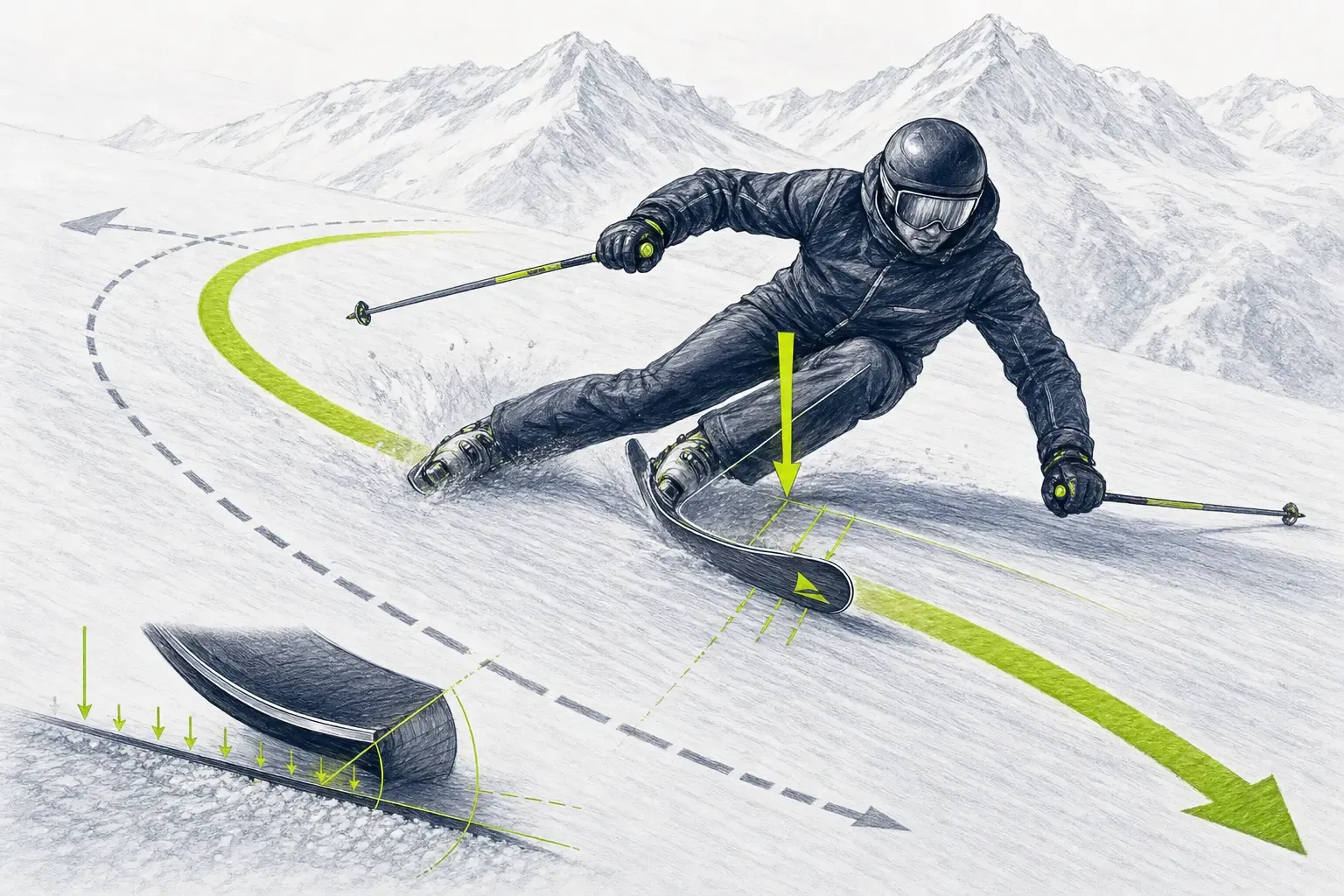
These phases should not be a mechanical sequence of isolated movements. In smooth skiing, they overlap, and their duration changes according to speed, turn radius, slope angle, snow conditions, and the skier’s intention.
Practical meaning
The shape and size of a direction change are among the main tools for controlling speed. A turn led more across the slope usually deflects the skier more strongly away from the fall line. A straighter line with less change of direction usually allows higher speed. Effective speed control therefore does not mean only hard braking at the end of the turn, but above all creating the desired line early and smoothly.
Children’s context
For a beginning child, the visible result is more important than an exact description of the movements of individual joints: can they deliberately turn both ways, adapt the direction to the space, and link several turns without losing balance? A wedge is a legitimate solution for the first controlled direction changes, not just a “broken parallel turn.”
Training practice: the task should match the child’s motor level. On a gentle, easy-to-read slope, the width of the corridor, the distance between markers, or the shape of the line can be changed. The coach mainly watches smoothness, bilateral ability, balance, and the ability to adapt direction, not imitation of one “ideal” body position.
Race context
In racing skiing, the needed direction changes are defined by the gate set, the slope, and the course profile. The goal is not to achieve the greatest possible edge angle, but to create a line that combines precision, speed, and manageable load. In technical disciplines, large reaction forces appear mainly during turn shaping, and the outside ski often carries a larger share of the load. However, both skis can actively contribute to steering depending on the phase and technique.
The racer does not start changing direction only at the gate. An effective direction change is prepared earlier so the skis pass the gate in the required orientation and can smoothly continue into the next turn. Late, abrupt steering of the skis often leads to excessive skidding, loss of speed, or a line that is too low below the gate.
Typical misunderstandings
- “I turn my shoulders and the skis will follow.” Strong rotation of the upper body can turn the skis, but it often worsens balance and support on the outside ski. More precise steering comes mainly from the work of the lower limbs under a suitably stable torso.
- “The more I push, the shorter the turn will be.” Increasing the load alone is not enough. The ski needs proper edging, alignment, flexing, and contact with the snow.
- “A correct turn must always be carved.” Both carved and controlled skidded turns have their place. Terrain, space, speed, and intention decide.
- “Changing edges is changing direction.” It is only one of the prerequisites for a new turn; the skier’s line begins to drift more significantly only through the action of a new force between the skis and the snow.
Coach’s view
The coach evaluates direction change by the resulting line and timing: where the turn began to take shape, how quickly the skis changed their line, whether the movement was smooth, and whether the skier stayed balanced. Only then is the cause sought in edging, steering of the skis, load distribution, or body position. The same line can arise from different combinations of movements, so there is no single universal instruction suitable for every child, speed, and snow condition.
Sources and further reading
- PSIA-AASI – Fundamental Mechanics of Alpine Skiing
- U.S. Ski & Snowboard – Level 100 Alpine Manual
- U.S. Ski & Snowboard – The Turn Model: Alpine Guide to Ski Fundamentals
- Sports Engineering – Mechanics of wedge turns in alpine skiing
- Frontiers in Physiology – Recent Kinematic and Kinetic Advances in Olympic Alpine Skiing
- European Journal of Sport Science – Connected skiing: Validation of edge angle and radial force estimation
- Frontiers in Sports and Active Living – Alpine Ski Motion Characteristics in Slalom
- Sensors – Technique-Dependent Relationship between Local Ski Bending Curvature, Roll Angle and Radial Force
- Journal of Sports Science and Medicine – Influence of slope steepness, foot position and turn phase on plantar pressure distribution