What is an early line
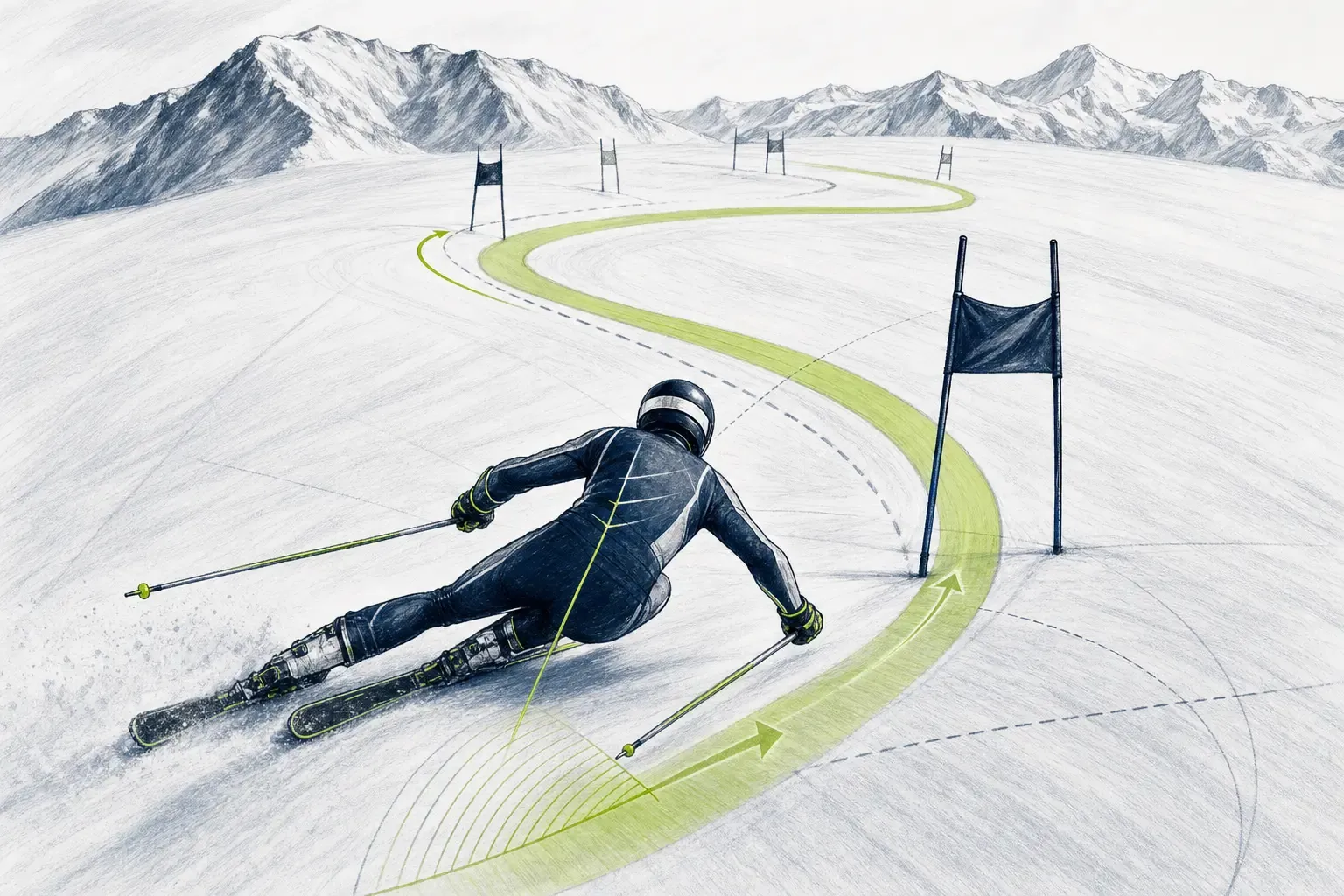
Early line (Engl. early line) is a coaching term for tactical line choice in which the skier starts a new turn and creates its necessary shape sufficiently early before the turning pole. The skier therefore does not arrive at the gate without direction, but already on a curved path that allows them to continue toward the next gate without a significant correction below the gate.
It is not a precisely defined or mandatory trajectory. Professional papers rather describe the position of the start and end of the turn, the path of the center of mass, the turning radius, speed, and the point of the most pronounced change of direction. The term early line is therefore a practical coaching shortcut, not a separate race rule.
What it looks like in the run
With a suitably chosen early line, the racer:
- finishes the previous turn in time and releases its edges,
- starts tipping the skis and changing direction before reaching the gate,
- builds support mainly on the outside ski in the upper part of the new turn,
- already points toward the next section of the course when passing the gate,
- does not need to резко turn the skis across the slope below the gate.
Research in ski racing shows that smoother turns started higher above the gate can preserve more speed and allow a more direct exit. A shorter line by itself does not guarantee a better time. The result depends on the relationship between the distance covered, maintained speed, skidding, terrain, and the sequence of the following gates. In giant slalom, different strategies are used as well: sometimes a longer smooth turn is advantageous, other times a more direct passage with a more focused change of direction.
Early does not mean rushed. If a skier suddenly pivots the skis after edge change, pushes them sideways, or throws the body inside, they may start turning early, but they will not create a good line. In training, the focus is therefore on a smooth catch of the new edges, guiding the outside ski, and gradually building direction. Quick edge change and early creation of centripetal force are especially important in more difficult gates, but they must match the speed, slope, and the skier’s abilities.
Early line for children
For a young skier, an abstract instruction to move the turn apex higher usually does not help. Clearer tasks are, for example start turning before the pole, have the skis pointed toward the next gate at the gate or let the skis turn above the gate, not below it.
Training must match the child's age and technical level. A child first needs to master balance on the outside ski, release from the old edges, basic parallel-ski steering, and looking ahead. The coach may use brushes, soft poles, corridors, or markers, but their spacing is not a universal rule. An overly demanding line can lead a child into rotation, a braking skid, or an excessive chase for contact with the pole.
In slalom, there is less time to create direction, and a delay can quickly carry through several gates. In giant slalom, the difference between an early and a late line is usually more visible: a late racer finishes the arc deep below the gate, while a well-prepared racer can release the skis earlier and move into the next arc. The specific line must always be adapted to the course set, slope, snow surface, and speed.
Typical mistakes and misunderstandings
- Too high and wide a line: the racer adds metres without a corresponding gain in speed.
- Forced early turn: the skis are turned by skidding instead of smoothly creating support and direction.
- Late completion of the previous arc: the problem does not arise at the current gate, but already when exiting the previous one.
- Stretching the body after the pole: trying to touch the gate can cause a loss of balance and support on the outside ski.
- One line for the whole course: the right passage changes according to the terrain, gate spacing, offset, and the following combination.
- Looking only at the nearest pole: the skier reacts too late because they do not have the next direction ready in time.
Coach's view
An early line is not judged by how narrowly the racer passed the pole. More important is whether they had direction created at the gate, whether the skis held a clean and purposeful line, and whether the exit allowed timely preparation for the next arc. In video analysis, the coach therefore follows the transition already from the previous gate: the moment of edge release, the place where the new arc begins, the creation of skid, and the direction of the skis when passing the gate.
The goal is not to always ski as high as possible, but to create the needed change of direction at the right time and with the smallest possible loss of speed. Results from biomechanical studies help explain this principle, but measurements from a specific course and adult racers cannot be turned into a universal guide for every child or every gate combination.
Sources and further reading
- Supej et al.: Influence of Line Strategy Between Two Turns on Performance in Giant Slalom
- Hébert-Losier et al.: Recent Kinematic and Kinetic Advances in Olympic Alpine Skiing
- Brodie et al.: Fusion Motion Capture – biomechanical analysis of ski racing
- Spörri et al.: The Role of Path Length- and Speed-Related Factors in Alpine Giant Slalom
- Reid et al.: Alpine Ski Motion Characteristics in Slalom
- Spörri et al.: Course Setting and Selected Biomechanical Variables Related to Injury Risk
- 3D Motion Analysis of Alpine Skiing on a Steep-Slope Gate in Men’s Giant Slalom
- Gilgien et al.: Characterization of Course and Terrain and Their Effect on Skier Speed