What video analysis is
Video analysis is the systematic observation of a recorded run according to pre-defined criteria. In training, it serves as additional feedback: the skier sees their own movement, and the coach helps them distinguish an essential issue from a random detail.
The recording can be watched at real speed, in slow motion, or frame by frame. It can be used to assess, for example, the rhythm and continuity of turns, the skier’s position relative to the skis, the course of the transition between turns, the work of individual body parts, or the racing line relative to the gates. Video can capture the result of movement as well, but not automatically its cause.
Systematic reviews of research suggest that video supported by clear verbal feedback can help with learning movement skills. However, the result depends on the athlete’s age and experience, the difficulty of the task, and also the way, timing, and frequency of the feedback. Research does not define a single ideal method suitable for every skier.
What can be learned from the recording
Video makes it possible to repeatedly observe an issue that lasts only a fraction of a second at normal speed. The coach can compare several runs, mark a specific moment, and connect it with what the skier felt during the run. In race training, technique and tactics can be assessed at the same time, for example the point where the turn begins, position relative to the gate, exit direction, or loss of rhythm.
However, a standard two-dimensional recording is not a complete biomechanical measurement. The final image is affected by the direction and height of the camera, the distance, zoom, the slope gradient, and perspective. From the position of the body in a single frame, it is not possible to reliably determine the size of forces, pressure on the ski, or the exact distribution of load. The coach therefore combines the image with the course of the whole run, the terrain, the ski track, the athlete’s description, and, if needed, time measurement.
Procedure in training practice
Effective analysis starts with a question, not a camera. Before the run, the coach decides what they want to observe. One angle may not be suitable for everything: front, rear, and side views show different relationships. The camera should be stable, and the shot should capture the skier, the skis, the relevant part of the course, and the slope of the terrain according to the goal.
In practice, the following sequence works well:
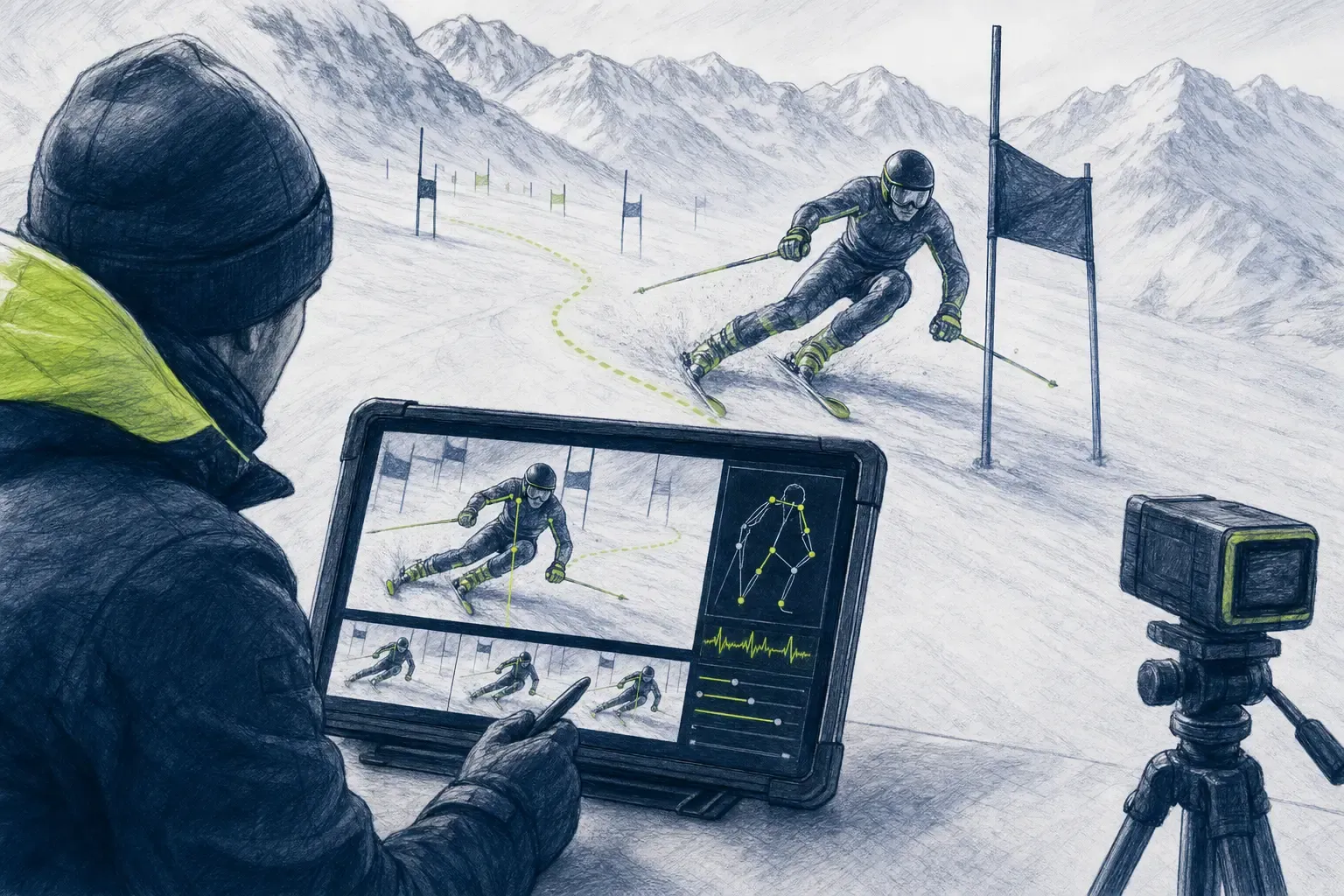
1. first watch the run at real speed, 2. then let the skier briefly describe their feeling and intent, 3. choose one main issue, 4. use slow motion or a freeze frame if needed, 5. agree on a simple task for the next run, 6. check whether the change showed up in the movement and in the result.
A slow-motion shot reveals the sequence of movements in time, but it should not completely replace viewing at real speed. It is in real speed that rhythm, smoothness, and the overall purposefulness of the run are most visible. When comparing two attempts, it is necessary to take into account different snow, terrain, speed, course setup, and camera position.
Video analysis for children
For younger children, the analysis should be short, specific, and linked to a task they understand. A long explanation of angles and individual phases of the turn can go beyond their attention span and their ability to transfer abstract information into movement. A beginner usually needs to see mainly the basic result of the task; an older and more experienced racer can work with finer timing, the track, or the relationship between several movements.
The child should not be just a passive viewer. A simple question such as “What worked well in this turn?” supports self-observation and helps the coach find out what the young skier understands. Research on feedback also does not support the idea that showing an elite athlete is always the best model. Differences in age, body proportions, speed, equipment, and course difficulty can lead to an incorrect conclusion in a direct comparison.
The recording should serve learning, not mocking or public comparison of children. Skiing research has also warned that poorly delivered analysis can be demotivating. The club therefore needs clear rules for recording, storing, and sharing children’s footage.
Typical mistakes and misunderstandings
- filming a large number of runs without a defined question,
- looking for many mistakes at once instead of one priority,
- assessment of technique based only on an isolated frame,
- confusing the visible body position with proof of pressure or force,
- mechanically copying an elite skier regardless of role and age,
- comparing shots from different perspectives as if it were precise measurement,
- watching only slow-motion video without the full picture of the run,
- an analysis without a follow-up task and without verification in further attempts.
Coach’s view
Video is not a verdict on technique, but a shared working basis. A good analysis connects three things: what the skier sees in the video, what they feel during the run, and what they should try next time. The value of the analysis therefore does not depend on how many lines, angles, or graphics are on the screen, but on the correctly chosen question and on the coach’s ability to turn observation into an appropriate movement task.
Sources and further reading
- Mödinger, Woll and Wagner: Video-based visual feedback to enhance motor learning in physical education – systematic review
- Petancevski et al.: The effect of augmented feedback on the performance and learning of gross motor and sport-specific skills – systematic review
- Zhou et al.: Effects of Feedback on Students’ Motor Skill Learning in Physical Education – systematic review
- Sollie et al.: Observational vs coaching feedback on whole-body motor skill performance in adolescent cross-country skiers
- Ruzicka and Milova: Increasing the efficiency of motor learning with the help of video analysis in downhill skiing
- International Ski and Snowboard Federation: FIS development activities using video analysis and race simulations
- U.S. Ski & Snowboard: Alpine Coach Education Pathway and Alpine Guide