What Is Angulation
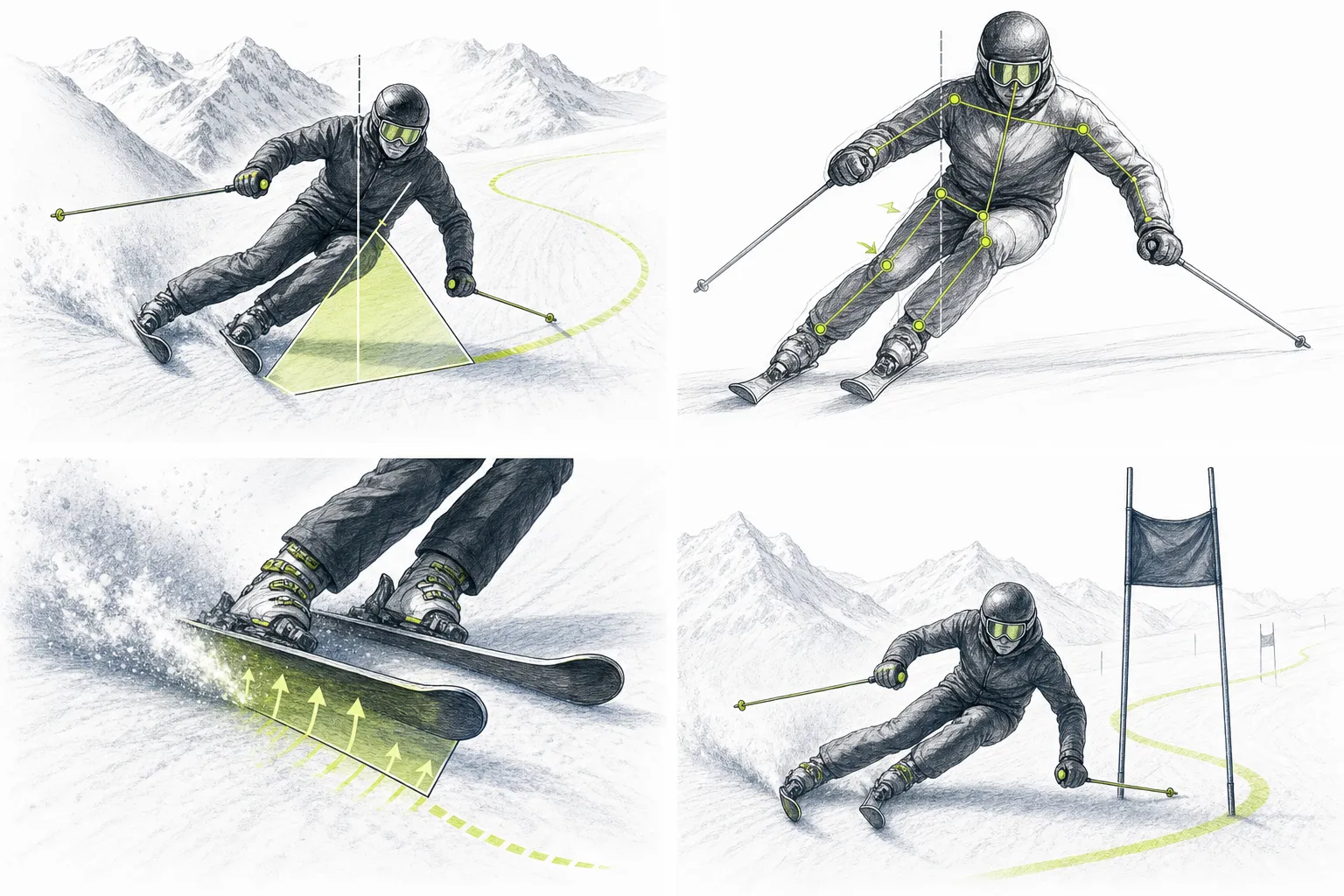
Angulation is a sideways bend of the skier’s body in which the lower body and skis have a different lateral tilt than the pelvis and torso. In professional English terminology, the term angulation, and when the bend is pronounced in the hip area, hip angulation.
The purpose of angulation is not to create a certain look in the stance. Its practical function is to regulate the edge angle of the skis and align the body so that the skier can transfer forces between the snow, the skis, and their center of mass. Modern teaching methods therefore describe edge control as a combination of inclination and angulation.
Angulation and Inclination
With inclination the skier leans inward into the turn with the whole body. With angulation, a side bend forms between the lower and upper body: the skis and legs can be tilted more inward, while the pelvis and torso remain relatively more above the outside ski or point more out of the turn.
Both movements complement each other in good skiing. A fast turn usually requires a suitable lean of the whole body, because the skier must balance the forces acting in the turn. Angulation gently adjusts this lean and makes it possible to change the edging without shifting the whole body to the same extent. It is therefore impossible to define one correct ratio of angulation and inclination for all turns.
Angulation is created by the coordination of several parts of the movement system. The ankles and hip joints, the position of the pelvis, and the sideways movement of the torso all play an important role. The knee contributes to the final shape of the stance, but it should not be forced inward. Apparent “knee angulation” is the result of the interplay of the foot, ankle, femur rotation, flexion, and hip movement, not isolated sideways bending at the knee.
Effect on the Ski and the Turn
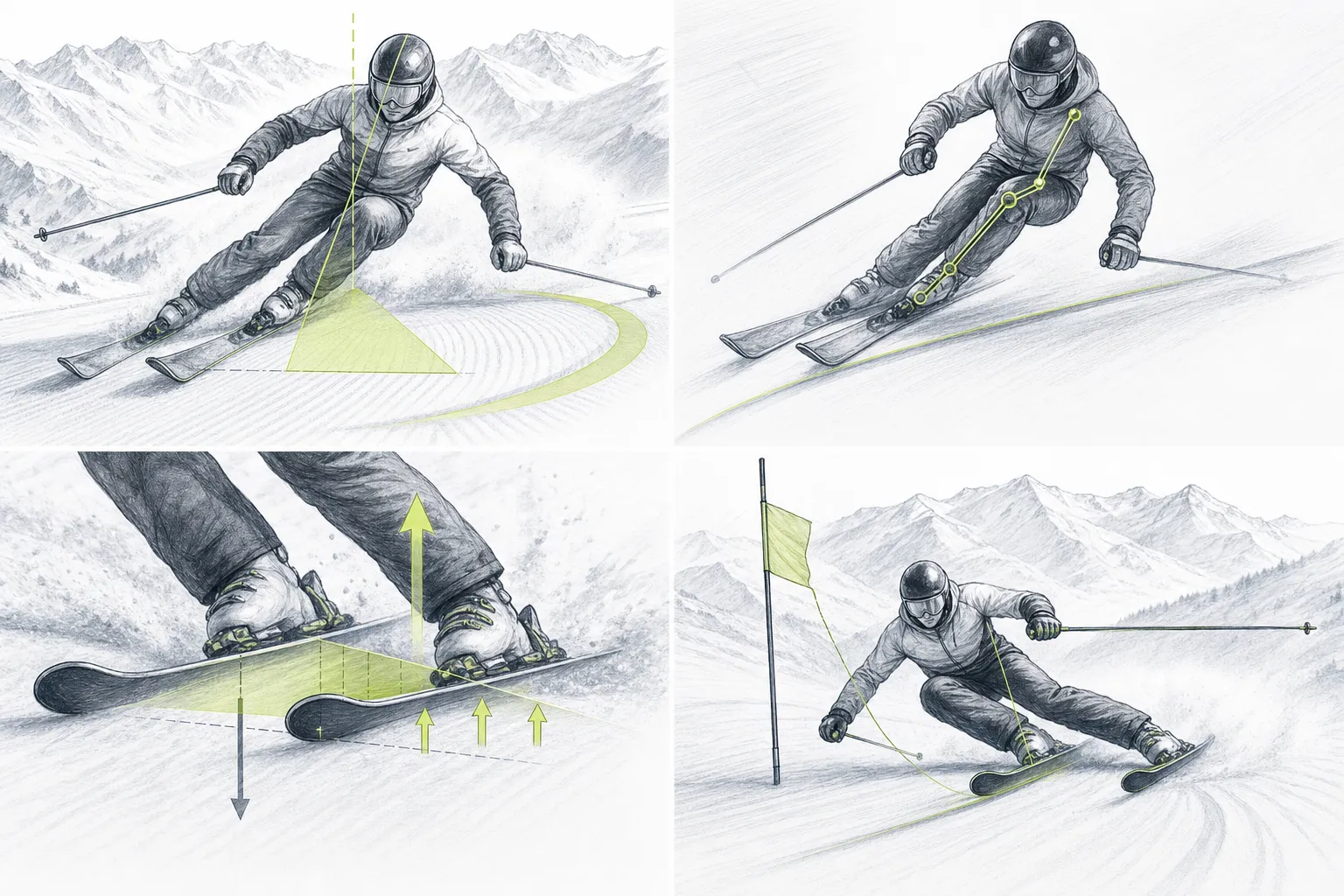
The edge angle expresses the tilt of the ski base relative to the snow surface. Angulation makes it possible to increase or decrease this angle without the skier having to move the whole body in the same way. A greater edge angle can, in a carved turn, support greater ski bend and a smaller turn radius. However, the actual shape of the turn also depends on the ski’s construction, its loading, the angle of attack, speed, snow firmness, and the skier’s movements. The claim that “more angulation automatically means a shorter turn” is therefore incomplete.
Angulation can help direct support to the outside ski, but by itself it does not guarantee correct pressure distribution. A skier can be strongly bent and still load the inside ski, sit back, or lose contact with the snow. The deciding factor is the result: effective ski steering, balance, and the ability to change stance smoothly.
Angulation in Children
In children’s skiing, angulation develops gradually together with balance, edging, and the independent movement of the legs under the torso. A beginner does not need to imitate the deep angulation of a racer. On gentle terrain and at low speed, only a small range of movement is usually needed.
In training practice, it is better to use simple movement tasks than to place a child into a stiff position. The tasks can lead to smooth edging of the skis, pressure on the outside ski, and a return to a more neutral stance between turns. Their selection must match the child’s age, technical level, coordination, terrain, and current conditions.
The coach mainly watches whether the child:
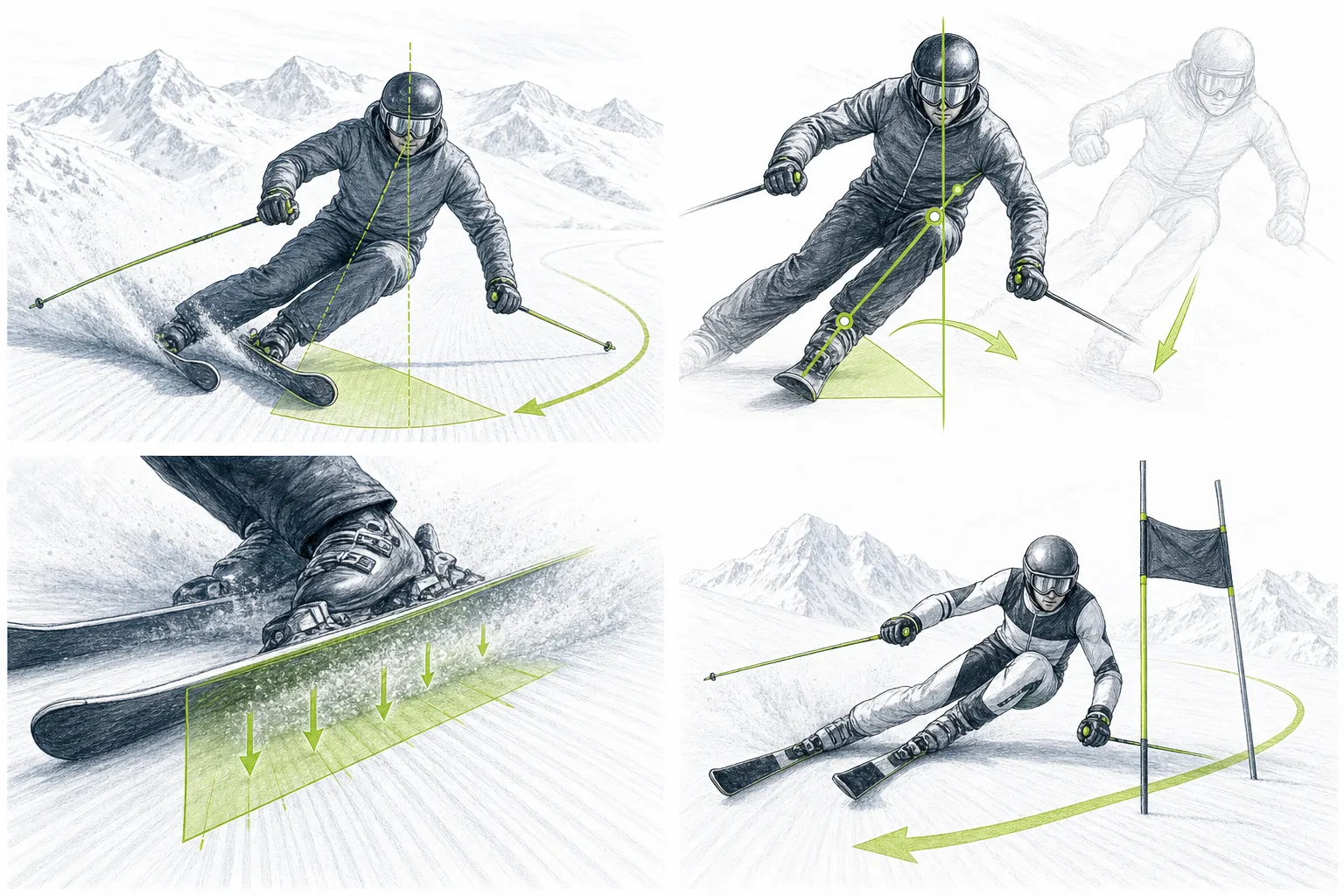
- can change edging smoothly and to both sides,
- stays in movement balance and can finish the turn safely,
- does not push the knee inward without involving the ankle and hip,
- does not use the torso only as a counterweight after losing support,
- can unedge the skis and move into the next turn.
Angulation cannot be judged from a single photo. A static shot does not show speed, the phase of the turn, the direction of movement, or the development of forces.
Race context
In racing skiing, the range and timing of angulation change according to the discipline, speed, turn radius, gate setup, slope, and course profile. The racer uses it for precise control of edge, line, and pressure, not as an end in itself. In one part of the turn, transfer and inclination may dominate, while in another the separation between the lower and upper body may increase.
Even in slalom, maximum angulation is not always the fastest. Excessive angulation, or angulation held for too long, can make it harder to release the old edges, transfer into the next turn, and adapt to an unexpected change in terrain. Effective technique is dynamic and adjusts to the specific situation.
Typical mistakes and misunderstandings
Riding in one block. The whole body leans inward without enough ability to adjust the position of the torso and pelvis. This type of skiing is often called banking. But inclination itself is not a mistake; the problem is using it too much or losing support.
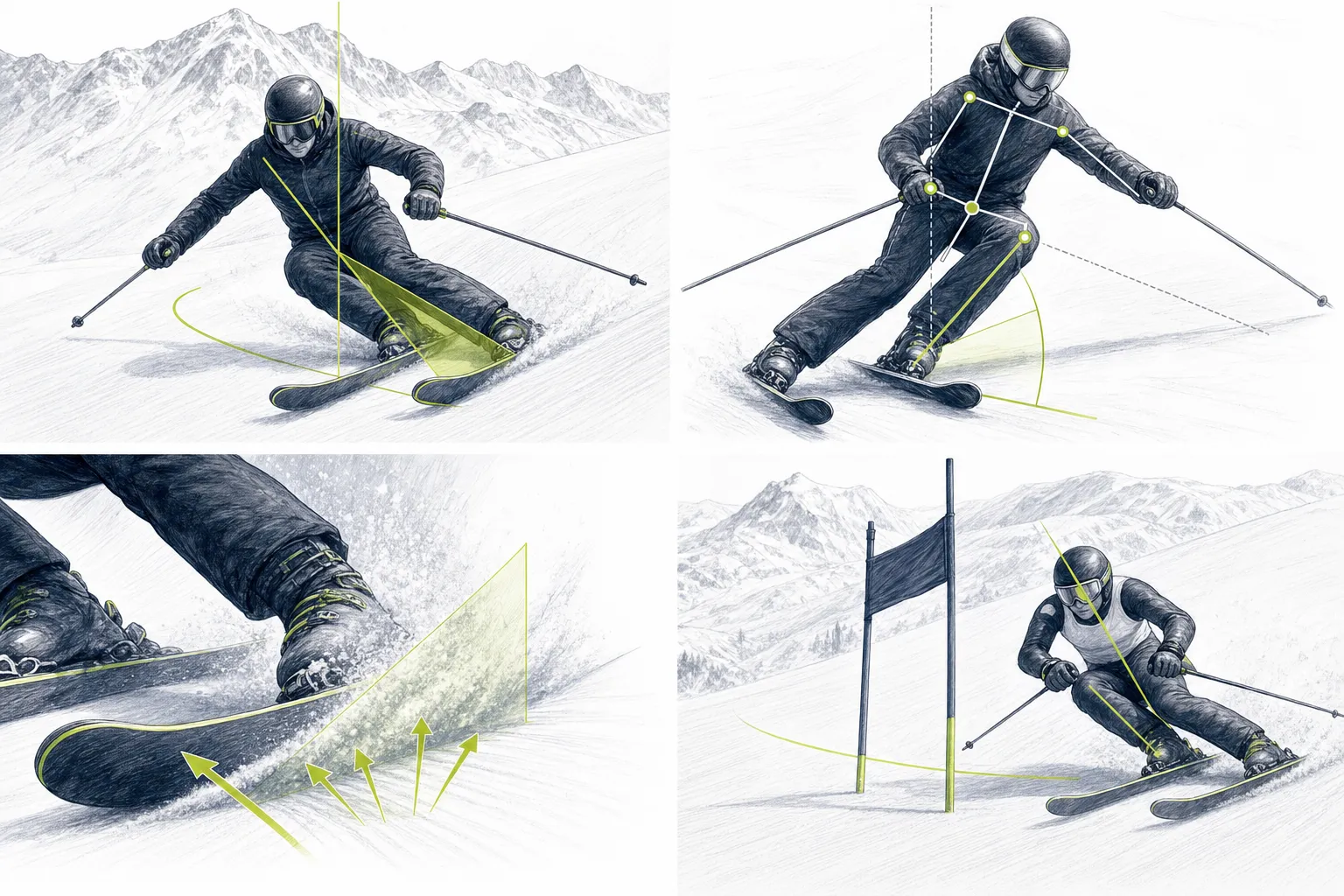
Falling onto the side or “hanging into the hip.” The skier suddenly drops the pelvis inward, often only after the turn has already developed. The result can be a static position, overload of the inside ski, or blocked movement.
Pushing the knee inward. Trying to create an edge with an isolated knee movement does not respect the natural cooperation of the foot, ankle, thigh, and hip. The coach should evaluate the axis of the whole leg, not just the position of the knee.
Artificially level shoulders. The upper body does not have to stay horizontal to the horizon throughout the whole turn. Its position depends on the slope, speed, and the forces acting on it.
Often confused with counter-rotation. Angulation mainly describes the lateral difference in the tilt of body segments. Counter-rotation, or rotational separation, describes their different rotation around the vertical axis. These movements can occur at the same time, but they are not the same phenomenon.
Coach’s view
The coach does not judge whether the stance looks like the model picture, but whether angulation fulfills its function. They watch the ski track, the smoothness of edging and releasing the edges, support on the outside ski, pelvis position, joint mobility, and readiness for the next turn. Useful angulation develops gradually, can be adjusted continuously, and does not prevent the skier from reacting. Its appropriate size is always the result of the specific task, not a universal technical rule.
Sources and further reading
- Debertin et al.: A framework for measuring alpine skiing technique, Journal of Sports Sciences, 2026
- PSIA-Rocky Mountain: Alpine Assessment Guide 2025–26
- U.S. Ski & Snowboard: Alpine Ski Fundamentals – Level 100 Instructor Manual
- U.S. Ski & Snowboard: Angulation – Skiing Drill Plan
- Supej et al.: Alpine Ski Motion Characteristics in Slalom, Frontiers in Sports and Active Living, 2020
- Snyder et al.: Connected skiing – Validation of edge angle and radial force estimation, European Journal of Sport Science, 2022
- Thorwartl et al.: Technique-Dependent Relationship between Local Ski Bending Curvature, Roll Angle and Radial Force, Sensors, 2023
- Gilgien et al.: Recent Kinematic and Kinetic Advances in Olympic Alpine Skiing, Frontiers in Physiology, 2018