What is coordination
Coordination is the ability of the nervous and movement systems to organize individual movements into a purposeful whole, carry them out in the correct order and at the right time, and adapt them to a changing situation. In skiing, it is not just about balance or “quick feet.” The skier simultaneously processes visual, balance, and proprioceptive information and uses it to control body position, the movement of both legs, the torso, and possibly the poles as well.
In professional literature, coordination partly overlaps with the terms motor competence, motor skill, and neuromuscular control. In training practice, its manifestations are usually described as balance, orientation, rhythm, reaction, movement accuracy, and the ability to change a movement that has already begun. However, individual methodologies divide these components differently, so this is not a binding competition classification.
How it appears on skis
A coordinated skier can appropriately time changes in edging, pressure, and direction of the skis while maintaining a stable yet mobile stance. They can adjust movement according to the slope, bumps, snow quality, speed, or the next gate. Alpine skiing therefore requires not only a learned movement pattern, but also constant adaptation of it.
Research on young racers shows that balance assessed in a ski-specific task may distinguish performance level better than a general test without ski equipment. This does not mean that general movement preparation is useless. It does suggest, however, that success in a standard balance exercise may not automatically transfer to skiing.
Coordination in children
Coordination is not an unchanging inborn talent. It develops through experience, varied movement, and appropriate feedback. Systematic reviews of research support the positive effect of movement programs and active play on the development of children's motor skills. The results of studies are, however, varied and do not define one universal number of exercises, repetitions, or training sessions suitable for every child.
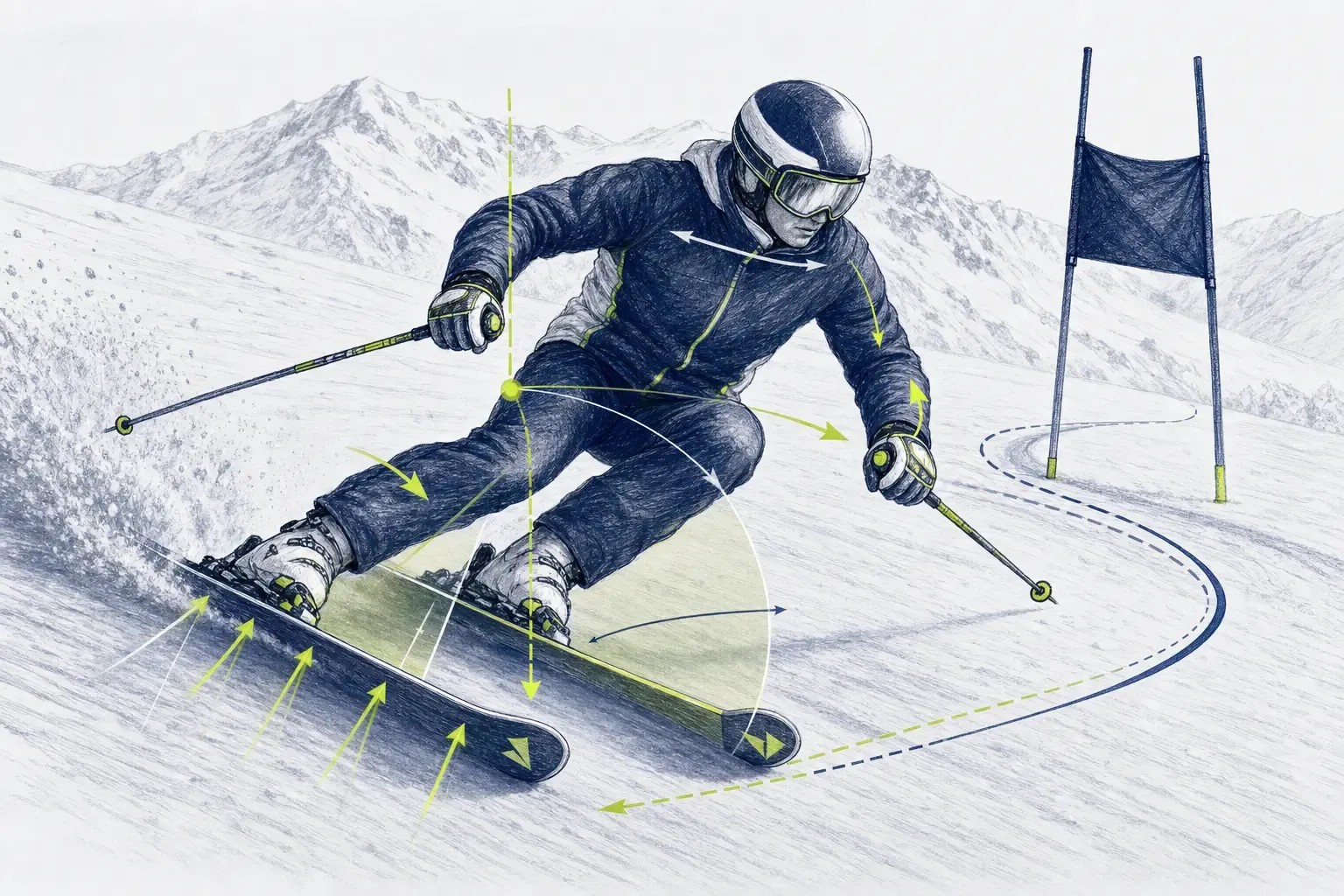
For younger children, a broad movement base takes priority: running, jumping, safe landings, climbing over and under, rolling, throwing, catching, rhythmic tasks, and balance games. On snow, coordination develops through skiing in different terrain, changes in the radius and rhythm of turns, tasks to both sides, and reaction to a simple external signal. The US Ski & Snowboard long-term development system emphasizes age-appropriate progression and a broad foundation of skiing and general movement skills.
Chronological age is not the only criterion. Children of the same age may differ in experience, physical development, attention, and ability to handle speed. During adolescence, biological maturation must also be considered when assessing performance, because dynamic postural stability develops during this period.
Coach's view
A coordination task should be challenging enough that the child has to look for a solution, but still be able to perform it safely and with appropriate control. In training practice, it works well to:
- vary the terrain, rhythm, direction, or way the task is carried out,
- develop both the right and left sides and not focus only on the preferred turn,
- combine general movement games with tasks similar to real skiing,
- first master the task at an appropriate speed and only then add more complexity,
- if control is lost, simplify the task, reduce speed, or add a break,
- watch not only the result, but also the ability to correct a mistake and adapt movement to a new situation.
A typical mistake is to confuse coordination with fast stepping through a ladder or with the most complex possible exercise. Without a clear goal, the task may be merely chaotic. It is equally inappropriate to mechanically transfer exercises from adult racers to small children or to evaluate coordination solely by time on the course.
Good coordination does not mean a rigid "textbook" stance. It shows when a skier can complete a task steadily, respond to changes, and keep control of direction and speed. Coordination training does not replace learning skiing technique; it builds the movement base that makes it possible to learn and use technical skills in different conditions.
Sources and further reading
- US Ski & Snowboard – Alpine Training Systems
- US Ski & Snowboard – Level 100 Alpine Manual
- McDonough, Liu, Gao – Effects of Physical Activity on Children's Motor Skill Development: A Systematic Review
- Müller et al. – Sport-specific balance tests account for youth alpine skiers’ ranking
- Steidl-Müller et al. – Dynamic Postural Stability in Youth Competitive Alpine Skiers
- Johnstone et al. – Active play interventions and fundamental movement skills in children