What stability is
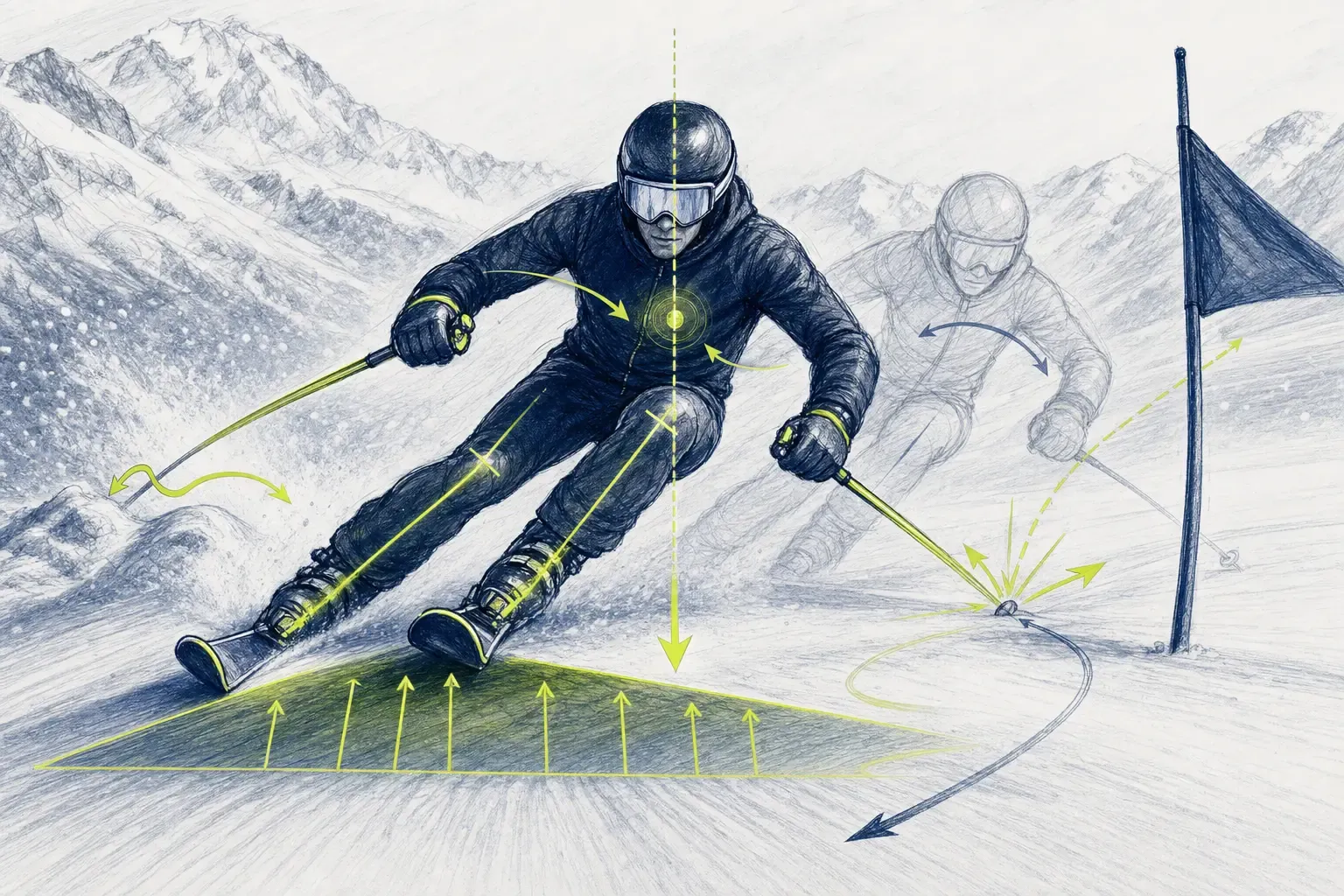
In skiing, stability is the ability to maintain or restore a functional body position and ski control after balance has been disturbed. Such a disturbance can be acceleration in a turn, uneven terrain, a change in slope, soft snow, contact with a gate, or the skier’s own imprecision.
The terms stability and balance are often used as synonyms, but they are not quite the same. Balance refers to the ability to regulate body position in relation to support and acting forces. Stability expresses how well a skier resists being thrown off line and how effectively they return to controlled movement afterward. In alpine skiing, it is almost always about dynamic stability, because the skier, the skis, and the acting forces are constantly changing.
A stable stance therefore does not mean stillness. A good skier makes many small corrections in the ankles, knees, hips, and torso. The nervous system combines visual, vestibular, and somatosensory information. The result should be an appropriate muscle response, not a stiffening of the whole body.
Importance for ski technique
Stability creates the conditions for precise control of pressure, edging, and turning the skis. It allows the legs to work under a relatively calmer torso, while also enabling the whole body to adapt to the terrain and the direction of the resulting forces as needed.
In a turn, the functional position is not maintained above a fixed point. The load on the outside and inside ski changes, as does the amount of edge support and the position of the center of mass relative to the skis. Stability therefore cannot be reduced to the instruction “stay centered.” The skier must be able to move forward and back, in and out of the turn, without losing effective contact with the snow.
The ability to recover is also important. A brief unweighting of the ski, a hand touching the snow, or a movement of the torso does not automatically mean a complete loss of stability. What matters is whether the skier can continue in a controlled movement and prepare for the next situation.
Stability in children
Postural control continues to develop throughout childhood and adolescence. A child’s performance therefore cannot be judged only by the criteria of an adult racer. It is influenced by age, experience on snow, growth, fatigue, attention, and the ability to process multiple stimuli at once.
The American SkillsQuest program includes balance among the four basic areas of skiing skills and increases the difficulty of tasks according to developmental stage. In younger categories, it makes sense to build a broad movement experience: free skiing, changes in turn size, safe terrain waves, different types of snow, appropriate exercises on one ski, or skiing without poles. Such exercises are training practice, not a universal prescription. The difficulty must match the technical level, terrain, and the coach’s instructions.
For children, the goal is not to stand as long as possible on an unstable aid or to imitate demanding adult exercises. First, they need to master basic movement in safe conditions. Only then are speed, a smaller support surface, more challenging terrain, more decision-making, or fatigue added. Exercises on one ski or on pronounced uneven terrain belong on an appropriate slope and under the coach’s supervision.
Race context and fatigue
In race skiing, the skier must maintain stability at higher speed, greater forces, time pressure, and a precisely defined line. But it is not just about core strength. Coordination of the entire movement chain is needed: foot, ankle, knee, hip, and torso.
Research on a group of 19 adolescent alpine skiers showed that short, intense exertion can change parameters of postural control. The results of one small study cannot be automatically applied to every child, but they support the practical experience that technique and the ability to correct should also be monitored under fatigue, not just at the start of training.
The ISPA program, which FIS presents as injury prevention for young racers, includes lower-limb axis stability and trunk stability together with neuromuscular coordination. That does not mean that every balance exercise by itself will demonstrably prevent injury. Systematic reviews confirm the benefits of balance training for postural and neuromuscular control, but direct transfer to ski performance or prevention of a specific injury depends on the content and conditions of training.
Common mistakes and misconceptions
- Stability is confused with stiffness. An overly tense body reacts slowly and absorbs bumps less effectively.
- Only a quiet trunk is assessed. Trunk movement can also be useful if it matches the forces and helps maintain ski control.
- Stability is reduced to a “strong core.” The trunk is important, but without the work of the feet, ankles, knees, and hips, it is not enough.
- Lab or dry-land balance is considered a finished skiing skill. General balance training can help, but transfer to snow is not automatic.
- The difficulty is increased too soon. If a child is only surviving a series of uncontrolled falls during an exercise, the task is probably not appropriate.
- Only a skier without mistakes is considered stable. A high level also includes a quick and efficient recovery after a mistake.
Coach’s perspective
The coach does not just watch whether the child “stands straight.” They notice whether the child can hold the line, regulate pressure on the skis, adapt the legs to the terrain, and keep going smoothly after being thrown off balance. Each exercise should change only as many conditions as the skier can still use to find an effective solution. Stability is best developed as part of varied technical training, not as an isolated ability with no link to skiing.
Sources and further reading
- U.S. Ski & Snowboard – SkillsQuest
- U.S. Ski & Snowboard – Descriptions SkillsQuest Drills
- FIS – Injury & Return, ISPA injury-prevention programme
- Jastrzębska et al. – Gender Differences in Postural Stability among 13-Year-Old Alpine Skiers
- Kiers et al. – Sport-Specific Training-Induced Adaptations in Postural Control and Their Relationship to Athletic Performance
- Zech et al. – Balance Training for Neuromuscular Control and Performance Enhancement: A Systematic Review
- Hébert-Losier and Holmberg – Exercise-Based Injury Prevention Recommendations for Recreational Alpine Skiing and Snowboarding