What speed is
Speed shows how much distance a skier covers in a certain time. Average speed can be written as the ratio of distance to time; it is commonly given in kilometres per hour or metres per second. Instantaneous speed changes continuously during a run — the skier speeds up, slows down, and changes direction.
In alpine skiing, it is not just a number on a sports watch. Speed must always be assessed together with the direction of travel, visibility, the width and steepness of the slope, snow quality, traffic, and the ability to stop safely or avoid an obstacle.
What affects speed
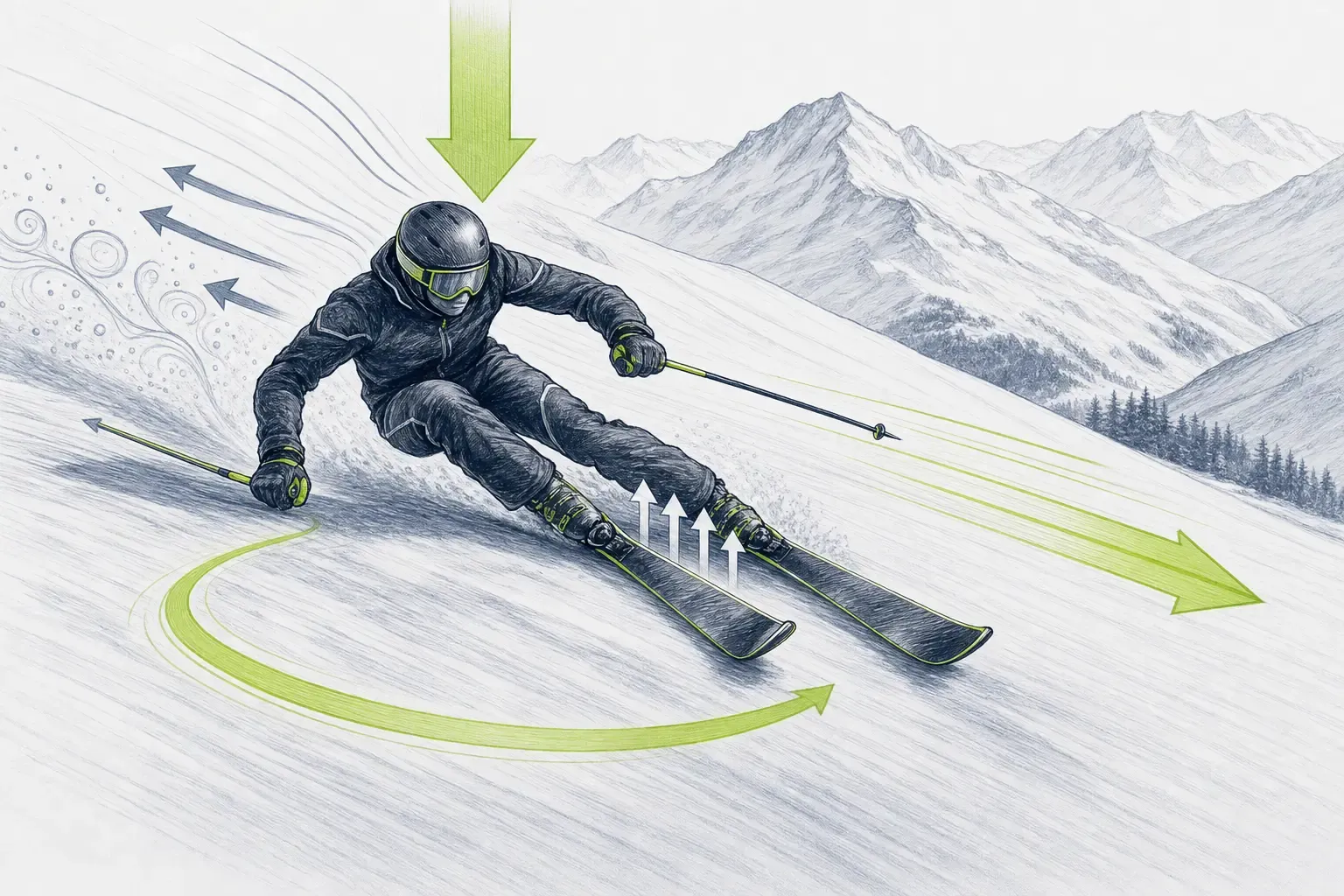
A skier’s movement down the slope is determined mainly by the action of gravity, resistance between skis and snow, air resistance, and the forces created when guiding the skis through a turn. The importance of each factor changes depending on the discipline and the situation.
- Slope angle and line of travel: A direct line down the fall line usually leads to acceleration. Guiding the skis more across the slope or finishing the turn away from the fall line helps control speed.
- Turn shape and how it is guided: More pronounced sideways skidding of the skis dissipates more energy. A clean carved turn usually preserves more of it, although speed can also be reduced by changing direction and finishing the turn appropriately.
- Body position: A lower, more aerodynamic speed position reduces air resistance. Its importance increases at higher speeds; it is not a substitute for stability, balance, or the ability to change direction.
- Snow and equipment: The hardness and texture of the snow, the temperature, ski base preparation, edges, and ski characteristics affect gliding as well as braking options. Servicing must match the equipment, the conditions, and the manufacturer’s instructions.
Speed fundamentally changes the consequences of a mistake. Kinetic energy increases with the square of speed: at double the speed, it is four times greater for the same mass. At the same time, greater speed shortens the time available to perceive the situation, make a decision, and perform an evasive manoeuvre.
Speed control as a skiing skill
Controlling speed does not mean only braking with a snowplough. An advanced skier regulates it mainly by choosing a line, the size and shape of turns, the degree of edging and skidding, and by reacting to the terrain in time. The basic criterion is whether they can change direction or stop in the available space.
Research on recreational skiers shows that subjective perception of speed varies according to the skier’s level and willingness to take risks. The feeling of “I’m going slowly” is therefore not a reliable measure of safety. Even data from a device may not accurately describe the conditions, visibility, or the space needed to stop.
Speed in children’s skiing
For children, the priority is control of movement over maximum speed. Appropriate speed depends on technical level, motor development, attention, fatigue, terrain and traffic density, not just age.
A suitable training approach can be seen as one in which the child first masters a stable stance, independent stopping, changing direction and reacting to a command. Speed is then increased gradually on a clear section with a sufficiently long and open run-out. Descending in a speed position only makes sense once the child no longer loses balance and can leave the position, turn or brake immediately.
A coach can develop a feel for speed, for example by:
- skiing the same section along different lines,
- alternating carved turns and turns with controlled skidding,
- setting a point before which the skier must slow down or stop,
- practicing the transition from straight-line skiing into a turn,
- comparing the skier’s own estimate with timing on a secured section.
The goal is not to chase the highest number. A child should learn that speed is chosen according to the situation and that the ability to slow down is just as important as the ability to speed up. A helmet or protectors do not make inappropriate speed safe.
Speed in racing skiing
In alpine races, the time between start and finish measured according to the relevant rules decides the result. Slalom and giant slalom are classified as technical disciplines, while super-G and downhill are speed disciplines. That does not mean that technical disciplines do not require speed management or that speed disciplines are only about going straight.
The final time is influenced by the line, the quality of the turns, maintaining speed between gates, handling terrain changes, aerodynamics and mistakes. The shortest line is not necessarily the fastest if it requires hard braking or leads to a poor exit into the next section. More important than top speed itself is often the ability to carry appropriate speed smoothly through a whole series of turns.
In children’s race training, speed preparation therefore also includes reading the terrain, choosing the line, stability, smooth pressure on the skis, controlled slowing down and following the designated corridor. Entry conditions, course setting, safety measures and equipment requirements are governed by the current FIS rules, the national federation and the specific competition.
Common misconceptions
- “A good skier is one who goes fast.” A good skier is defined mainly by control of movement and the appropriate choice of speed.
- “Carving automatically slows you down.” A carved turn can preserve a lot of speed; its direction, shape and finish are what matter.
- “A speed position means pressing the torso as low as possible.” A functional position must remain stable and allow further movement, ski control and reaction to the terrain.
- “I know the slope, so I can go flat out.” The surface, visibility, traffic and obstacles can change even during a single day.
Coach’s view
The coach does not assess speed separately from control. They watch whether the skier holds the chosen line, stays balanced, looks far enough ahead, and has room to react to an unexpected change. Speed is appropriate when technique remains functional and the skier can consciously reduce it. If movement is driven by fear, stiffness, or random sudden braking, the task or terrain is probably too demanding.
Sources and further reading
- FIS – Alpine Skiing Documents
- FIS – Timing & Data, Alpine Skiing Timing Booklet
- Supej M. et al. – Recent Kinematic and Kinetic Advances in Olympic Alpine Skiing: Pyeongchang and Beyond
- Reid R. et al. – Alpine Ski Motion Characteristics in Slalom
- Brunner F. et al. – Factors Associated with the Perception of Speed among Recreational Skiers
- Ruedl G. et al. – Mean speed of winter sport participants depending on various factors
- Spinks A. B. and McClure R. J. – Downhill ski injuries in children and adolescents