What training volume is
Training volume is the amount of training work done in one unit or over a certain period,for example in a day, a week, a mesocycle, or a season. It answers mainly the question how much was trained, not how hard, effective, or high-quality the training was.
Volume is one of the basic factors in training planning, but it cannot be confused with total training load. Modern sports methodology distinguishes mainly:
- external load – the work the athlete performed, such as time skiing, number of runs, or repetitions,
- internal load – the individual physical and psychological response to that work, such as perceived effort, heart rate, or fatigue.
Two skiers can therefore complete the same volume but handle it very differently. The same ten runs can be easy technical training for one and a highly demanding load for another.
How volume is measured in skiing
The unit of volume must match the content of the training. In alpine skiing, for example, you can track:
- number of training days and sessions,
- total or active time on snow,
- number of runs, turns, or gates completed,
- elevation gained or skied downhill,
- time spent free skiing, in technical drills, and in gates,
- number of starts or training attempts.
In conditioning, volume is expressed, for example, by time and distance in endurance work, by the number of sets and repetitions in strength training, or by the number of jumps and attempts in coordination drills.
The figure “three hours on the slope” on its own is inaccurate. It may include riding the lift, waiting at the start, course reset, and video analysis too. For a coach, it is usually more useful to record active time, the number of quality runs, and the type of work performed. Even the number of runs is not perfectly comparable if they differed in length, terrain, gate layout, or intensity.
Volume, intensity and quality
Volume must be assessed together with intensity. Longer free skiing on gentle terrain is a different stimulus than a short slalom session at high speed. If both the amount and the demands of the work increase significantly at the same time, the athlete may receive a stronger stimulus than they are ready for.
A practical estimate of total load can be the combination of session length with a subjective rating of how demanding it was, known as session-RPE. However, the result is not a pure measure of volume: it also includes how demanding the athlete perceived the training to be. For children, the scale must be explained simply, and the responses cannot be used as the sole basis for decision-making.
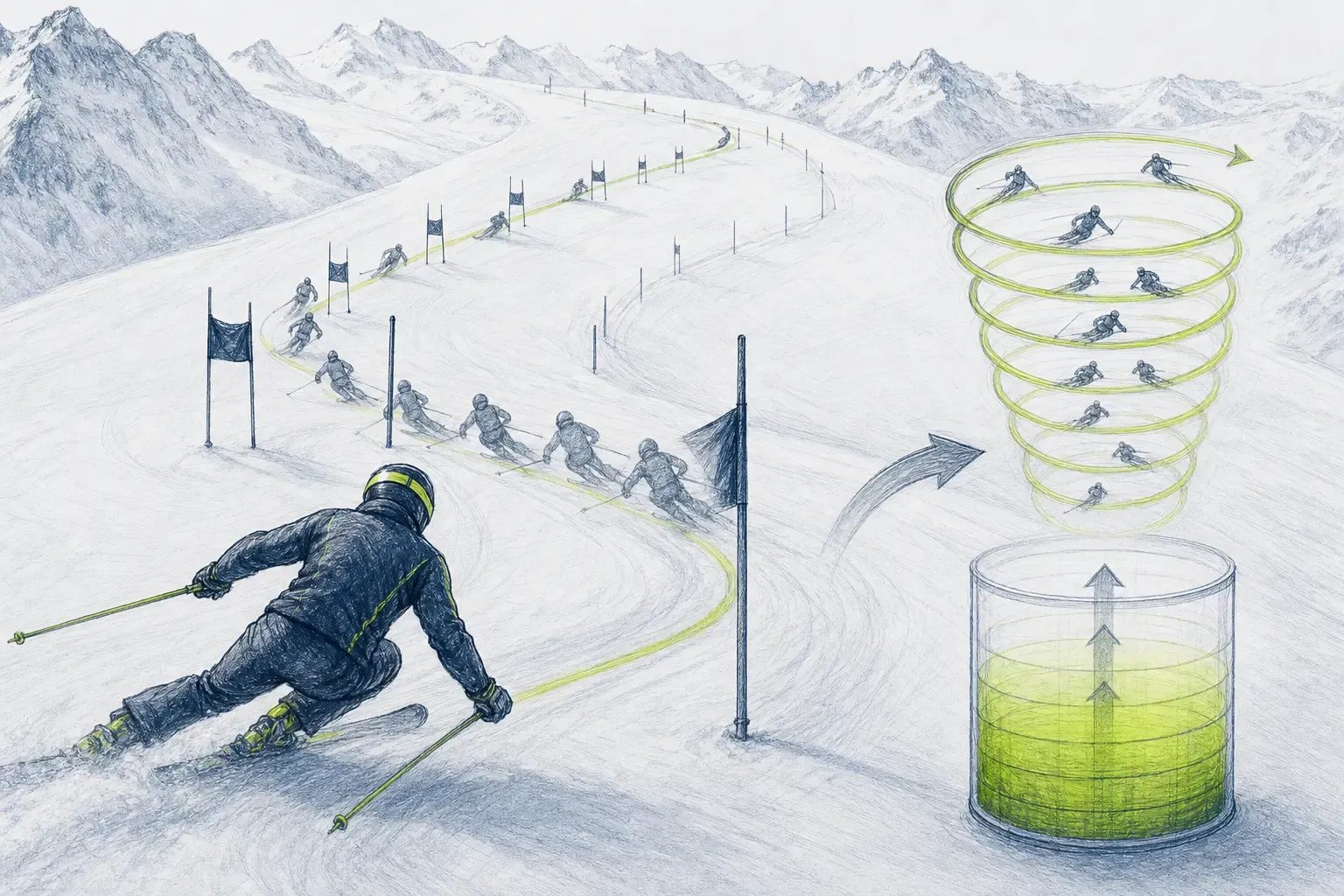
Expert consensus documents point out that load must be monitored in context. A single number cannot reliably determine an athlete’s readiness or predict injury. Previous training, health status, growth and maturation, sleep, recovery, school commitments, travel, and psychological stress also matter.
Training volume in children
There is no single correct number for children’s skiing that can be used for everyone. National long-term skier development systems do give indicative ranges of training days, sessions, or the balance between training and competition, but these are frameworks tied to a specific system. They are not a universal individual prescription.
When determining volume, it is especially important to consider:
- the child’s biological and motor development,
- training age and technical level,
- the ability to maintain attention and movement quality,
- previous load and recovery,
- slope conditions and the nature of the training session,
- other sports, physical education, school, and travel,
- health issues and periods of rapid growth.
A younger skier needs enough repetitions to gain movement experience, but a large part of the volume should take the form of varied skiing, games, and the development of basic movement skills. Simply adding more runs through gates does not necessarily lead to better learning. When fatigue leads to repeated breakdowns in posture, delayed reactions, or loss of control, additional volume may only reinforce incorrect movement.
Volume should increase gradually and over the long term, not in a sudden jump based on the result of the next race. During growth, coordination, mobility, and load tolerance can temporarily change, so children of the same calendar age cannot automatically be trained in the same way.
Typical misconceptions
- More hours mean better training. Without adequate intensity, purpose, and quality, it may just be a longer time on the slope.
- Volume means only runs through the gates. A skier’s development also includes free skiing, technical drills, conditioning, and other sports activities.
- Races replace training volume. Competition provides specific experience, but it usually offers few repetitions and limited room to correct technique.
- The same program is fair for everyone. The same external load can trigger different internal responses.
- One indicator will reveal overload. The number of days, hours, or runs should be assessed together with fatigue, pain, health, mood, sleep, and movement quality.
Coach’s view
Before the training period begins, the coach should define what will be tracked under the term volume. For a children’s team, a few simple data points are often enough: active time, type of training, number of quality runs, and a brief note on difficulty or fatigue. The record should help compare the plan with the work actually done, not create a competition over the number of hours.
What matters is not the effort to achieve the greatest possible volume, but to create an appropriate amount of quality repetitions, which a child can handle safely, with sound technique, and with enough recovery. If pain, illness, unusual fatigue, or a significant drop in coordination appears, adjusting the training is the coach’s responsibility and, depending on the situation, that of a medical professional.
Sources and further reading
- Bourdon et al.: Monitoring Athlete Training Loads – Consensus Statement
- International Olympic Committee: How Much Is Too Much? Load in Sport and Risk of Injury
- McLaren et al.: Monitoring Internal and External Loads in Adolescent Athletes – Systematic Review
- U.S. Ski & Snowboard: Alpine Training Systems
- U.S. Ski & Snowboard: Alpine Training System
- U.S. Ski & Snowboard: Athlete Performance Profile
- Alpine Canada: Long-Term Athlete Development – Reference Materials