Definition
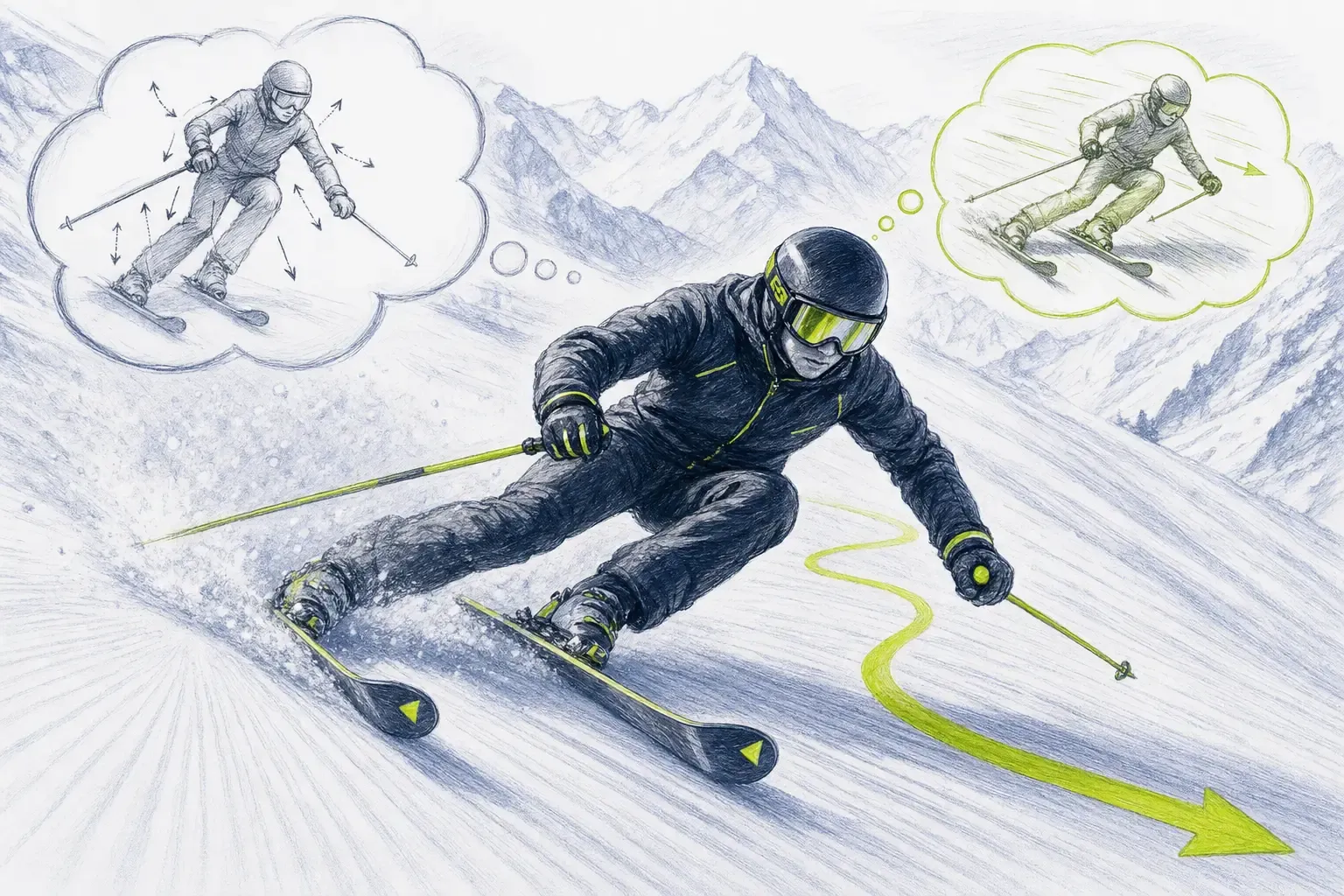
Movement automation is the gradual reduction in the need to consciously control individual parts of a learned movement skill. The skier no longer has to think about every movement separately and can devote more attention to the goal of the run and the changing environment.
Automation is not a separate technique or a final state in which movement no longer changes. It is one of the manifestations of motor learning and is always tied to a specific task and conditions. A child may have a turn well established on a gentle groomed slope, but still not be able to handle it just as reliably on ice, over bumps, at higher speed, or between gates.
What changes during automation
When learning a new skill, the skier pays a lot of attention to instructions, body position, and the sequence of actions. The movement is usually slower, less precise, and can easily be disrupted by changes in terrain or by another task. With practice, coordination gradually becomes more stable, and executing the movement requires less conscious control.
Skill level and the degree of automation are related, but they are not the same. Two skiers can achieve a similar result, even though one controls the movement mostly consciously and the other with less demand on attention. Research often examines automation through a secondary task performed at the same time. However, such a laboratory method is not a guide for testing children while skiing on the slope, where distracting attention could compromise safety.
A skill cannot be considered learned just because of a successful attempt immediately after the coach’s instruction. What matters is whether the performance is maintained over time and whether the skier can transfer it adequately to changed conditions. Automation is therefore not a matter of one training session or a fixed number of repetitions.
Importance in skiing
Skiing takes place in a changing environment. The slope angle, surface, visibility, speed, spacing between people, and the shape of the course all change from run to run. If the skier spends most of their attention on consciously controlling the basic stance or ski guidance, they have less capacity to notice these conditions.
Adequately automated basic skills make it possible to respond more quickly:
- to monitor the space and choose a safe line,
- to adjust the size and shape of the turn,
- to react to changes in snow or slope,
- to regulate speed,
- in race skiing, to sense the next gates, the line, and the rhythm of the course.
In race skiing, automation does not mean skiing “without thinking.” The racer still decides, anticipates, and adapts. However, they should not consciously piece together technique from many separate body cues during every turn.
How automation develops
A proven principle of motor learning is that automation develops through practice, but repetition alone does not guarantee the right result. An ineffective movement can also be reinforced. The coach therefore first creates a clear task and conditions in which the child has a chance to find a functional solution.
In training practice the following are used especially:
- frequent but careful repetition of an appropriately challenging task,
- short, clear instructions instead of a long list of body details,
- a demonstration, a vivid comparison, or a task focused on the effect of the movement,
- gradual changes in radius, rhythm, speed, terrain, and line setting,
- breaks and returning to the skill in later training sessions,
- feedback that helps the skier recognize the result, but does not create dependence on constant coach commentary.
Instructions with an external focus of attention point to the effect of the movement or to the environment, for example to the ski tracks, the direction of travel, or the place where the turn should end. Research often links them with less conscious interference in movement control. In children, however, no single form of instruction can be called universally the best; the effect depends on age, task, experience, and the way it is delivered.
A systematic review comparing implicit and explicit motor learning moreover did not find a clear advantage of implicit methods in most of the comparisons studied. The coach therefore combines explanation, demonstration, a suitably designed task, and independent practice according to the specific child.
Children’s context
Younger or less experienced children need a simple task, a safe space, and a level of difficulty at which the movement remains manageable. Play and situational tasks can bring many purposeful repetitions without being overloaded with technical terms. Older and more experienced skiers are usually able to work even with more precise technical feedback.
Automation should not be rushed by increasing speed or slope difficulty too early. If a child can manage the task only by chance, in a defensive stance, or with a significant loss of control, further repetition in harder conditions may not lead to the desired learning.
Common misconceptions
- “Lots of repetition automatically creates correct technique.” Repetition reinforces what the skier actually does, including errors and compensations.
- “An automated movement is unchanging.” Good skiing skill must remain adaptable to conditions.
- “Fast skiing proves automation.” Speed can hide a lack of control and precision.
- “A child no longer needs feedback.” Even a well-established movement can change with growth, fatigue, equipment, or new conditions.
- “Technique must be consciously monitored throughout the whole run.” Too many simultaneous instructions can increase attentional demands and disrupt smoothness.
Coach’s perspective
The coach does not judge automatization by a single successful run. They watch whether the skier can repeatedly handle the task without constant reminders, keep control when conditions change reasonably, and return to the skill after a break. The goal is not to create a rigid movement pattern, but a reliable and adaptable skill that frees attention for safety, tactics, and handling the situation on the slope.
Sources and further reading
- Kal et al. (2018): Does implicit motor learning lead to greater automatization of motor skills compared to explicit motor learning? A systematic review
- van Abswoude et al. (2021): Implicit motor learning in primary school children: A systematic review
- How can instructions and feedback with external focus be shaped to enhance motor learning in children? A systematic review
- The effectiveness of different attentional foci on the acquisition of sport-specific motor skills in healthy adults: A systematic review with network meta-analysis
- McDonough et al. (2020): Effects of Physical Activity on Children's Motor Skill Development: A Systematic Review of Randomized Controlled Trials
- Khodaverdi et al. (2022): Motor competence interventions in children and adolescents – theoretical and atheoretical approaches: A systematic review
- Wulf, McNevin a Shea (2001): The automaticity of complex motor skill learning as a function of attentional focus