What is fatigue
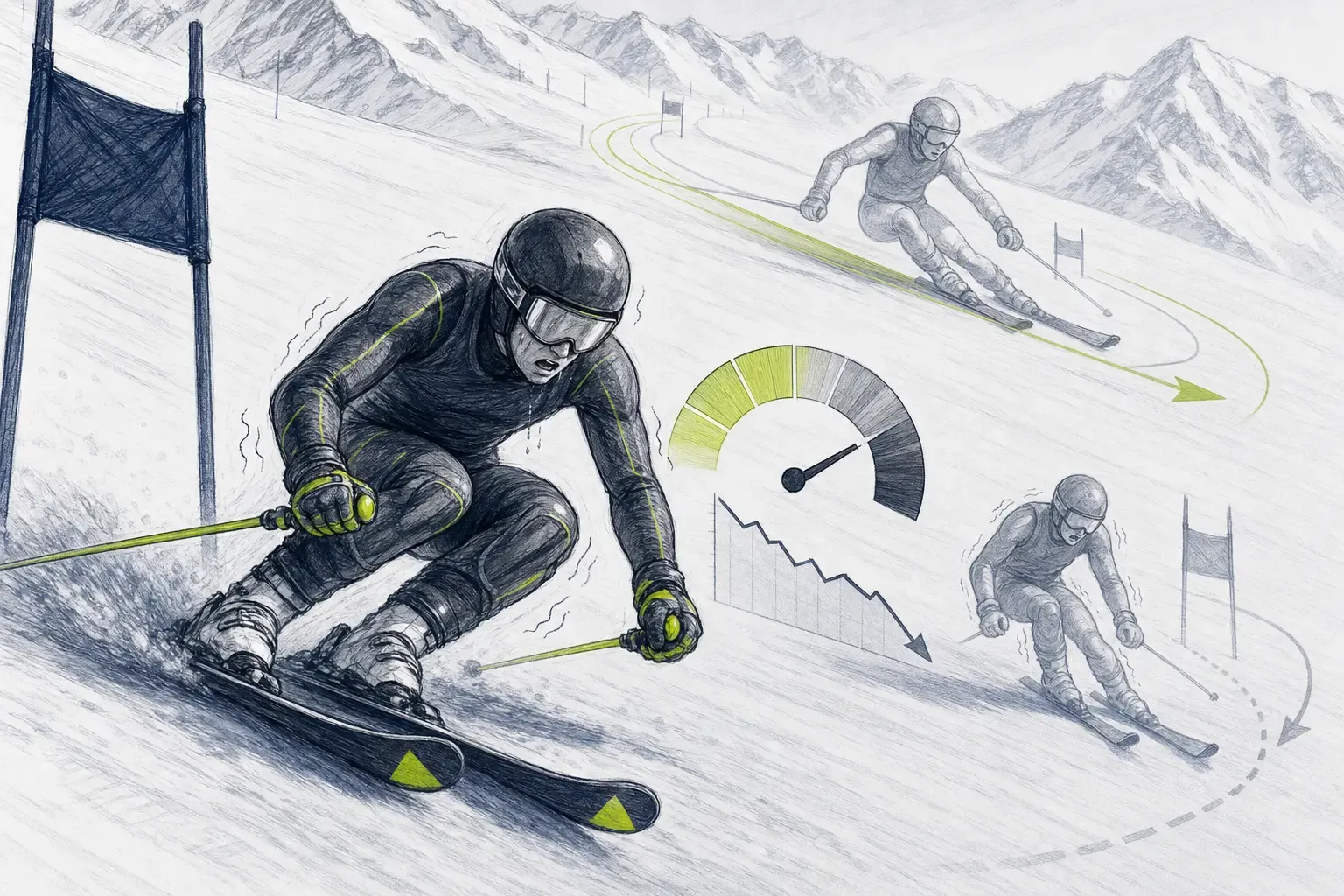
Fatigue is a temporary state in which a skier’s ability to generate force, maintain coordination, concentrate, or make correct decisions decreases. The same run takes more effort, and the movement is no longer as precise as at the start of training. Fatigue can be physical, mental, or a combination of both.
Common acute fatigue after an appropriate load is not a problem in itself. After rest, refueling with fluids and energy, warm-up, and sleep, it should ease. However, unusually strong, long-lasting, or repeatedly returning fatigue may be related to insufficient recovery, lack of sleep, illness, excessive training load, or inadequate energy intake. Fatigue is a symptom, not a separate diagnosis.
FIS includes fatigue together with sleep and training load among the data whose development in athletes can be monitored continuously. What matters is the trend and the context, not one isolated number or the feeling after a single run.
How it shows on skis
Alpine skiing loads the muscles of the legs and torso while also requiring continuous assessment of terrain, speed, and the movement of other skiers. Practical signs of increasing fatigue may include:
- falling behind the group repeatedly or taking unusually long breaks,
- worsening balance and more frequent falls,
- a stiff stance or pronounced backseat position,
- late initiation of the turn and weaker control of its finish,
- less precise ski control and loss of rhythm,
- slower reactions to instructions, gates, or changes in terrain,
- irritability, lack of interest, unusual silence, or poorer decision-making.
These signs are not a diagnostic test. The same picture can be caused by fear, cold, hunger, pain, unsuitable slope difficulty, or a poorly understood task. The coach therefore assesses several signs at the same time.
An expert overview of children’s and youth injuries in alpine skiing lists excessive fatigue among several factors that can contribute to injury. But it does not create risk on its own: it acts together with age, experience, speed, conditions, and equipment.
Fatigue in children
A younger child may not be able to say accurately whether they are tired, cold, hungry, or scared. They may say they still have energy even though their movement and attention have already clearly worsened. On the other hand, short-term reluctance does not necessarily mean physical exhaustion.
The appropriate training duration therefore does not depend only on age. It is determined by skiing level, motor development, health, sleep, weather, altitude, terrain difficulty, and the load in previous days. Two children of the same age may not be able to handle the same volume or intensity.
For younger skiers, it is advisable to alternate more demanding tasks with easier skiing and breaks. This is a training practice, not a universal rule with a fixed number of runs or minutes.
Race context
For a racer, it is not just the time spent between the gates that matters. The overall load includes warm-up, course inspection, waiting at the start, repeated runs, moving around, fitness preparation, school duties, and sleep quality. Fatigue can build up over the course of a training day and across several days.
A drop in time in one run does not by itself mean the athlete is tired, just as one fast result does not prove full recovery. The coach compares the subjective feeling of effort, technical quality, behavior, and performance development. In protecting athletes’ health, FIS emphasizes systematic testing, training, and monitoring, not decisions based on a single indicator.
When to stop skiing
A run should be ended or made significantly easier if there is repeated loss of control, unusual weakness, dizziness, nausea, disorientation, impaired vision, severe headache, breathing problems, or a suspicion of hypothermia or illness. A sudden worsening after a fall or a blow to the head must not be explained by fatigue alone. If a concussion is suspected, the child is removed from skiing, and further steps belong to a medical professional according to the relevant protocol.
If unusual fatigue persists outside training, worsens, or is accompanied by pain, fever, a significant drop in performance, or changes in behavior, a medical evaluation is appropriate.
Coach’s view
The coach’s job is not to wait until the child reports complete exhaustion. The coach watches whether the athlete can still safely complete the task in the given terrain and speed. At the first stable signs of fatigue, the coach may reduce the difficulty, lengthen the break, switch to an easier run, or end the training session. In speed disciplines and on hard or uneven surfaces, decisions must be especially conservative.
Fatigue should not be confused with laziness or used as proof of good training. The goal is not to collect as many runs as possible, but to end training before repeated poor-quality movement becomes a safety problem or a reinforced technical habit.
Sources and further reading
- FIS – Injury & Return: Testing, Training and Monitoring in Snow Sports
- FIS – Health Data and Injury Surveillance
- FIS – Athlete Health Corner
- FIS – Athlete Health Unit launches the Athlete Health Corner
- Brudvik C. Downhill ski injuries in children and adolescents – PubMed
- Skiing injuries in children, adolescents, and adults – PubMed
- Consensus statement on concussion in sport: Amsterdam 2022 – British Journal of Sports Medicine
- FIS – Stakeholders unite for workshop on Alpine Skiing risk reduction