What is recovery
Recovery is the process by which the athlete’s physical and mental readiness is restored after training, races, or other exertion. It includes replenishing energy and fluids, restoring strained tissues, easing fatigue, processing mental tension, and regaining the ability to move well, concentrate, and make decisions.
Recovery is not separate from training. Load creates the stimulus, but performance improvement can happen only when the body has suitable conditions for recovery and adaptation. Insufficient recovery may not show up only as fatigue. It can also appear as poorer coordination, lower motivation, poor sleep, unusual muscle tenderness, or repeated health problems.
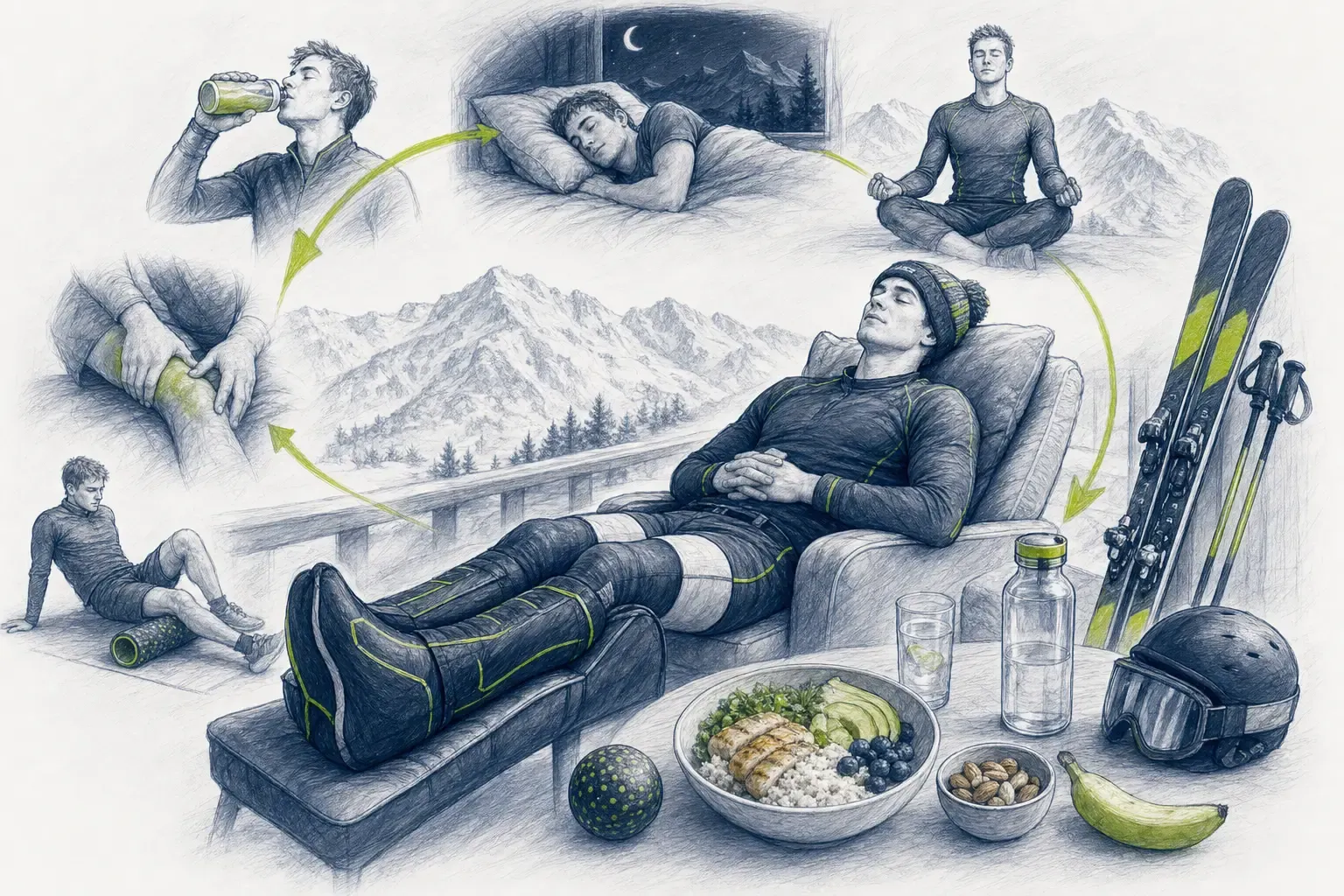
The basics of a skier’s recovery
A proven starting point: the greatest importance lies in well-planned load, sleep, adequate energy and nutrient intake, fluid replacement, and time without intense training. Massage, rolling, compression gear, or other procedures can be a supplement, but they do not replace these basics. Dietary supplements do not make up for a lack of food, sleep, or a poorly designed program.
In skiing, the effects of cold, wind, dry climate, travel, and long periods outdoors must also be taken into account. A practical part of recovery is therefore changing out of wet clothing, warming up, having drinks and food available, and a calmer routine after returning from the slope. Protecting health in a cold environment is one of the topics FIS includes in athlete care.
Sleep
Sleep is the main passive recovery tool. What matters is not only how long it lasts, but also its regularity and quality. Late returns from training, early morning wake-ups, travel, school, and screen use can reduce real sleep time. Sleep needs vary among children, so the same routine cannot be set for all skiers regardless of age and daily schedule.
Food and drink
After skiing, meals should help replenish energy used and provide the nutrients needed to restore the body. For a child, a regular daily routine and ordinary varied meals are better than randomly replacing meals with bars, drinks, or supplements. The exact amount of energy, carbohydrates, or protein depends on age, growth, health condition, and training load. Individual nutrition questions belong with a qualified sports nutrition expert, especially when limiting food, digestive issues, or a suspected energy deficiency are involved.
Active recovery
Training practice: active recovery can be light walking, easy cycling, low-effort mobility work, or simple movement games. The intensity should be so low that the activity does not add further fatigue. With small children, there is often no need to create a separate “recovery session” – free movement without a performance goal may be better. Stretching can be used to work on mobility and for a subjective feeling of release, but not as a substitute for rest.
Recovery of a child skier
A child is not a smaller adult athlete. When planning, the coach takes into account biological and motor development, skiing level, school duties, travel, and load from other sports. The same number of runs or training days can be different in difficulty for two children.
A younger skier may also not be able to name fatigue precisely. That is why the parent and coach also watch for mood changes, reluctance to move, unusual sleepiness, reduced attention, repeated mistakes, poorer balance, or pain that changes technique. A single bad day does not necessarily mean a problem; what matters is the development over time and the connection with the previous load.
During a multi-day camp, the goal does not have to be to use every minute of lift operation. If coordination worsens and the child can no longer complete the technical task, shortening the training may be more valuable than continuing with poor-quality runs. In athlete preparation, FIS emphasizes systematic planning, monitoring the response to training, and using both objective and subjective data.
Recovery is not rehabilitation
Normal recovery addresses the expected fatigue after an appropriate load. Rehabilitation is expert-guided return after an injury or illness. Pain that persists, gets worse, or changes the way you move should not be just “massaged away” and covered up with more training.
Safety rule: after a suspected concussion, the skier does not return to the slopes just because they feel better for a moment. FIS recommends a gradual return to activity, with the course and length of recovery being individual. Return after an injury, surgery, or a more serious illness should be managed by a healthcare professional in cooperation with the coach and parent.
Typical mistakes
- recovery is dealt with only once performance drops significantly,
- massage or stretching is considered the only recovery,
- hard days are repeated without adjusting volume and intensity,
- the load from school, travel, and other sports is not taken into account,
- the child continues despite pain or worsened coordination,
- food is restricted because of the idea of a “racing body” without expert assessment,
- return after an injury is guided by the calendar instead of health status and gradual coping with load.
Coach’s view
Recovery is not prescribed by one universal method. The coach watches what the goal of the training was, how demanding it really was, and how the child responds. Based on that, they adjust the number of runs, intensity, the content of the next session, or the need for a day off. Good recovery is not a reward for training or a sign of weakness. It is part of a skier’s long-term development and a condition for the next training session to remain technically good, appropriate, and safe.
Sources and further reading
- FIS Athlete Health Corner – Injury & Return
- FIS Athlete Health Corner
- FIS Athlete Health Corner – Health Data
- FIS Athlete Health Corner – Concussion
- FIS Athlete Health Corner – Illness & Return
- American College of Sports Medicine – Position Stands
- American College of Sports Medicine – Proper Recovery
- International Olympic Committee – Consensus Statement on Sports Nutrition