What is compensatory exercise
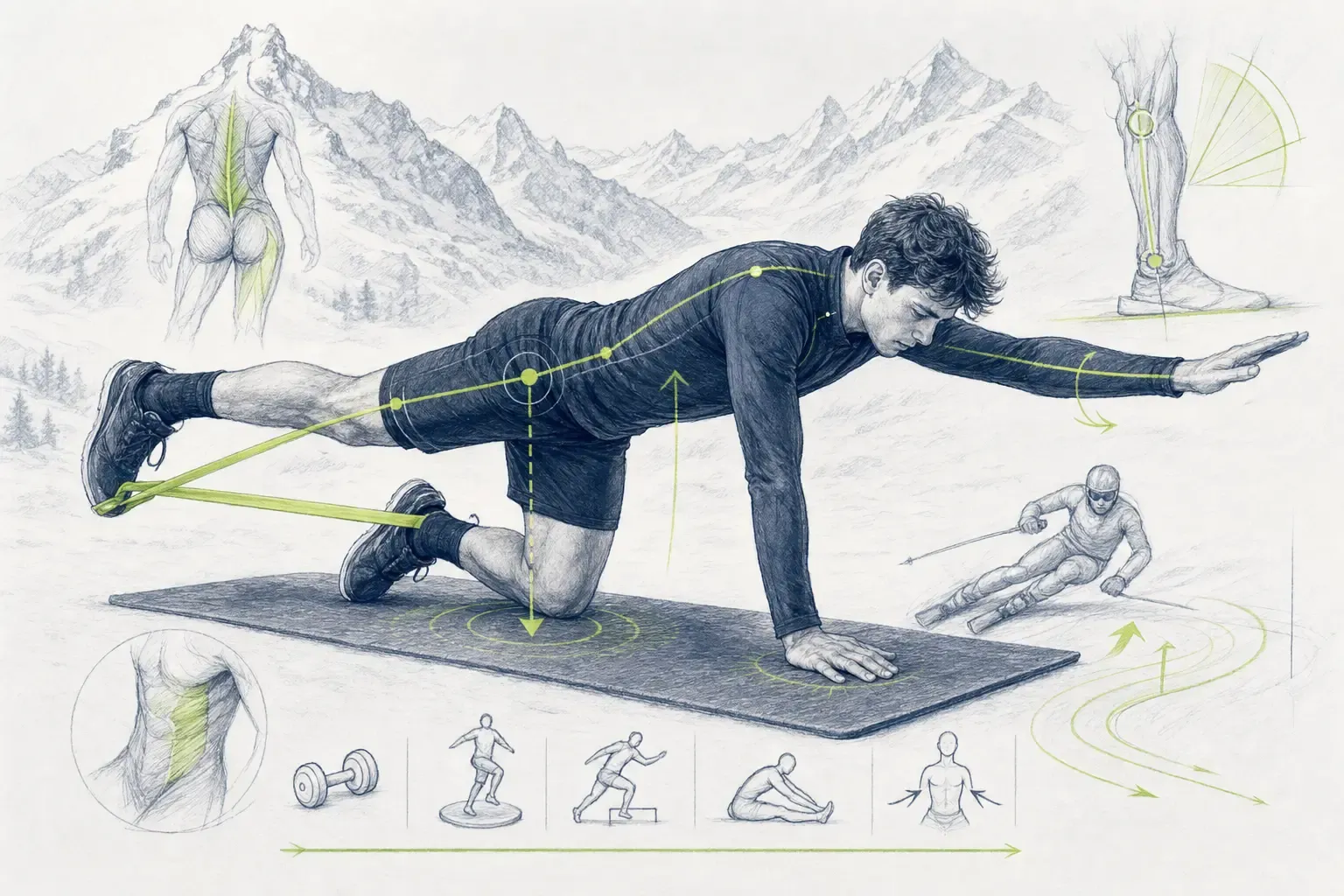
Compensatory exercise is a targeted supplementary exercise used in sports practice to offset the effects of repeated training load. Its purpose may be to maintain or restore the necessary mobility, strengthen underused muscle groups, improve stability and coordination, or practise a higher-quality movement pattern.
It is not one precisely defined set of exercises. The content depends on the skier's age, movement abilities, current training phase, fatigue, previous injuries, and what the coach's observation or a specialist examination shows. Compensatory exercise may partly overlap with conditioning preparation and preventive training, but it cannot be confused with rehabilitation after an injury.
Importance for the skier
Alpine skiing places high demands on the musculoskeletal system, torso control, lower-limb alignment stability, and the ability to generate and absorb large forces. That is why FIS includes strength and conditioning, coordination, mobility, motor skills, and recovery among the components of off-snow preparation.
Depending on the specific need, compensatory exercises may focus mainly on:
- ankle, hip, and thoracic spine mobility,
- torso and pelvic stability,
- knee control and lower-limb alignment when standing, squatting, landing, or changing direction,
- strength of the gluteal muscles, external hip rotators, and hamstrings,
- balance and comparable movement quality on the right and left leg.
These areas are not a universal list for every skier. For example, FIS lists eccentric hamstring strength, lower-limb alignment stability through the hip muscles, and torso stability in the ISPA programme for young racers. However, this is a specific preventive programme, not a general guide for all children.
Compensation for children
For younger children, the exercise should be simple, varied, and easy to understand in terms of movement. More important than the number of repetitions or difficulty is correct body position, smooth breathing, and the ability to perform the movement without losing control. Jump testing of young racers aged 7 to 15 years showed that performance changes with age and that, alongside the achieved result, the quality of movement execution must also be assessed.
The coach therefore adapts the choice of exercises to the child's motor level and maturation. An exercise suitable for a racer in the U16 category may not be suitable for a beginner in the first grade of primary school. Compensation should not be a punishment for a mistake on the slope or a competition of exhaustion. In case of pain, after an injury, or when there is a significant difference between sides, the decision on the next steps belongs to a physiotherapist or doctor.
Common misconceptions
Compensatory exercise is not just stretching. Simply increasing the range of motion may not address insufficient stability, strength, or coordination.
It is not the same as warm-up. Warm-up prepares the body for the activity that follows immediately; compensatory exercise responds to the longer-term needs of the skier.
It does not guarantee that the skier will not get injured. A systematic review of recreational skiing found not enough direct evidence to claim that general exercise alone prevents ski injuries. On the other hand, a study of adolescent racers found a lower incidence of anterior cruciate ligament injuries with a structured program focused on core stability, neuromuscular control, and balanced work of both legs. The result supports targeted prevention, not any random “extra exercise”.
Coach’s view
Good compensatory work does not come from a list of favorite exercises, but from the question: What load has the child completed, and what movement ability do they need to maintain or improve? The coach mainly monitors movement technique, fatigue, differences between sides, and the child’s ability to maintain a controlled axis of the trunk, hip, knee, and foot. The choice and dosage change during the season. At the same time, varied everyday movement remains the basis of healthy development in children and adolescents.
Sources and further reading
- FIS – Injury & Return: Testing, Training and ISPA Programme
- FIS consensus statement on training and testing in competitive alpine and freestyle skiers and snowboarders
- Westin et al. – Prevention of Anterior Cruciate Ligament Injuries in Competitive Adolescent Alpine Skiers
- Spörri et al. – How to Prevent Injuries in Alpine Ski Racing
- Hébert-Losier, Holmberg – Exercise-based injury prevention recommendations for recreational alpine skiing and snowboarding
- Jump performance and movement quality in 7- to 15-year-old competitive alpine skiers
- World Health Organization – Guidelines on physical activity and sedentary behaviour