Mobility is the ability to bring a joint or movement segment into the range needed for a specific task and actively control that range. It therefore includes not only available range of motion, but also muscle control, coordination, and appropriate stability. In skiing, the goal is not extreme positions, but purposeful movement without pain and without unwanted compensatory movements.
Mobility is not just flexibility
The terms mobility and flexibility are often confused. Flexibility refers mainly to the available range of motion in a joint or group of joints and is also related to the properties of muscles and connective tissues. Mobility is a more practical, functional term: it expresses whether the athlete can create and control the range in a squat, lunge, landing, or ski turn. Passive stretching alone therefore does not yet mean good movement ability.
Mobility is also not the opposite of stability. The two abilities work together. A skier needs mobile ankles and hips, but also the ability to keep the lower-limb axis aligned and control the trunk. A large range without sufficient control may not be an advantage.
Importance in skiing
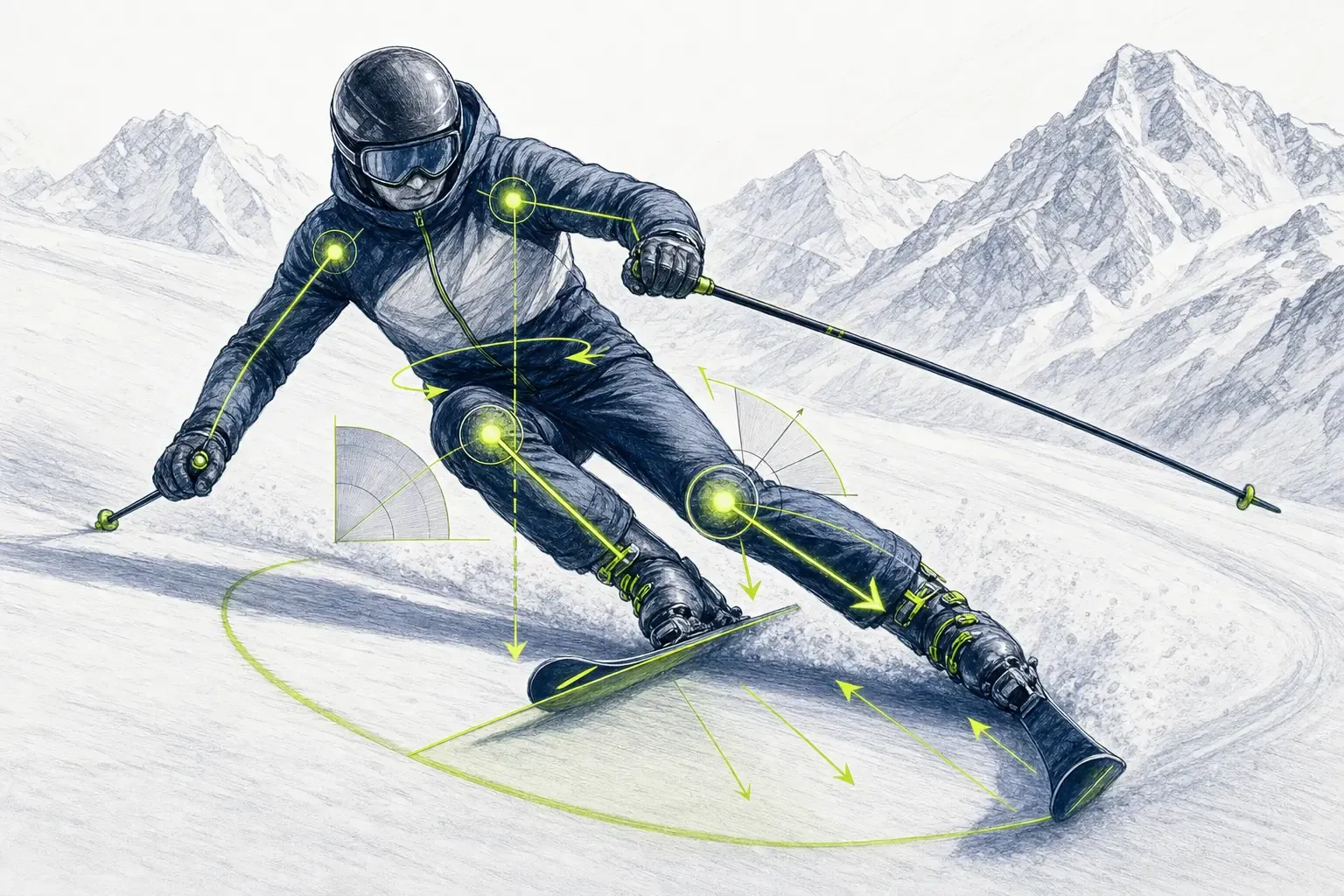
In alpine skiing, movement is transmitted through the entire chain from the feet and ankles through the knees and hips all the way to the trunk. Functional mobility helps the skier:
- take a balanced and appropriately low stance,
- adapt body position to changes in slope and uneven terrain,
- move the lower limbs under a more stable trunk,
- perform a squat, lunge, lateral shift, or landing without major compensations,
- maintain movement reserve under greater load.
From a training perspective, mobility of the ankles, hips, and thoracic spine is especially important. A limitation in one place may be compensated for by excessive forward lean of the trunk, lifting the heel during exercises, knee valgus, or rotating the whole body. However, such compensation does not have to be caused only by insufficient mobility. It may also result from weaker strength, coordination, balance, fatigue, technical uncertainty, or improperly adjusted equipment.
Mobility in children and adolescence
Range of motion changes during growth. Research describes changes especially during adolescence and the growth spurt; in some young athletes, movement fluidity or available range may temporarily worsen. That is why it is more important to monitor the development of a particular child than to compare a one-time result with others.
A systematic review of flexibility training showed that regular static stretching can increase range of motion in children and adolescents. However, it did not confirm the simple claim that there is one narrow age window outside of which flexibility can no longer be effectively developed. Mobility can therefore be addressed continuously, in line with age, physical development, and sporting level.
In younger children, varied movement games, climbing, squats, lunges, movements, and movement in different directions take priority. During adolescence, the coach can more specifically monitor individual limitations and differences between sides. The official long-term athlete development system for alpine skiers of U.S. Ski & Snowboard includes mobility, range of motion, and coordination already in the early developmental stages and points to the need to maintain these abilities during the growth period.
How mobility develops
In training practice, mobility is developed not only through stretching. Appropriate preparation can combine:
- dynamic movements through a gradually increased range,
- bodyweight exercises performed technically and in a controlled way,
- strength through the full usable range,
- balance and coordination,
- movements similar to skiing demands,
- individually chosen stretching if the range is truly limited.
Examples include a controlled squat, a side lunge, moving the knee over the foot without lifting the heel, or thoracic rotation in a stable position. This is not a universal rule. The coach must adapt the choice, range, and difficulty to the child's age, experience, and current condition. Movement should not be forced or performed through sharp pain.
A test, such as a deep squat, does not assess just one quality. At the same time, it checks the mobility of several joints, stability, coordination, and the ability to understand the task. The result therefore cannot automatically be labeled a
shortened muscle
- or be used on its own to prescribe corrective exercises. A systematic review of children's functional movement also points to age-related and developmental differences in test results. Typical mistakes and misunderstandings
- The bigger the range, the better. A skier mainly needs usable and controlled range, not extreme flexibility.
- Every technical problem can be solved by stretching. The cause may be strength, balance, coordination, fatigue, skill, or equipment.
- Mobility alone prevents injuries. Injury prevention is multifactorial. A program successfully used with adolescent alpine skiers focused mainly on neuromuscular control, core stability, and balanced work of both lower limbs, not just on increasing range.
- A one-time test is a diagnosis. The result is only part of the picture and must be assessed together with movement on the ground, behavior on skis, and the child's development.
The child needs to be pushed into the position.
Forced passive positions without control and without respecting pain are not an appropriate goal of children's training.
Sources and further reading
- Is There a “Window of Opportunity” for Flexibility Development in Youth? A Systematic Review with Meta-analysis
- The Assessment of Functional Movement in Children and Adolescents: A Systematic Review and Meta-Analysis
- The Relationship Between Range of Motion and Injuries in Adolescent Dancers and Sportspersons: A Systematic Review
- Prevention of Anterior Cruciate Ligament Injuries in Competitive Adolescent Alpine Skiers
- International Olympic Committee Consensus Statement on Youth Athletic Development
- U.S. Ski & Snowboard — Alpine Training Systems
- What We Do Not Know About Stretching in Healthy Athletes: A Scoping Review with Evidence Gap Map from 300 Trials
- Jump Performance and Movement Quality in 7- to 15-Year-Old Competitive Alpine Skiers