What is explosiveness
Explosiveness is the ability to develop great force or mechanical power in a very short time. In sports practice, the term explosive strengthis also often used. It is related to how quickly the neuromuscular system can recruit muscles, create force and transfer it into purposeful movement.
Explosiveness is not the same as maximal strength. Maximal strength expresses the greatest force an athlete can produce regardless of time. In an explosive movement, what matters is how much usable force is produced in a short time span. Likewise, it should not be confused with skiing speed or agility.
A related indicator is rate of force development (rate of force development, RFD). In take-offs and repeated jumps, reactive strengthalso comes into play, that is, the ability to quickly follow a braking muscle stretch with a take-off. These abilities overlap, but they are not exactly the same.
Importance in skiing
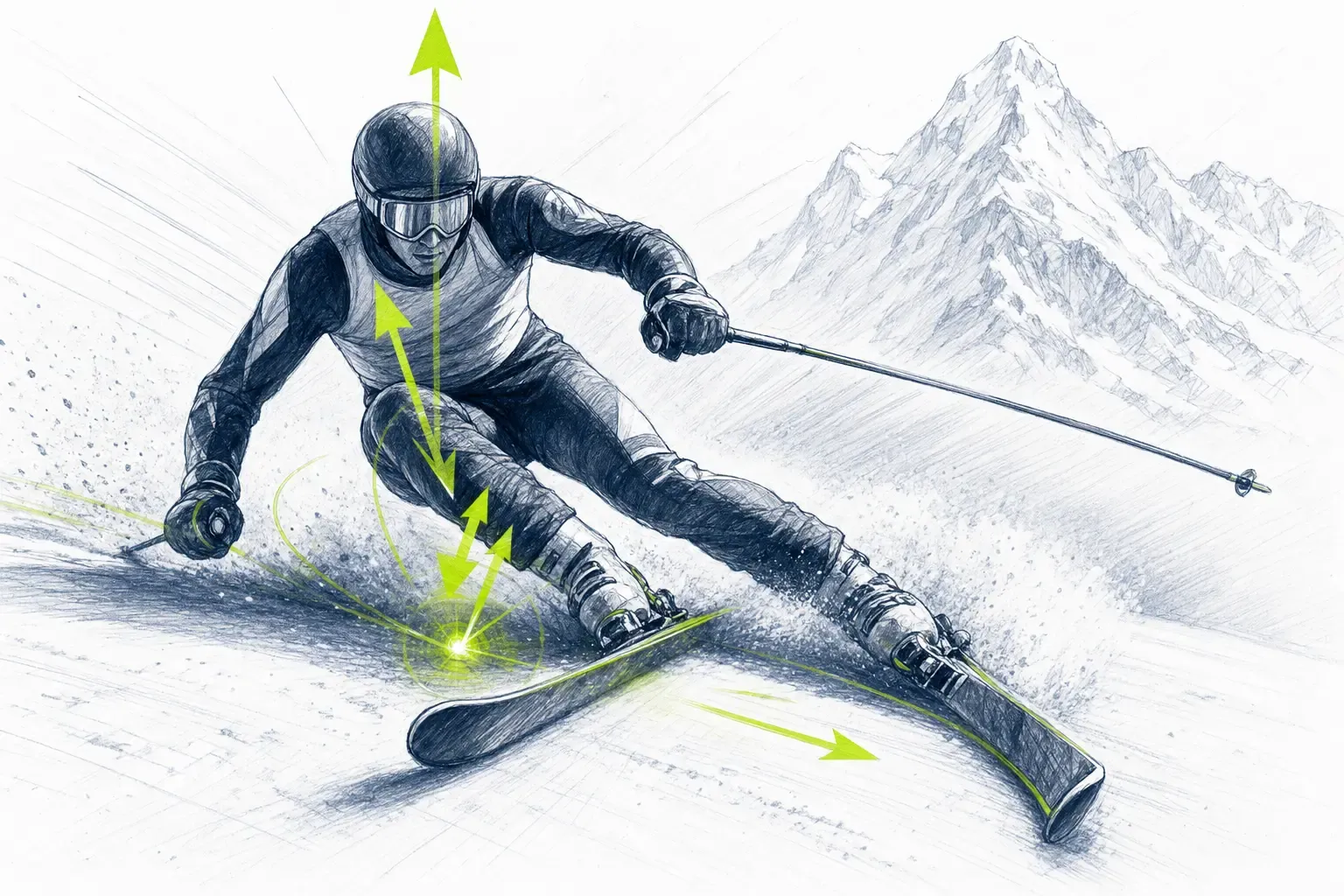
In alpine skiing, explosiveness can show up in starts, skating, quickly building pressure into the skis, transitioning between turns, or reacting immediately to bumps and loss of balance. It does not mean that the skier should push off from every turn or hop between edges. Effective force must be timed correctly, directed properly and linked with technique.
Competitive skiing requires a combination of strength, power, coordination, balance, mobility and both aerobic and anaerobic endurance. Also important is the ability to withstand repeated isometric and eccentric loading during turns. Explosiveness therefore cannot be considered the only or universally most important prerequisite for performance.
The importance of individual strength abilities may differ by discipline. A study published in 2026 found a link between rate of force development and performance in slalom among the racers studied, while in giant slalom and speed events, the ability to maintain high force for longer was the more significant indicator. This is the result of one study, not a rule that applies to every skier, but it clearly shows why it is not enough to train only jumps and short maximal efforts.
Analyses of the fitness profiles of elite alpine skiers also confirm that performance arises from the interplay of several qualities and cannot be reliably explained by a single explosiveness test.
Explosiveness in children
For a young skier, the foundation is first and foremost movement literacy: a stable stance, squat, lunge, take-off, safe landing, running, change of direction and appropriate trunk control. Only on this basis does it make sense to increase speed, resistance or exercise difficulty. Long-term development should respect biological maturation, previous experience and the child’s current level, not just their calendar age.
Suitable means can include movement games, short bursts of acceleration, jumps over low obstacles, take-offs in different directions, throws with a light ball, skating, relays, or simple strength exercises done with the intention of moving quickly. In jumping, landing is just as important: the child should know how to absorb the load in a controlled way and keep a stable torso and lower-body position.
A systematic review of research in children and adolescents showed that both strength training and performance-oriented training can improve strength, speed, and explosive performance, with the result depending on the training content and the similarity between the exercise and the tested task. A small controlled study of competitive skiers aged 9 to 15 years found improvements in strength and explosiveness after both compared movement programs. By itself, however, it does not determine the best training method for all children.
Appropriate plyometrics are not automatically unsuitable for children. The risk rises especially when intensity, volume, or frequency exceed the child’s readiness, supervision is lacking, or training continues despite poorer technique and fatigue. Demanding drop jumps, high obstacles, and large sets of repeated jumps therefore do not belong among beginner methods.
Typical mistakes
- confusing explosiveness with the highest or farthest possible jump,
- a large number of repetitions without enough rest, turning performance training into fatigue training,
- including demanding jumps before the child can land stably,
- copying the strength program of adult competitors,
- ignoring maximal strength, eccentric control, coordination, and mobility,
- judging talent from a single jumping test,
- trying to transfer explosiveness to the snow by forcefully pushing off every turn.
Coach’s view
The coach watches above all the quality and purpose of the movement. In explosive exercises, the movement should be fast but still controlled. When speed drops, body position falls apart, or landing gets worse, the set usually no longer develops the same ability.
In its consensus on training and testing, FIS recommends adapting the development and assessment of fitness abilities to age, sex, performance level, and discipline. In youth, testing may include jumping performance and landing quality, lower-body and trunk strength, agility, balance, and endurance. The result of one test matters mainly when tracking the same skier over time under comparable conditions, not as a stand-alone predictor of racing success.
Explosiveness is therefore an important tool for a skier, not a goal in itself. It is most valuable when the athlete can use it at the right moment, in the right direction, and through the right range without losing technique or balance.
Sources and further reading
- International Ski and Snowboard Federation (FIS) consensus statement on training and testing in competitive alpine and freestyle skiers and snowboarders
- Lower-Limb Strength in Alpine Skiing: Are Maximal, Explosive or Endurance Capacities More Important for Performance?
- The Training of Olympic Alpine Ski Racers
- Effectiveness of Traditional Strength vs. Power Training on Muscle Strength, Power and Speed with Youth: A Systematic Review and Meta-Analysis
- NSCA Position Statement: Youth Resistance Training
- NSCA: Youth Training and Long-Term Athletic Development
- Improving strength and postural control in young skiers: whole-body vibration versus equivalent resistance training
- A Classification of Fitness Components in Elite Alpine Skiers: A Cluster Analysis